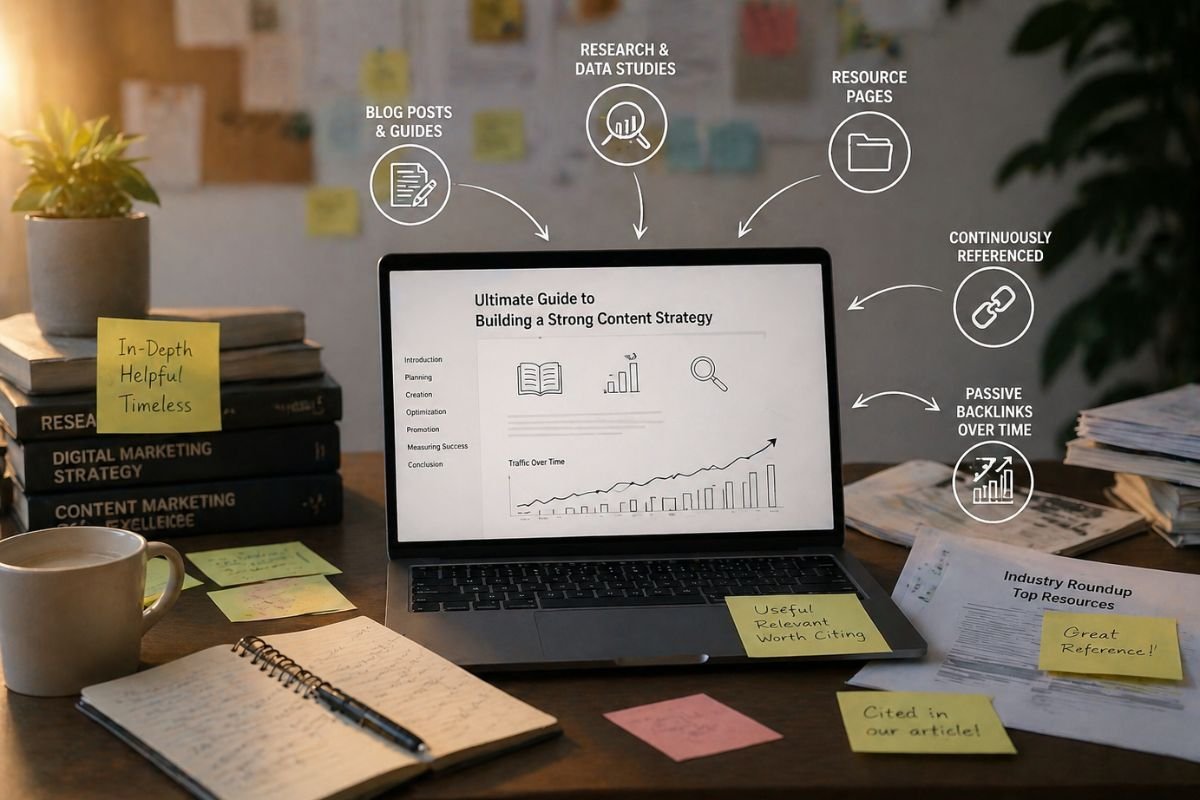

Content that generates passive backlinks over time is usually content that stays useful after publication. That often includes guides, research-based pages, and resource style content that people continue to reference without being asked. The common thread is not format alone. It is whether the page remains worth citing as time passes.
What content generates passive backlinks over time most consistently
If the question is what content generates passive backlinks over time, the answer is usually content that keeps solving the same problem for new people entering the topic.
That matters because passive backlinks are not created through direct requests. They appear when a writer, editor, or publisher finds an existing page useful enough to mention on their own. For that to keep happening over time, the content has to remain relevant beyond its first publishing window.
This is why not all good content produces passive links. Some pages are helpful in the moment but fade quickly. Others continue to serve as reference points months or years later. Those are the pages more likely to keep earning links quietly in the background.
Guides can keep attracting links when they stay referenceable
Guides are one of the clearest examples of content that can generate passive backlinks over time.
A strong guide gives people something stable to point to. It helps explain a process, define a subject, or organize a topic in a way that reduces confusion. That makes it useful not only for readers, but also for other content creators who need something reliable to reference.
The key point is not that guides are automatically link-worthy. Many guides are written for immediate consumption and offer little long-term reference value. The ones that keep attracting passive backlinks usually do something more durable. They clarify a subject in a way that remains useful when others write about it later.
Over time, a guide can become the page people link to when they need a clear explanation already in place. That is where the passive link potential comes from.
Research content often earns links because it supports other writing
Research based content can also generate passive backlinks over time because it gives other websites evidence, data, or source material they can cite.
This type of content works differently from a guide. A guide usually earns links by explaining. Research content often earns links by supporting.

A writer may need a source to strengthen an argument, provide context, or add credibility to a statement. If your page contains data, findings, compiled evidence, or original analysis that stays relevant, it has a stronger chance of being referenced repeatedly.
This is one reason research content often has a longer linking life than more opinion-driven pages. The page can continue serving a supporting role in new articles long after it was first published.
That does not mean all research content keeps earning passive backlinks. If the information becomes outdated quickly or has little reuse value, the linking pattern can fade. What lasts is research that remains usable in future writing.
What lasts is research that remains usable in future writing, and you can learn more here about how supporting content earns backlinks.
Resource pages generate passive backlinks by saving people effort
Resource style content is another format that often generates passive backlinks over time.
A resource page gives people something they can use directly. That may be a collection of relevant materials, a curated set of references, a tool list, a glossary, or a central page that helps them navigate a subject more efficiently. Its value often comes from consolidation.
This matters because writers link when it is easier to point to a useful existing page than to recreate the same groundwork themselves.
A good resource page can become a practical shortcut inside the topic. Instead of explaining everything from scratch, another site may simply reference the page and move forward. That gives the page a durable role. It keeps helping people do work, which is one of the strongest patterns behind passive backlinks.
The more consistently a resource page reduces friction, the more likely it is to stay linkable over time.
The pattern is durability, not just format
It is easy to treat guides, research, and resources as separate buckets, but the deeper pattern is that all three can hold value beyond the moment they are published.
That is the real reason they are more likely to generate passive backlinks over time.
A page continues earning links when it continues being useful in future content creation. It remains citeable, not just readable. That distinction matters. Many pages are informative once. Far fewer keep functioning as references.
In practice, the strongest passive link content usually has staying power in one of three ways. It keeps explaining something clearly, keeps supporting claims with usable information, or keeps helping people navigate a subject more efficiently.
Those functions tend to outlast short-term content cycles.
Where this often goes wrong
A common mistake is assuming that any long-form content will generate passive backlinks over time if it is detailed enough. Length is not the deciding factor.
You can learn more here about what actually drives backlinks
A long page can still fail to earn links if it does not become useful as a reference.
Another mistake is reducing the answer to content type alone, as if publishing a guide, a study, or a resource page automatically creates passive link potential. It does not. The format helps only when the page keeps serving a meaningful role after publication.
That is the more useful way to think about it. Passive backlinks over time tend to come from content that remains usable inside other people’s work. Guides, research, and resources often fit that pattern because they can keep helping long after the publish date stops mattering.