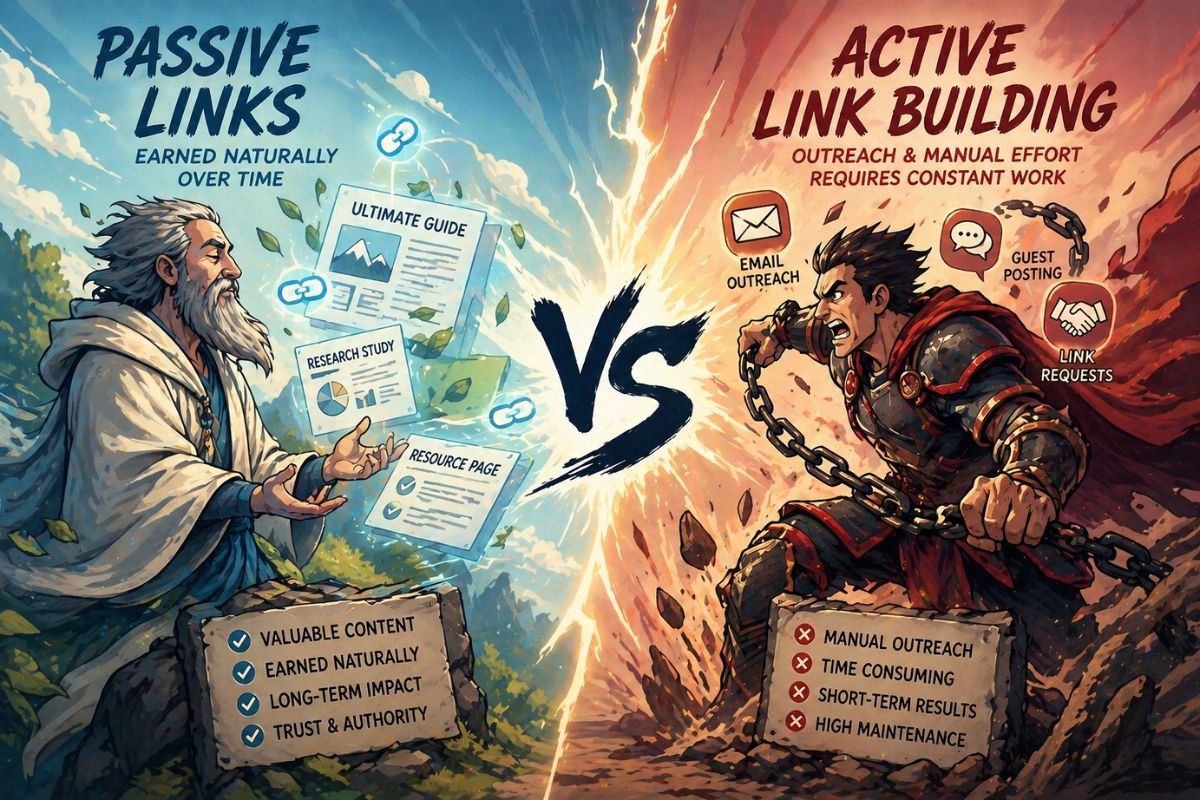

Passive links and active link building both result in backlinks. However, they do so in different ways. Passive links occur without asking for them. Active link building involves action to get the link.
The basic idea of passive links and active link building
The main difference between passive links and active link building is not the backlink. It is how they get there.
A passive link is a backlink where someone has decided to link to content on their site based on content they found on another site. No one asked them to link back. They simply found the content and decided to link back.
Active link building is different. To get a backlink with active link building, someone on the site wants to get a backlink. They do this by finding an opportunity and taking action to get the link. It is not just about relevance and usefulness. It involves action to get the link.
The reason this is important is that the same backlink can mean very different things depending on how it got there.
Passive links: What passive links are and how they get there
Passive links get there by becoming useful to someone else’s work.
A writer may need a source, a reference point, or a source of information to help explain something. This source may be on another site.
This makes the acquisition of passive links more dependent on reference value. The content must be able to stand on its own. It must be able to exist without someone having to intervene and explain its relevance and importance.
This does not mean that passive links are easy to acquire. It simply means that the acquisition of passive links is an indirect process. The link is not negotiated. It is not discussed. It is simply chosen.
Discover how passive links work
Active link building as a different model
Active link building is a different model. It is a model that relies on intervention.


Instead of waiting for the content to be discovered and referenced on its own, the website actively attempts to build opportunities. This could mean emails, link prospecting, contributing to other sites, relationship building, and even direct communication regarding a certain piece of content.
The method of acquiring a link is not as important as the fact that it is now a deliberate and active process. Because of this, active link building is more dependent on execution. The quality of the page is important, but it is not as important as the quality of the active link-building process. A quality page may not work if the active link-building process is lacking. A decent page may work if the active link-building process is of high quality.
This makes active link building a more controlled and manipulable process. It also makes it more dependent on execution.
The signals involved are different
Both passive links and active link building can result in quality backlinks. However, they are different.
A passive link may imply that the information was useful enough to be cited on its own. The link was included by the editor without any direct input from the original site. This may be important in certain situations where the value of the information cited is important.
Active link building, on the other hand, reveals something else entirely. It reveals that the site was willing and able to pursue the placement of the link intentionally. This does not necessarily mean that this is weaker or that it is any less legitimate. It simply means that the story of the backlink is different.
At this point, the value of comparison rather than preference comes into play. The difference between the two approaches is not necessarily that one is better than the other. It is simply that the problems they solve are different, as are the dynamics at work.
Passive links are more about discovery, whereas active link building is more about opportunity.
Discover more in our complete Link Building Methods category!
Why do people often blur the two
One of the biggest mistakes that people make is that they tend to treat backlinks as if they are the same, regardless of the logic that was involved in their acquisition.
If the backlink was acquired as the result of direct outreach, this does not mean that it was passive simply because the content was also good. Conversely, if the page was able to acquire backlinks without any form of outreach, this does not mean that the link building was active simply because the site was able to put in the effort to create quality content.
This is important because it affects how the outcome is interpreted. A backlink that was generated through independent use is different from a backlink that was generated through active promotion. They are both important. They are also valuable. However, they should not be assumed to mean the same thing.
Where this often goes wrong
One of the common mistakes is that passive backlinks are superior compared to active backlinks. This is not true. A passive backlink is not superior to an active backlink just because the former is independent.
Another mistake is that active backlinks are assumed to be generated through manipulation. This is not true either. This is not always the case.
However, the difference between passive backlinks and active backlinks is that passive backlinks are generated through independent use, whereas active backlinks are generated through active promotion. When this difference is clear, the comparison becomes easier.
The backlink may look the same, but the process is different.