

Friday, May 1, 2026
BacklinkSense
  • Anchor Text
    • Anchor Text Context
    • Anchor Text Distribution
    • Anchor Text Strategy
    • Types of Anchor Text
  • Backlink Quality and Analysis
    • Authority and Trust Signals
    • Backlink Analysis Tools
    • Link Context
    • Link Placement
    • Link Quality Signals
    • Link Relevance
  • Link Building Basics
    • How Google Ranks Links
    • Types of Backlinks
    • What Are Backlinks
    • Why Backlinks Matter
  • Link Building Methods
    • Asset-Based Link Building
    • Content-Based Link Building
    • Digital PR and Authority Mentions
    • Passive Link Acquisition
    • Resource and Reference Links
  • Link Building Risks
    • Link Penalties
    • Link Velocity
    • Low-Quality Backlinks
    • Over-Optimized Anchor Text
    • Unnatural Link Patterns
  • Link Outreach
    • Finding Outreach Targets
    • Follow Up in Outreach
    • Outreach Email Strategies
    • Outreach Personalization
    • Relationship Based Outreach
No Result
View All Result
  • Anchor Text
    • Anchor Text Context
    • Anchor Text Distribution
    • Anchor Text Strategy
    • Types of Anchor Text
  • Backlink Quality and Analysis
    • Authority and Trust Signals
    • Backlink Analysis Tools
    • Link Context
    • Link Placement
    • Link Quality Signals
    • Link Relevance
  • Link Building Basics
    • How Google Ranks Links
    • Types of Backlinks
    • What Are Backlinks
    • Why Backlinks Matter
  • Link Building Methods
    • Asset-Based Link Building
    • Content-Based Link Building
    • Digital PR and Authority Mentions
    • Passive Link Acquisition
    • Resource and Reference Links
  • Link Building Risks
    • Link Penalties
    • Link Velocity
    • Low-Quality Backlinks
    • Over-Optimized Anchor Text
    • Unnatural Link Patterns
  • Link Outreach
    • Finding Outreach Targets
    • Follow Up in Outreach
    • Outreach Email Strategies
    • Outreach Personalization
    • Relationship Based Outreach
No Result
View All Result
BacklinkSense
No Result
View All Result
ADVERTISEMENT

Anchor Text vs Context: What Signal Is More Relevant?

Backlink Sense by Backlink Sense
March 5, 2026
in Anchor Text Context
Reading Time: 4 mins read
0
Share on FacebookShare on Twitter

Page Contents

  • 1 The Role of Anchor Text as a Direct Signal
  • 2 The Role of Context as an Interpretive Framework
  • 3 Related Posts
  • 4 How Surrounding Text Strengthens Anchor Relevance
  • 5 Writing Natural Anchor Text Context for Backlinks
  • 6 How Search Engines Interpret Anchor Text Context
  • 7 How Paragraph Structure Influences Link Relevance
  • 8 Ambiguity Resolution in Link Interpretation
  • 9 Contextual Reinforcement and Signal Strength
  • 10 When Anchor Text Is the Stronger Signal
  • 11 When Context Is the Decisive Signal
  • 12 Signal Hierarchy in Link Interpretation
  • 13 The Balance Between Anchor and Context

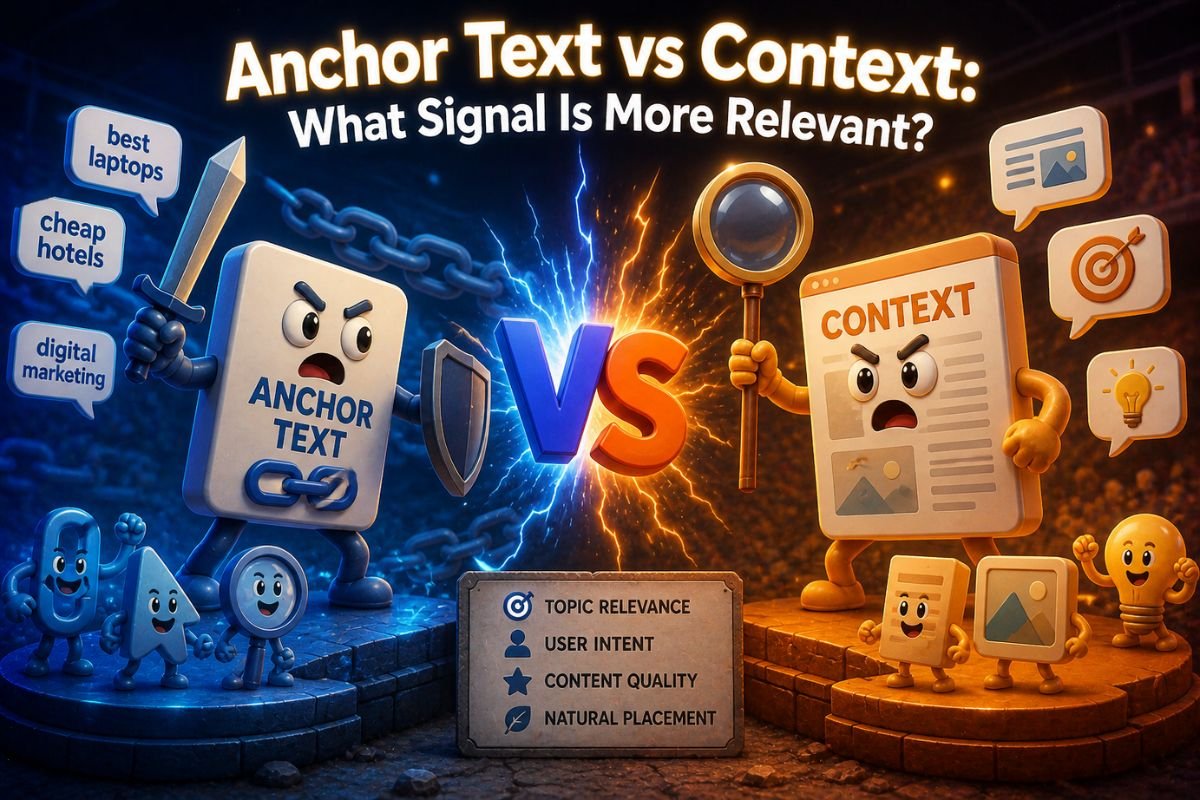
Both anchor text and context play a role in determining what a search engine thinks about a link. However, they play these roles in different ways.

One acts as a direct indicator of what a search engine might expect a link to mean. The other functions as a framework that helps interpret what that indicator represents.

It is important to note that these two signals work together. A search engine does not use one without considering the other.

The Role of Anchor Text as a Direct Signal

Anchor text is arguably the most direct indicator of what a search engine might expect a link to mean. It functions as a linguistic signal that describes what is represented by the link.

Because anchor text is specifically designed to act as a reference, search engines treat it as a descriptive element of the link.

This is where anchor text tends to be strongest as a signal. It performs best when the wording is clear and unambiguous.

The Role of Context as an Interpretive Framework

Context can be understood as the set of circumstances that influence how a link is interpreted. In practice, this refers to the language and content surrounding the link.

The text around the link acts as a conceptual framework that helps explain the meaning of the link. The search engine algorithm does not rely solely on anchor text; it also evaluates the surrounding language.

If the surrounding text consistently discusses a specific topic, the link becomes associated with that topic. The context also helps explain the relationship between the linked page and the source page.

This allows the search engine to understand the meaning of the link even when the anchor text alone does not provide many clues. The surrounding context therefore, acts as a stabilizing factor. It helps the search engine interpret the anchor text in relation to the overall topic of the content.


Related Posts

Surrounding Text Strengthens Anchor Relevance

How Surrounding Text Strengthens Anchor Relevance

April 14, 2026

Writing Natural Anchor Text Context for Backlinks

April 12, 2026
Search Engines Interpret Anchor Text

How Search Engines Interpret Anchor Text Context

March 25, 2026

How Paragraph Structure Influences Link Relevance

March 9, 2026

Ambiguity Resolution in Link Interpretation

Ambiguity is common in natural language. Words and phrases can have different meanings depending on how they are used.

Anchor text alone is not always able to resolve this ambiguity. If the anchor phrase can refer to multiple meanings or subjects, the context around the link helps search engines determine which meaning is intended.

The surrounding language provides signals about the subject that the author of the content is discussing. In these cases, context becomes the deciding factor. It resolves ambiguity and anchors the link to a particular conceptual area.

Without contextual support, it becomes more difficult for a search engine to interpret the meaning of anchor text.

Contextual Reinforcement and Signal Strength

If the surrounding text consistently indicates the same topic as the anchor text, a reinforcing effect is created.

In this situation, the search algorithm sees multiple signals pointing toward the same concept or topic.

This reinforcement increases the algorithm’s confidence in interpreting the link and understanding what it represents.

When both the anchor text and the surrounding context point toward the same subject, the search algorithm gains a clearer picture of what the link represents.

When Anchor Text Is the Stronger Signal

In some situations, the search algorithm may give more weight to anchor text than to the surrounding context.

This typically happens when the anchor phrase is very specific and clearly refers to a particular concept or idea.

In such cases, the search algorithm can rely more heavily on the anchor phrase because it directly identifies the concept being referenced.

However, this advantage weakens when the anchor text becomes ambiguous or unclear.

you can explore how surrounding text strengthens anchor relevance

When Context Is the Decisive Signal

Context becomes the more important signal when the anchor text does not clearly indicate a specific concept or idea.

In these cases, the surrounding language provides the information necessary to understand what the link represents.

Context also becomes more influential when the surrounding text consistently discusses the subject related to the link. In this case, the contextual signals may provide stronger guidance than the anchor phrase itself.

Signal Hierarchy in Link Interpretation

Anchor text and context are part of a broader signal hierarchy that search engines use to interpret links.

Anchor text provides a direct description of what is being referenced. Context provides the framework needed to understand how that reference relates to the surrounding content.

Search engines analyze both signals simultaneously. As long as anchor text and context are consistent, the interpretation of the link becomes clearer.

When anchor text is ambiguous, context becomes the key factor that helps determine meaning and how anchor text should be selected.

The Balance Between Anchor and Context

Anchor text and context are not competing signals. They function together as part of a unified system used by search engines to interpret links.

When both signals align, the meaning of the link becomes clear. Anchor text identifies the concept being referenced, while context explains how that concept relates to the surrounding discussion.

Understanding this relationship helps explain why search engines evaluate links in relation to their textual environment rather than relying solely on the anchor phrase.


Tags: Search Engine InterpretationSemantic SEOSEO fundamentals
ShareTweetPin

Related Posts

Domain Authority vs Real Link Authority
Authority and Trust Signals

Domain Authority vs Real Link Authority: What Truly Matters Most?

by Backlink Sense
April 25, 2026
0

While Domain Authority is a measure used by SEO tools to estimate the power...

Read moreDetails
Passive Link Acquisition

What Is Passive Link Acquisition? The Hidden Advantage in SEO

April 25, 2026
Website Authoritative for Backlinks

What Makes a Website Authoritative for Backlinks?

April 23, 2026
Backlink More Valuable

What Trust Signals Make a Backlink More Valuable?

April 23, 2026

Leave a Reply Cancel reply

Your email address will not be published. Required fields are marked *

  • About Us
  • Terms of Use
  • Use of Cookies
  • Affiliate Disclosure
  • Contact
  • Privacy Policy
2026 BacklinkSense © All rights reserved.

Welcome Back!

Login to your account below

Forgotten Password?

Retrieve your password

Please enter your username or email address to reset your password.

Log In

Accessibility Toolbar

  • Powered with favoriteLove by Codenroll
No Result
View All Result
  • Anchor Text
    • Anchor Text Context
    • Anchor Text Distribution
    • Anchor Text Strategy
    • Types of Anchor Text
  • Backlink Quality and Analysis
    • Authority and Trust Signals
    • Backlink Analysis Tools
    • Link Context
    • Link Placement
    • Link Quality Signals
    • Link Relevance
  • Link Building Basics
    • How Google Ranks Links
    • Types of Backlinks
    • What Are Backlinks
    • Why Backlinks Matter
  • Link Building Methods
    • Asset-Based Link Building
    • Content-Based Link Building
    • Digital PR and Authority Mentions
    • Passive Link Acquisition
    • Resource and Reference Links
  • Link Building Risks
    • Link Penalties
    • Link Velocity
    • Low-Quality Backlinks
    • Over-Optimized Anchor Text
    • Unnatural Link Patterns
  • Link Outreach
    • Finding Outreach Targets
    • Follow Up in Outreach
    • Outreach Email Strategies
    • Outreach Personalization
    • Relationship Based Outreach

2026 BacklinkSense © All rights reserved.

This website uses cookies to improve your experience and analyze site performance. By continuing to browse, you agree to our Privacy and Cookie Policy.