

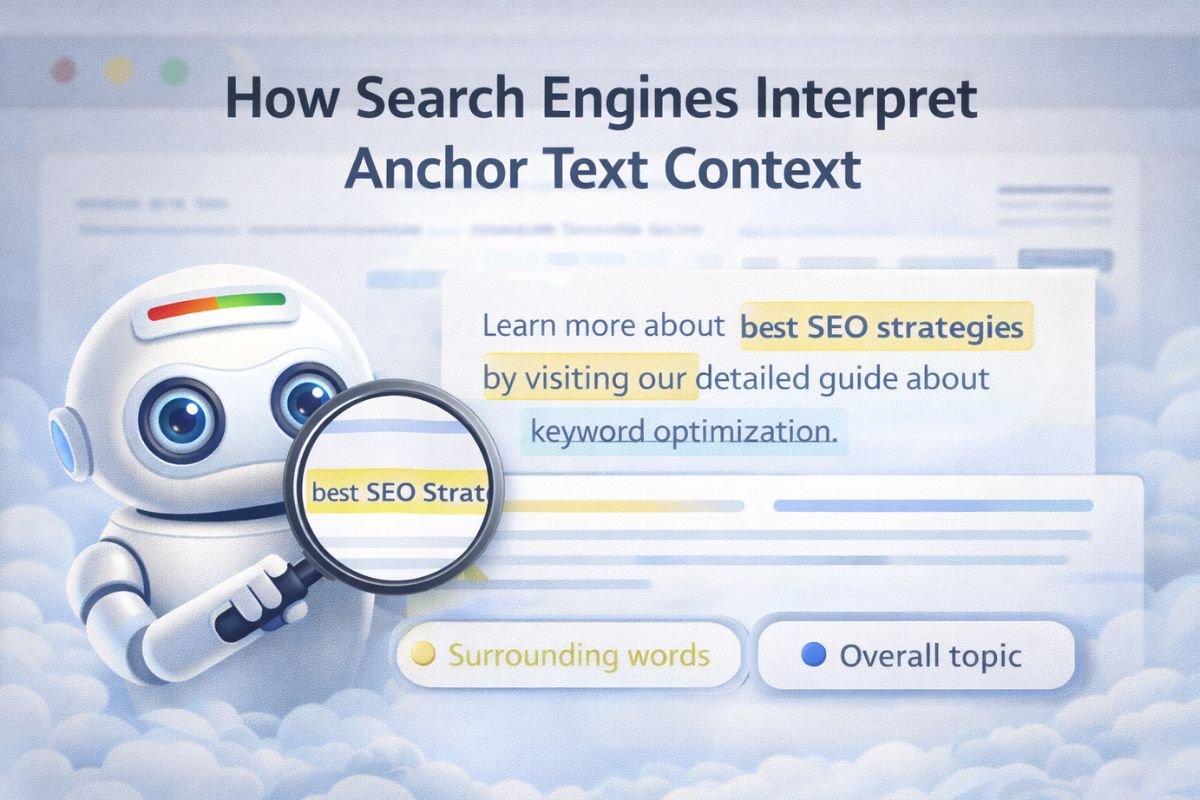

Search engines interpret the context of anchor text by analyzing the surrounding text and identifying the entities and topics mentioned in the content, along with their relationship to the search term or phrase.
The search engine does not see the link as a phrase or a separate entity in isolation. Instead, it evaluates how the link interacts with the sentence, the surrounding text, and the overall concept of the page.
Semantic Parsing and the Structure of Language
The first step in interpreting a link and its context is semantic parsing. This is the process by which the search engine understands the grammatical structure of a sentence and determines the relationships between the different words within it.
If the link is placed in a sentence, the search engine analyzes how the link interacts with the surrounding text. It examines the subject of the sentence, the objects mentioned, and the terms that define the subject or topic.
The structure of language provides clues about the relationship between different ideas or concepts. Semantic parsing allows this information to be translated into signals that help determine how these ideas are connected.
In this process, the context of the anchor text becomes part of the overall meaning of the sentence in which it appears.
The Role of Topical Graph Signals
Search engines also evaluate anchor text context using topical graph signals. A topical graph represents the relationships between subjects, entities, and concepts across documents.
Each webpage sends various signals to search engines based on the subjects discussed on the page. When a link appears within that page, the search engine evaluates the context of the link in relation to the subjects discussed, considering anchor and context signals.
For example, if the page frequently refers to a specific topic, the search engine will interpret the link within the framework of that topic.
This does not necessarily mean that the search engine relies solely on the anchor text itself. The surrounding context may strengthen or weaken the relationship between the linked page and the topic discussed on the source page.


Over time, search engines refine these relationships within the topical graph based on contextual signals around links.
Disambiguation and Contextual Meaning
Words and phrases can carry multiple meanings depending on the context in which they appear. The process that helps search engines determine the correct meaning is called disambiguation.
The context surrounding anchor text plays an important role in this process.
For example, anchor text may refer to several different concepts depending on how the words are used. The surrounding text helps search engines determine which meaning is intended.
Disambiguation relies heavily on semantic context. Sentence structure, the paragraph topic, and the overall subject of the page all contribute to clarifying meaning.
This process allows links to be interpreted based on subject relevance rather than simple keyword matching.
Entity Recognition and Relationships
Another important layer of interpretation is entity recognition. Modern search engines are able to recognize entities such as organizations, places, and conceptual topics within text.
When a link appears near these entities, it is interpreted in relation to them. The words around the link may describe attributes or relationships associated with those entities.
This enables the algorithm to place the link within a broader framework of relationships between entities and concepts.
The linked page can then be associated with those entities based on how the relationship is expressed within the context of the page.
Entities play a significant role in language because they act as stable reference points. Once an entity is recognized, the algorithm can better evaluate the relationships between words, concepts, and topics surrounding the link.
Contextual Alignment Across the Page
The interpretation of anchor text context is not limited to individual sentences. Search engines also evaluate how the link aligns with the overall subject of the page.
If the content consistently discusses a specific subject, the context surrounding the link becomes clearer. The thematic environment created by the surrounding content strengthens the interpretation.
If the page discusses many unrelated topics, the context becomes less clear. The algorithm can still parse the sentence, but the broader content provides fewer signals to reinforce meaning.
This page-level alignment helps search engines determine the degree of confidence with which a link is associated with a particular topic.
Where Anchor Text Context Is Often Misunderstood
There is often a misconception about what anchor text context actually means and what role it plays in determining what a link represents.
Many assume that the anchor text itself is the primary factor in defining the meaning of the link.
However, this is not accurate. Anchor text context includes multiple layers of language interpretation. The anchor phrase itself is only one component of that process.
Search engines are not simply matching keywords. They are analyzing how language is used to define relationships between ideas and concepts.
Anchor text context therefore, represents a broader system of interpretation rather than just the anchor phrase itself.
You May Also like:
Interpreting Links Through Context
Search engines interpret links by analyzing how anchor text interacts with the surrounding context in which the link appears.
Semantic parsing identifies relationships within the sentence.
Topical graph signals evaluate how the link fits with the subject of the content.
Disambiguation clarifies ambiguous language.
Entity recognition connects the link with identifiable concepts.
Together, these processes allow search engines to treat anchor text context as part of a larger system for understanding language and relationships between pages.