

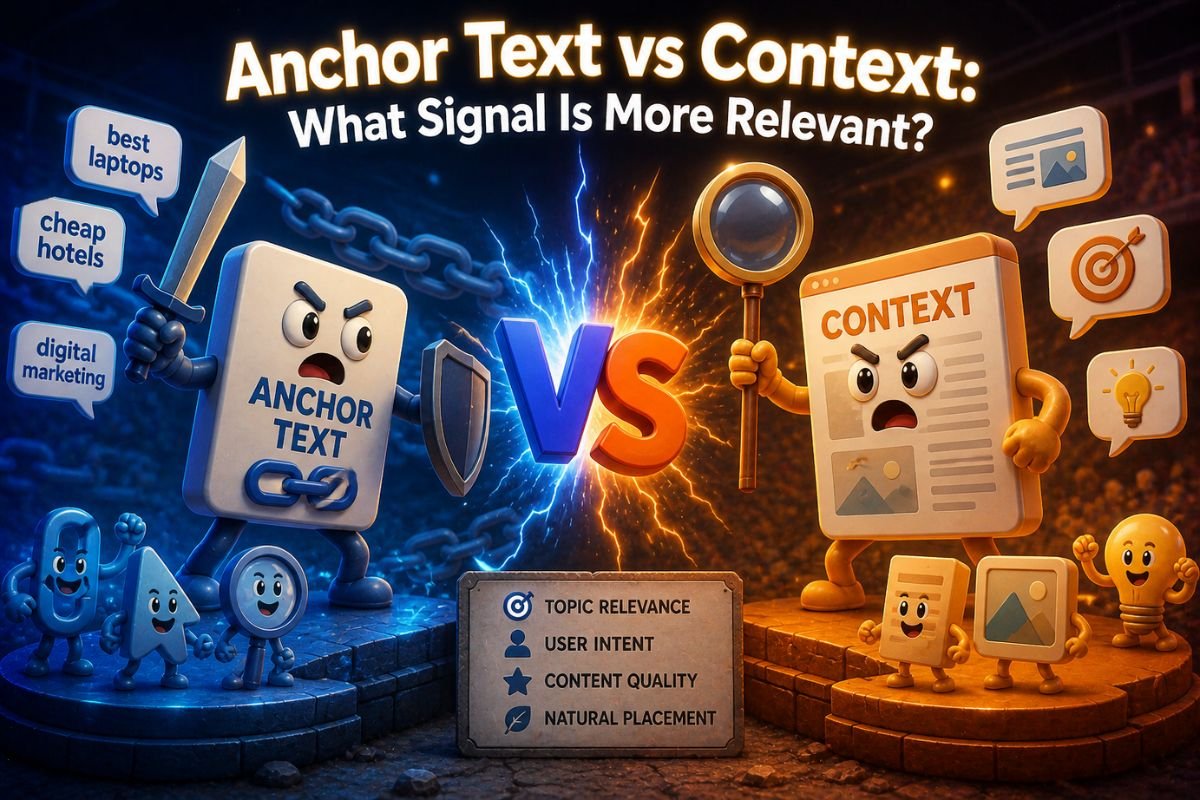

Both anchor text and context play a role in determining what a search engine thinks about a link. However, they play these roles in different ways.
One acts as a direct indicator of what a search engine might expect a link to mean. The other functions as a framework that helps interpret what that indicator represents.
It is important to note that these two signals work together. A search engine does not use one without considering the other.
The Role of Anchor Text as a Direct Signal
Anchor text is arguably the most direct indicator of what a search engine might expect a link to mean. It functions as a linguistic signal that describes what is represented by the link.
Because anchor text is specifically designed to act as a reference, search engines treat it as a descriptive element of the link.
This is where anchor text tends to be strongest as a signal. It performs best when the wording is clear and unambiguous.
The Role of Context as an Interpretive Framework
Context can be understood as the set of circumstances that influence how a link is interpreted. In practice, this refers to the language and content surrounding the link.
The text around the link acts as a conceptual framework that helps explain the meaning of the link. The search engine algorithm does not rely solely on anchor text; it also evaluates the surrounding language.
If the surrounding text consistently discusses a specific topic, the link becomes associated with that topic. The context also helps explain the relationship between the linked page and the source page.
This allows the search engine to understand the meaning of the link even when the anchor text alone does not provide many clues. The surrounding context therefore, acts as a stabilizing factor. It helps the search engine interpret the anchor text in relation to the overall topic of the content.



Ambiguity Resolution in Link Interpretation
Ambiguity is common in natural language. Words and phrases can have different meanings depending on how they are used.
Anchor text alone is not always able to resolve this ambiguity. If the anchor phrase can refer to multiple meanings or subjects, the context around the link helps search engines determine which meaning is intended.
The surrounding language provides signals about the subject that the author of the content is discussing. In these cases, context becomes the deciding factor. It resolves ambiguity and anchors the link to a particular conceptual area.
Without contextual support, it becomes more difficult for a search engine to interpret the meaning of anchor text.
Contextual Reinforcement and Signal Strength
If the surrounding text consistently indicates the same topic as the anchor text, a reinforcing effect is created.
In this situation, the search algorithm sees multiple signals pointing toward the same concept or topic.
This reinforcement increases the algorithm’s confidence in interpreting the link and understanding what it represents.
When both the anchor text and the surrounding context point toward the same subject, the search algorithm gains a clearer picture of what the link represents.
When Anchor Text Is the Stronger Signal
In some situations, the search algorithm may give more weight to anchor text than to the surrounding context.
This typically happens when the anchor phrase is very specific and clearly refers to a particular concept or idea.
In such cases, the search algorithm can rely more heavily on the anchor phrase because it directly identifies the concept being referenced.
However, this advantage weakens when the anchor text becomes ambiguous or unclear.
you can explore how surrounding text strengthens anchor relevance
When Context Is the Decisive Signal
Context becomes the more important signal when the anchor text does not clearly indicate a specific concept or idea.
In these cases, the surrounding language provides the information necessary to understand what the link represents.
Context also becomes more influential when the surrounding text consistently discusses the subject related to the link. In this case, the contextual signals may provide stronger guidance than the anchor phrase itself.
Signal Hierarchy in Link Interpretation
Anchor text and context are part of a broader signal hierarchy that search engines use to interpret links.
Anchor text provides a direct description of what is being referenced. Context provides the framework needed to understand how that reference relates to the surrounding content.
Search engines analyze both signals simultaneously. As long as anchor text and context are consistent, the interpretation of the link becomes clearer.
When anchor text is ambiguous, context becomes the key factor that helps determine meaning and how anchor text should be selected.
The Balance Between Anchor and Context
Anchor text and context are not competing signals. They function together as part of a unified system used by search engines to interpret links.
When both signals align, the meaning of the link becomes clear. Anchor text identifies the concept being referenced, while context explains how that concept relates to the surrounding discussion.
Understanding this relationship helps explain why search engines evaluate links in relation to their textual environment rather than relying solely on the anchor phrase.