
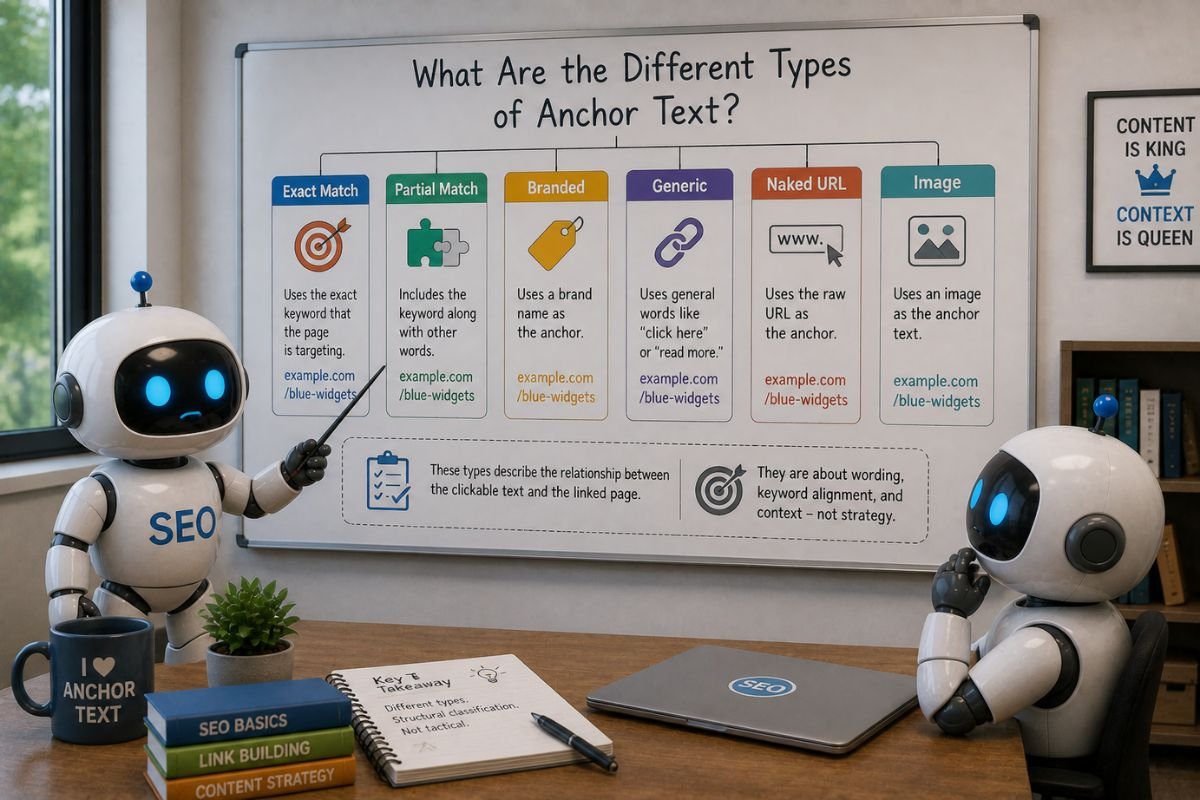
The different types of anchor text describe the relationship between a hyperlink’s clickable text and the page it links to. They do not refer to strategy or intent, but rather to wording, keyword alignment, and contextual construction. This is a structural classification, not a tactical one.
What Is Anchor Text?
Before examining the different types of anchor text, it is important to define the term itself. Anchor text refers to the clickable portion of a hyperlink. The word “anchor” was adopted as a metaphor for the connection point between the visible text and the destination page.
For example:
“Learn more about the importance of technical SEO fundamentals.”
If the phrase “technical SEO fundamentals” is hyperlinked, that phrase is the anchor text.
When someone asks, “What are the different types of anchor text?” they are typically referring to how that clickable text is categorized based on its wording.
Exact Match Anchor Text
Exact match anchor text is used when the clickable text is identical to the primary keyword the target page is attempting to rank for.
If a page targets the keyword “link building strategies,” then the anchor text “link building strategies” would be considered an exact match.
It represents the closest alignment between the wording of the link and the primary keyword of the destination page.
Partial Match Anchor Text
Partial match anchor text includes the target keyword but places it within a broader phrase or variation.


The core keyword is present, but it is extended or modified.
For example, if the target page focuses on “link building strategies,” a partial match might be:
“advanced link building strategies guide”
The phrase contains the keyword, but is not an exact duplication.
Branded Anchor Text
Branded anchor text uses a brand name as the hyperlink.
Example: “BacklinkSense” pointing to its homepage.
There is no keyword description involved. The anchor represents entity recognition rather than topical phrasing.
Naked URL Anchor Text
A naked URL anchor consists of the raw web address used as the clickable text.
Example:
https://example.com
There is no descriptive wording. The link appears exactly as the URL.
Generic Anchor Text
Generic anchor text includes non-descriptive phrases such as:
- “click here”
- “read more”
- “this page”
- “learn more”
These anchors do not contain keyword signals. Their meaning depends entirely on the surrounding context.
You can explore this further through the role of generic anchor phrasing in link interpretation.
Phrase Match or Semantic Anchor Text
Sometimes referred to as semantic anchor text, this type includes wording that is conceptually related to the target keyword but does not directly match it.
For example, if a page discusses anchor text optimization, a semantic anchor might be:
“How link wording influences rankings”.
The wording reinforces the topic without repeating the primary keyword.
Image Anchor Text
When an image is used as a hyperlink, the anchor text is derived from the image’s alt attribute.
For example, if an image links to an SEO guide and the alt text reads “SEO audit checklist,” that alt text functions as the anchor.
It is structurally different from text-based anchors but operates under similar principles.
Why These Distinctions Exist
These classifications are descriptive. They allow anchor text to be grouped and analyzed according to wording patterns.
By identifying these categories, it becomes easier to:
- Identify recurring patterns
- Analyze link profiles
- Discuss link structure in consistent terms
They are not prescriptive guidelines. They do not suggest a preference. They simply describe construction.
A Clear Taxonomy, Not a Strategy
Understanding the different types of anchor text is about taxonomy, not tactics.
Each category answers a structural question:
- Is the anchor identical to the keyword?
- Is it a variation?
- Is it branded?
- Is it generic?
- Is it a URL?
Knowing these distinctions does not define strategy. It clarifies terminology.