

Some webpages give people a natural reason to link to them.
A free calculator is a simple example. If an article explains how to work something out, the writer might link to an online calculator so readers can do the calculation themselves.
A research study can work in a similar way. If a writer needs to support a claim with a statistic, they might link directly to the study that produced the number.
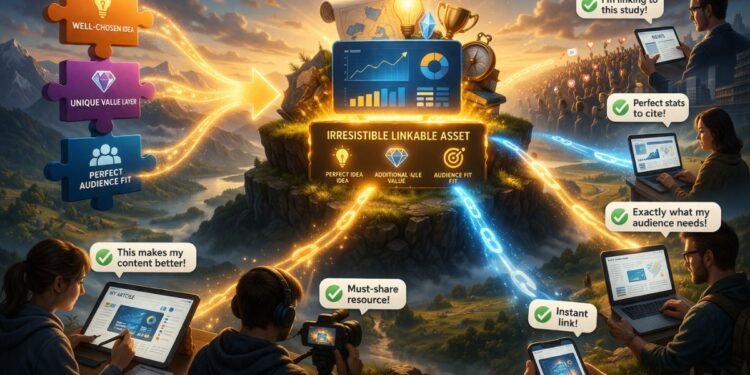
Pages like these are often called linkable assets. They provide something useful that another website may want to send its readers to.
That “something useful” can take many forms. It might be original research, a free tool, a helpful chart, or a collection of information that saves people time.
Real examples make this much easier to understand. By looking at successful linkable assets that already exist, we can see what each one provides and why another website might choose to link to it.
Pew Research Center: Original Research People Can Reference
Pew Research Center regularly publishes original survey research on subjects people write about every day.
One real example is its research on social media use. Its 2025 study was based on responses from 5,022 U.S. adults and examined the social media platforms they use.
Think about why that is useful to another writer.
Someone writing about social media does not need to conduct a survey of thousands of people just to include a reliable statistic in an article. They can use a relevant finding from the Pew research and direct readers to the original study.
The value of the asset is therefore the original information it provides.
This is one reason data studies can become powerful linkable assets. When you produce information that did not previously exist in that form, other people may have a reason to reference the original source.
Google PageSpeed Insights: A Tool People Can Actually Use
A linkable asset does not have to be something people read.
Google PageSpeed Insights is a good example. You enter the address of a webpage, and the tool gives you information about how that page performs on mobile and desktop, along with suggestions for improvements.
That creates a completely different reason to link.
A writer explaining how to improve a slow website could describe what readers should check. But instead of stopping there, the writer can also send readers to PageSpeed Insights so they can check their own page.
The link is useful because it gives the reader something to do.
That is why free tools can work as linkable assets. A useful tool does not need to convince someone to link to it simply because it exists. It can become a natural part of an article when readers need the tool to complete the task being explained.
Our World in Data: Charts That Make Data Easier to Use
Sometimes the useful asset is not the research itself but the way information is presented.
Our World in Data publishes charts and data on subjects ranging from population and health to education and the environment. Many of its charts can be downloaded or embedded on other websites, and the organization provides instructions for citing them.
This makes the charts useful to someone who needs to explain a change or comparison visually.
For example, imagine an article discussing how something has changed over several decades. A clear chart can show that change much faster than several paragraphs filled with numbers.
The reason for referencing the asset is different again. The research example provides information a writer can cite. The tool helps the reader complete a task. A good chart helps people see information more clearly.
This is what can make visual assets useful for earning links. The visual itself is not enough. It needs to make something easier to understand or use.
Curated Resources: Saving Someone Else the Search
Not every useful asset needs original research, a tool, or a chart.
A page can also become useful by bringing information that is spread across many places into one well-organized resource.
Think about someone looking for free resources to learn a new language. They could visit dozens of websites, compare what each one offers, and keep their own list.
A carefully maintained page that has already collected and organized those resources saves them some of that work.
The same benefit can matter to a writer. Instead of explaining every available resource inside an article, they may choose to point readers toward a well-organized collection where they can explore the options themselves.
In this case, the linkable value comes from saving time and making information easier to find.
But simply creating a long list is not enough. The collection needs to be genuinely useful, clearly organized, and worth visiting instead of searching for every item separately.
What These Examples Have in Common
The examples look very different from one another.
A research study gives writers information they can reference. A free tool lets readers complete a task. A chart makes information easier to understand. A well-organized resource saves people from searching across many different places.
That difference is important because there is no single format that automatically makes a page a successful linkable asset.
| Type of asset | What does it give people? | Why might someone link to it? |
|---|---|---|
| Original research | New information or statistics | To show where a fact or number came from |
| Free tool | A way to complete a task | To let readers try or check something themselves |
| Chart or visual | An easier way to understand information | To help readers see the information clearly |
| Curated resource | Useful information collected in one place | To save readers time searching for it |
The table also explains why copying the format of a successful asset is not enough.
Creating a survey does not automatically make the results worth referencing. Building a calculator does not automatically make it useful. Making an infographic does not automatically give another website a reason to link.
What matters is what the asset allows another person to do.
That is the common thread behind linkable assets that earn natural links. The strongest examples do not simply ask other websites for attention. They provide information, a tool, a clearer explanation, or another useful resource that can fit naturally into what someone else is creating.