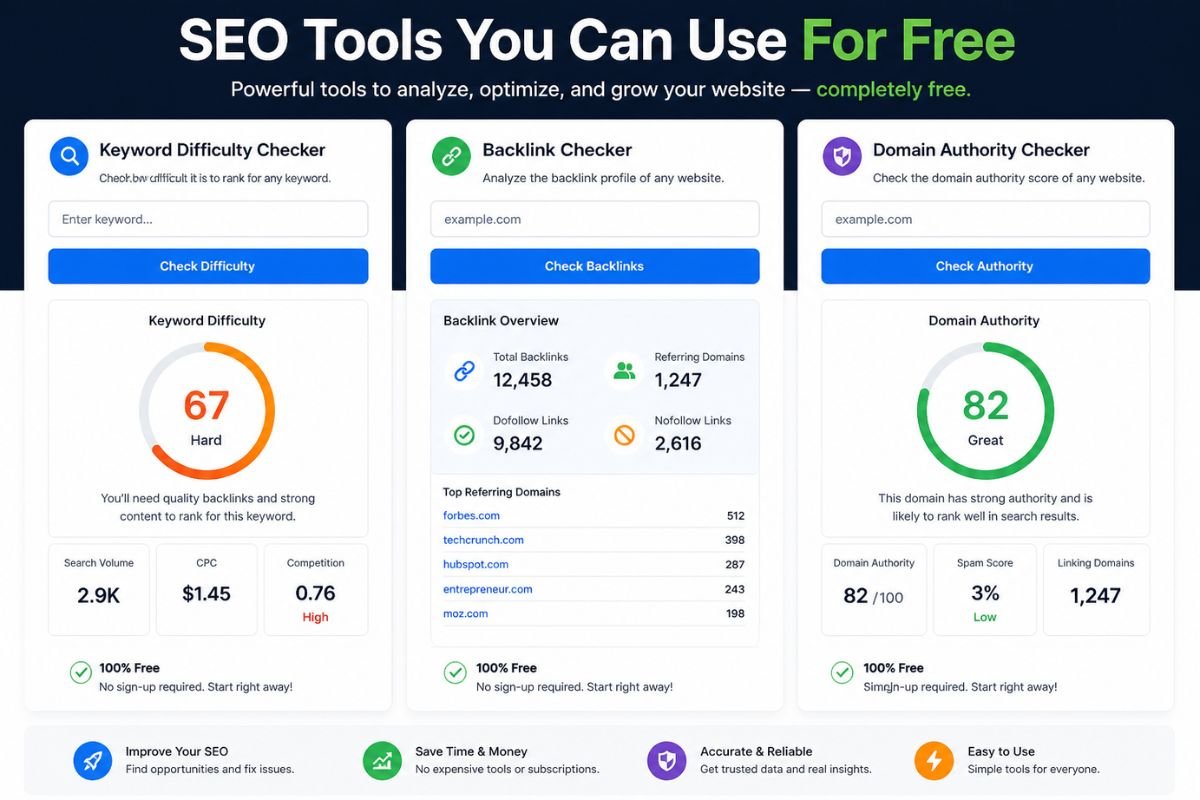

Free tools can be excellent linkable assets, but they are not automatically the best choice.
A linkable asset is a page or resource that gives other websites a clear reason to link to it. For example, a writer might link to a study for a statistic, a chart that helps explain an idea, or a tool that lets readers complete a task.
Free tools are one type of linkable asset, and their biggest advantage is simple: people can use them to do something.
Why Free Tools Can Attract Backlinks
Imagine you are reading about the price of something in another country, but the price is shown in a currency you do not normally use.
An article could explain how to convert the amount yourself. But it could also link to a free currency converter that lets you enter the amount and see the converted value immediately.
That link has a practical purpose. The article provides the explanation, while the tool helps the reader complete the task.
The same idea can apply to calculators, checkers, generators, and other free tools. When a writer wants readers to do something that the article cannot easily do for them, linking to a tool can make the article more useful.
What Gives Free Tools an Advantage?
Most articles are designed mainly to be read. A tool can add something different because the reader can interact with it.
That becomes especially valuable when the subject involves a task.
An article about exchange rates can explain how currency conversion works, but a currency converter can perform the calculation. A guide about website speed can explain why loading time matters, while a speed-testing tool can let readers check their own page.
In situations like these, the tool does not simply provide more information. It helps the reader move from learning something to doing something.
That can give other websites a natural reason to link to it.
When Another Linkable Asset Makes More Sense
Not every article gives its readers a task to complete.
A writer discussing how people use social media may need a reliable statistic. In that situation, original research is more useful than a calculator or generator.
Another writer may be explaining how something has changed over time. A clear chart could be more helpful because readers can see the change instead of working it out from a list of numbers.
This is why there is no single asset type that is best for every situation.
Different assets solve different problems:
| If the writer needs to… | A useful asset might be… |
|---|---|
| Support a statement with evidence | Original research |
| Let readers calculate or check something | A free tool |
| Make information easier to see | A chart or visual |
| Explain a subject in greater depth | A detailed guide |
| Help readers find useful information in one place | A curated resource |
The strongest choice depends on what another writer or their readers actually need.
A Free Tool Still Needs to Solve the Right Problem
Making a tool free does not automatically make it linkable.
Consider a currency converter again. People regularly encounter prices in currencies they do not use, so the tool solves a clear problem that is easy to recognize.
A tool designed for a task that almost nobody needs would have a much smaller reason to be referenced, even if it worked perfectly.
The problem also needs to match the people you want the tool to reach. A useful SEO tool, for example, is much more likely to fit naturally into articles about websites, search, or marketing than into unrelated subjects.
This is where the idea of a free tool as a linkable asset becomes more specific. The goal is not simply to build a tool. It is to identify a task people actually need help completing and create something that makes that task easier.
Tools Can Be Useful Long After They Are Published
A news story may become less relevant as time passes. A useful tool can continue solving the same problem whenever someone needs it.
A currency converter, calculator, or checker does not have to depend on a single story being popular. As long as the tool continues to work and the problem still exists, new people can continue discovering and using it.
That can create new opportunities for backlinks over time.
It also creates responsibility. A broken, inaccurate, or outdated tool becomes less useful to both readers and the websites considering linking to it. Keeping the tool working properly is therefore part of maintaining the asset.
Should You Build a Free Tool for Backlinks?
Start with the problem rather than the format.
If people regularly need to calculate, check, compare, generate, or test something related to your subject, a free tool may be a strong choice. It gives people an immediate result and gives writers a practical resource they can share with readers.
If the real need is evidence, a research study may make more sense. If people need to understand information visually, a chart may be better. If they need a deeper explanation, a guide could be the stronger asset.
That is why free tools are not automatically the best type of linkable asset.
They become strong linkable assets when using the tool is genuinely easier or more helpful than simply reading another explanation.