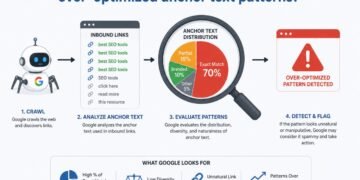


Many backlinks inside a profile may appear suspicious or even malicious at first glance while posing little or no actual danger to SEO performance.
Automated backlink analysis systems often classify links as toxic based on recognizable patterns associated with spam or manipulative behavior.
The problem is that pattern recognition does not always capture the full contextual picture.
Why SEO Tools Overclassify Toxic Backlinks
Most backlink audit platforms rely on automated scoring systems designed to identify signals commonly associated with manipulative link building.
For example, a backlink may be flagged when:
- the linking page has very low authority
- the website contains large numbers of outbound links
- the page uses another language
- the content appears thin or poorly structured
- the page itself has weak indexing signals
Many legitimate pages naturally contain one or more of these characteristics.
The algorithm detects a familiar pattern and classifies the backlink as potentially dangerous even when no actual manipulation exists behind it.
This is one reason toxicity reports often contain large numbers of false positives.
Strange Backlinks Are Not Automatically Dangerous
A common misconception is that unusual-looking backlinks automatically create SEO risk.
In reality, the internet naturally generates many random, irrelevant, and low-quality references without those links necessarily becoming harmful.
For example, backlink profiles often accumulate:
- automated scraper links
- random comment references
- low-traffic guest post mentions
- syndication duplicates
- obscure directory citations
Many SEO tools classify these environments as suspicious.
However, most of these links neither violate search engine guidelines nor meaningfully influence rankings.
They may simply exist as background noise within the broader web ecosystem.
The Main Problem With Toxicity Scores
One of the biggest weaknesses of modern toxicity scoring systems is limited contextual interpretation.
Automated tools evaluate patterns at scale.
They do not fully understand intent.
When several suspicious-looking signals appear together, the system often combines them into one risk score without accurately determining whether the backlink actually represents manipulative behavior.
As a result, many harmless links become overclassified.
For example:
- a backlink may resemble manipulative patterns accidentally
- the page may rarely get indexed despite being legitimate
- the link itself may pass almost no measurable SEO value
- the contextual relationship may be weak but still natural
These distinctions matter significantly during backlink audits.
Without contextual interpretation, toxicity reports can easily exaggerate actual risk.
Low Quality Does Not Necessarily Mean Toxic
Low-quality backlinks and toxic backlinks are not always the same thing.
Almost every website naturally accumulates irrelevant, weak, or obscure references over time.
That alone does not automatically create ranking danger, making the identification of genuinely toxic links far more nuanced than it may initially appear.
The difference usually depends on:
- how the link was created
- whether manipulation appears intentional
- how the broader pattern behaves
- whether the link environment suggests coordinated activity
A poorly written or irrelevant backlink may simply be low quality.
A toxic backlink usually implies deliberate attempts to manipulate rankings through artificial linking behavior.
In practice, these distinctions are often much less clear than toxicity tools suggest.
Why Link Evaluation Became More Complex
Modern search systems evaluate backlinks far more contextually than older algorithms did.
Search engines increasingly appear capable of ignoring weak or irrelevant links rather than treating every suspicious-looking backlink as harmful.
This changes the entire interpretation process.
A backlink profile no longer needs to appear perfectly clean in order to perform well.
What matters more is whether the overall behavior of the profile suggests intentional manipulation.
This is one reason why many websites continue performing normally despite accumulating large numbers of strange-looking backlinks over time, some of which may not be represented consistently across different backlink databases.
Search systems seem increasingly focused on patterns, intent, contextual consistency, and broader behavioral relationships rather than isolated low-quality references alone.
You May Also Like:
- A deeper look into backlink quality and link analysis signals
- A Guide to Identifying Risk Within Your Link Profile
Final Thoughts
Automated toxicity tools are useful for identifying potential patterns worth reviewing.
However, they often overclassify harmless backlinks because algorithms struggle to interpret contextual nuance accurately.
Strange backlinks are not automatically toxic.
Low quality does not automatically equal danger.
And suspicious-looking patterns do not always indicate manipulation.
Modern backlink interpretation appears increasingly dependent on broader behavioral context rather than isolated technical signals alone.