
Sunday, October 11, 2026
BacklinkSense
  • Anchor Text
    • Anchor Text Context
    • Anchor Text Distribution
    • Anchor Text Strategy
    • Types of Anchor Text
  • Backlink Quality and Analysis
    • Authority and Trust Signals
    • Backlink Analysis Tools
    • Link Context
    • Link Placement
    • Link Quality Signals
    • Link Relevance
  • Link Building Basics
    • How Google Ranks Links
    • Types of Backlinks
    • What Are Backlinks
    • Why Backlinks Matter
  • Link Building Methods
    • Asset-Based Link Building
    • Content-Based Link Building
    • Digital PR and Authority Mentions
    • Passive Link Acquisition
    • Resource and Reference Links
  • Link Building Risks
    • Link Penalties
    • Link Velocity
    • Low-Quality Backlinks
    • Over-Optimized Anchor Text
    • Unnatural Link Patterns
  • Link Outreach
    • Finding Outreach Targets
    • Follow Up in Outreach
    • Outreach Email Strategies
No Result
View All Result
BacklinkSense
No Result
View All Result

Home - Link Building Risks - Unnatural Link Patterns - Are Paid Backlinks Worth the Risk?

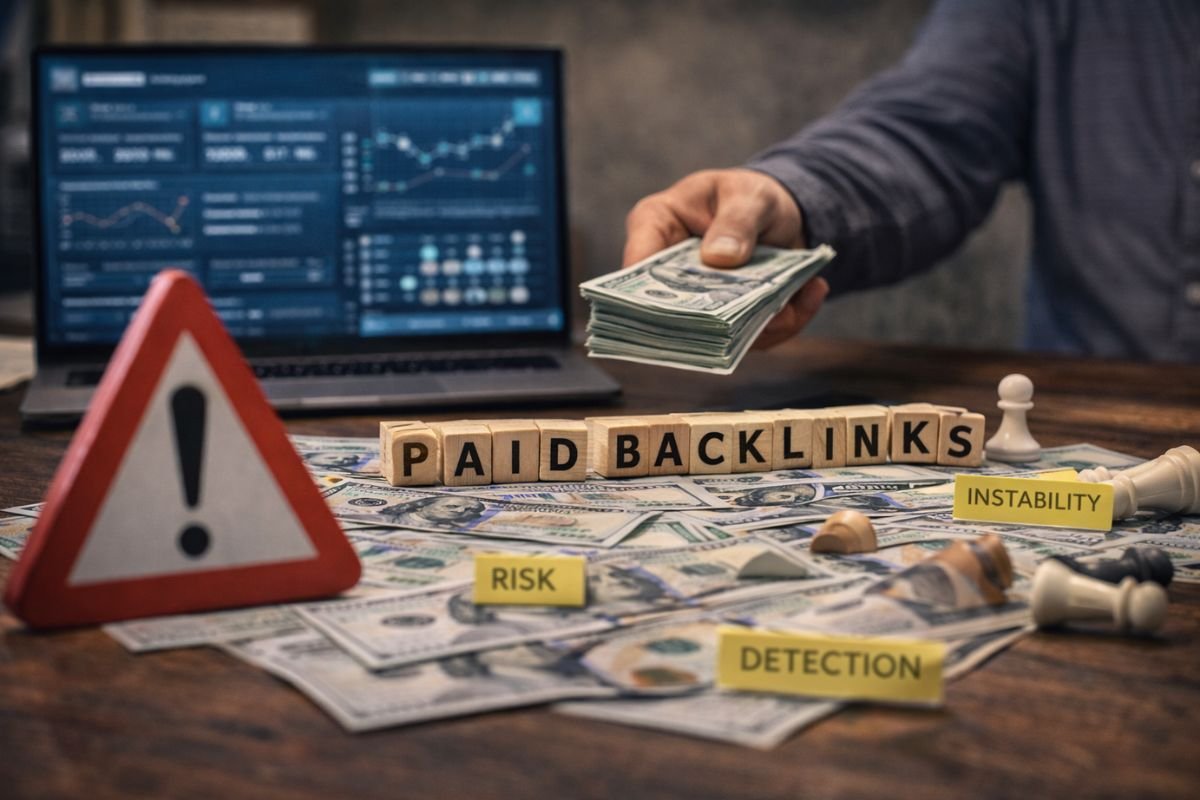
ALT Text: SEO risk analysis asking Are Paid Backlinks Worth the Risk as purchased links are associated with detection, instability, and potential ranking consequences.

Are Paid Backlinks Worth the Risk?

Backlink Sense by Backlink Sense
February 9, 2026
in Unnatural Link Patterns
Reading Time: 3 mins read
Share On FacebookShare On Reddit

Page Contents

  • 1. The Same Payment Can Create Two Very Different Links
  • 2. How Should a Legitimate Paid Link Be Marked?
  • 3. What Can Happen When a Link Is Bought for Rankings?
  • 4. Can Paid Backlinks Result in a Manual Action?
  • 5. A Simple Way to Judge Whether a Paid Placement Is Worth It

Paying for a backlink is not automatically against Google’s rules. The important question is what you are paying for and what you expect the link to do.

A paid backlink is simply a link to your website that exists because money, products, services, or another form of compensation was exchanged for it. That can happen in legitimate advertising and sponsorships, but it can also happen when someone buys a link specifically to improve search rankings.

That difference is where the risk begins.

Google allows paid links used for advertising or sponsorship when they are properly qualified, preferably with rel="sponsored" or, alternatively, nofollow. But buying links for the purpose of manipulating search rankings falls under Google’s definition of link spam.

So, are paid backlinks worth the risk? If you are paying specifically to gain ranking credit from the link, the potential SEO benefit comes with a clear conflict with Google’s spam policies. If you are paying for legitimate exposure and the link is properly qualified, you are dealing with a different kind of paid relationship rather than trying to buy ranking influence.

The Same Payment Can Create Two Very Different Links

A company might pay a publisher to feature its product in a sponsored article. Readers can follow a link from that article to the company’s website, and the company receives exposure to the publisher’s audience.

If the commercial relationship is properly represented and the link is qualified, paying for that placement is not what Google defines as link spam.

Now change one thing: the company pays specifically because it wants the link to pass ranking credit and improve its position in Google Search.

That is the distinction that matters. Google’s spam policies list buying or selling links for ranking purposes among examples of link spam.

How Should a Legitimate Paid Link Be Marked?

Google recommends marking links that are advertisements or paid placements with rel="sponsored". The older nofollow attribute is still acceptable, although Google says sponsored is preferred for this purpose.

This qualification does not stop a person from clicking the link. The advertisement can still send visitors to the website and provide whatever exposure made the placement worthwhile.

What changes is the information provided to Google about the relationship behind the link. Instead of presenting a commercially arranged link as an ordinary editorial link, the attribute identifies it as a paid relationship.

What Can Happen When a Link Is Bought for Rankings?

Paying for a manipulative backlink does not mean a penalty automatically appears.

Google uses automated systems to detect search spam. One of them is SpamBrain, an AI-based spam-prevention system that Google has said can detect sites buying links and sites being used to pass outgoing links.

Google has also explained that spammy links can be neutralized. In simple terms, the purchased link may no longer provide the ranking credit it was bought to create.

That makes the financial risk easier to understand. You can pay for a backlink specifically for its expected SEO effect, while Google is actively trying to prevent that effect from influencing search results.

Purchased links are also only one way unnatural linking can develop. Repeated exchanges, automated creation, and other coordinated practices can produce broader issues, which is why unusual linking behavior can create recognizable patterns beyond any single paid link.

Can Paid Backlinks Result in a Manual Action?

Google can also take a manual action when a human reviewer determines that pages on a site do not comply with its spam policies.

This is different from an automated system neutralizing spammy links. A manual action is communicated through Google Search Console, where the site owner can see the issue Google identified.

That distinction prevents a common mistake: seeing a ranking decline and immediately concluding that Google has manually penalized the site for paid backlinks. Without evidence such as a manual action in Search Console, a ranking change alone does not establish that diagnosis.

A Simple Way to Judge Whether a Paid Placement Is Worth It

Before buying a placement, ask one question:

Would you still pay for it if the backlink provided no ranking credit at all?

If the answer is yes because the placement puts your business in front of a valuable audience, sends relevant visitors, or provides worthwhile advertising exposure, then the value exists independently of manipulating Google rankings. The link should still be appropriately qualified when it is part of a paid relationship.

If the answer is no because passing ranking credit is the only reason you want the link, you are paying for an outcome that conflicts with Google’s spam policies and that Google’s systems are designed to prevent.

That is ultimately where the risk of paid backlinks becomes easiest to judge: not by asking whether money changed hands, but by asking what you are actually paying to receive.


Tags: manipulationSEO risk managementSEO risk signalsSponsored links
ShareShareShareShareSend

Related Posts

Anchor Text Distribution

How Much Exact Match Is Too Much?

by Backlink Sense
March 3, 2026
Physical backlink removal with pliers compared with the disavow process, illustrating Can You Remove Backlinks and the difference between both methods.
Low-Quality Backlinks

Can You Remove Backlinks?

by Backlink Sense
February 8, 2026
Competitor sending backlinks toward another website while Google evaluates their potential impact, illustrating whether Competitors Create Damaging Backlinks.
Low-Quality Backlinks

Can Competitors Create Damaging Backlinks?

by Backlink Sense
July 27, 2026
SEO specialist reviewing keyword performance to understand How Does Anchor Text Influence Rankings? through relevance and keyword signals.
Anchor Text Strategy

How Does Anchor Text Influence Rankings?

by Backlink Sense
February 9, 2026
SEO professionals analyze link quality, context, relevance, and backlink data, exploring Do Backlinks Still Work in 2026? as part of a modern SEO strategy.
Why Backlinks Matter

Do Backlinks Still Work in 2026?

by Backlink Sense
February 8, 2026
Load More
  • About Us
  • Terms of Use
  • Use of Cookies
  • Affiliate Disclosure
  • Contact
  • Privacy Policy
2026 BacklinkSense © All rights reserved.

Welcome Back!

Login to your account below

Forgotten Password?

Retrieve your password

Please enter your username or email address to reset your password.

Log In

Accessibility Toolbar

  • Powered with favoriteLove by Codenroll
No Result
View All Result
  • Anchor Text
    • Anchor Text Context
    • Anchor Text Distribution
    • Anchor Text Strategy
    • Types of Anchor Text
  • Backlink Quality and Analysis
    • Authority and Trust Signals
    • Backlink Analysis Tools
    • Link Context
    • Link Placement
    • Link Quality Signals
    • Link Relevance
  • Link Building Basics
    • How Google Ranks Links
    • Types of Backlinks
    • What Are Backlinks
    • Why Backlinks Matter
  • Link Building Methods
    • Asset-Based Link Building
    • Content-Based Link Building
    • Digital PR and Authority Mentions
    • Passive Link Acquisition
    • Resource and Reference Links
  • Link Building Risks
    • Link Penalties
    • Link Velocity
    • Low-Quality Backlinks
    • Over-Optimized Anchor Text
    • Unnatural Link Patterns
  • Link Outreach
    • Finding Outreach Targets
    • Follow Up in Outreach
    • Outreach Email Strategies

2026 BacklinkSense © All rights reserved.

This website uses cookies to improve your experience and analyze site performance. By continuing to browse, you agree to our Privacy and Cookie Policy.