A single sentence can change the meaning of what comes next.
If someone tells you, “You’ll need an umbrella,” the sentence makes much more sense after hearing that heavy rain is expected than after a conversation about choosing a new laptop.
Links work in a similar way:
A link does not usually appear by itself. There are words before it, words after it, and often an entire paragraph discussing a particular subject. That surrounding discussion helps explain why the link is there and what the reader should expect to find after clicking it.
This is what content relevance around the link means.
It simply asks whether the content being discussed around a link is related to the page the link leads to.
For example, if a paragraph explains different ways to analyze backlinks and then links to a detailed backlink analysis guide, the connection is easy to understand. The surrounding discussion has already prepared the reader for the destination.
So when we ask whether content relevance around a link matters for SEO, we are really asking something quite simple: does the conversation around the link make sense with the page on the other side?
What Can the Words Around a Link Tell You?
Consider an article explaining how to analyze backlinks.
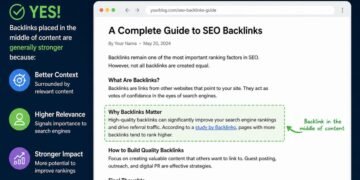
One paragraph discusses checking where backlinks come from, what anchor text they use, and whether the linking pages are relevant. During that discussion, the article links to a guide explaining why contextual backlinks can be useful.
The destination does not suddenly introduce a completely different subject. It continues something the reader was already learning about.
Now place the same link inside a paragraph explaining how to compress images to make a website load faster.
Both subjects can broadly fall under SEO, but the immediate conversation has changed. The paragraph is about image compression and website performance, while the destination is about backlinks.
This is why broad topical similarity alone does not tell you whether the content around a particular link is relevant.
Does Google Look at More Than the Clickable Words?
The clickable words in a link are called anchor text, but those words do not exist alone.
Google’s guidance on links explains that the words before and after a link provide context for that link. This gives us an important distinction: understanding a link is not limited to reading only the clickable phrase.
For example:
A backlink can appear relevant at first, but examining the surrounding content can reveal whether the destination actually belongs in the discussion.
The clickable words provide information about the destination, while the rest of the sentence helps explain why the link appears there.
This is one reason it makes sense to examine the surrounding content rather than judging a backlink from its anchor text alone.
How Far Around the Link Should You Look?
There is no public Google rule telling us to count a specific number of words before and after a backlink.
A more useful approach is to follow the discussion.
Start with the sentence containing the link. If the reason for the link is already obvious, you may understand the relationship immediately. Sometimes you need the paragraph to see what the writer is explaining. In other cases, the paragraph makes the most sense only when you understand the larger section it belongs to.
This means that “content around the link” should not be treated as a fixed number of nearby words. It is better understood as the part of the discussion that helps explain why the link is there.
What If the Website Covers the Same General Topic?
This is where content relevance can easily be misunderstood.
A backlink can come from a website in the same industry and still appear in a poorly related discussion.
For example, an SEO website might contain one article about backlinks and another about improving page speed. A backlink to a detailed guide about backlink quality and analysis could make perfect sense in the first article without necessarily making sense in the second.
The website is still about SEO. What changed is the specific conversation surrounding the link.
The opposite can happen too. A broad business website does not need to be entirely about SEO for one of its articles to contain a highly relevant discussion about backlinks.
This is why website relevance and content relevance around an individual link should not be treated as exactly the same thing.
Does Relevant Surrounding Content Make a Backlink High Quality?
Not by itself.
A link can appear inside a highly relevant paragraph and still have other problems. The page could exist primarily to place links, the destination could be poor, or the link could have been created as part of an arrangement intended to manipulate rankings.
Content relevance tells us something more specific: whether the discussion around the backlink creates a clear connection with the destination.
That is useful information, but it is only one part of understanding a backlink.
A simple way to check it is to forget about SEO metrics for a moment and read the passage as a normal reader. If the link disappeared, what subject would the paragraph still be discussing? Then look at the destination.
If the destination naturally continues that conversation, the relevance around the link is easy to understand.