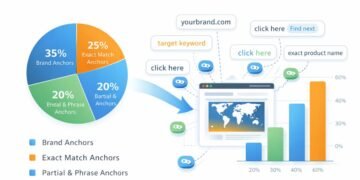



A backlink is a link from another website to your website. When a web page on another website includes a link to your web page, that is a backlink to your website. In terms of search engines, this link is an “incoming link” or “inbound link.”
This is the basic definition of a backlink. A backlink is simply an external link to your web page.

A Real Example of a Backlink – What is a Backlink?
Let’s say a digital marketing blog publishes an article with the title “How to Improve Technical SEO.” In this article, the blogger includes a link to your article, which is a comprehensive guide to internal linking. The blogger writes:
“For a deeper breakdown of internal link structure, see this guide.”
The words “see this guide” are a link to your article. This is a backlink.
The link is on another website, but it points to your website. People can click on this link to visit your website. Search engines will crawl this link to discover your website.
This is the basic concept of a backlink. There is nothing more to it.
Explore our Link Building Basics library for a broader understanding of how links work.
Why is a Backlink Considered a Signal?
A backlink is a signal to search engines. A signal is simply information being communicated to the search engines.
When a website links to your website, it is essentially saying, “Your website is good enough to link to.”


This is why a backlink is considered a signal. A website is choosing to reference your content.
In other words, search engines recognize patterns across a large number of links. For instance, if many websites link to a certain page, then the search engine recognizes that the page has value within a certain topic or subject. On the other hand, if no other websites link to a certain page, then the search engine recognizes that the page has little visibility or value.
A link to a website is not necessarily a vote for inclusion or exclusion. Instead, the link is just one of many factors that search engines use to determine the value of a website.
Not All Backlinks Mean the Same Thing
Although the definition of a backlink is simple, the context in which the backlink is provided can vary.
For instance, a backlink provided by a reputable publication within a certain industry is more important than a backlink provided by a new blog that has little to no audience. Similarly, a backlink provided by a website within the same niche as your website is more important than a backlink provided by a website within a completely unrelated niche.

Although the context of a backlink may change, the definition remains the same. Regardless of context, a backlink is still an external link to your website.
How Search Engines Use Backlinks
Search engines use backlinks to create a map of the web. In other words, search engines rely on backlinks to identify the structure of the web.
For instance, if Page A has a link to Page B, then the search engine recognizes the connection between the two websites. Over time, the search engine identifies a network of links across the web and recognizes which websites receive the most references.

This makes backlinks a relational signal. They tell the search engine that the content is being referenced, cited, or mentioned outside of its domain. This allows the search engine to understand the relevance, prominence, and authority of the content.
It is also important to understand that backlinks, while significant, are only one factor in the overall ranking algorithm. There are other considerations, such as the quality of the content, the user experience, and the technical aspects of the website. However, backlinks remain one of the clearest ways to understand that content has been referenced by other sites.
A Simple Way to Think About It
If you remove all the technical aspects, a backlink is merely a recommendation in the form of a link. It’s one website referencing another, and the search engine recognizes that the reference was made.
This becomes part of the larger system of evaluation.
This is why the question “What is a backlink with an example?” can be answered in simple terms. It is the ability for your website to be referenced by other websites, such as the marketing blog referencing your content about SEO.
That reference becomes a signal to the search engine that the content was relevant and worth linking to. Nothing more complex is needed to understand the foundation.