

Sunday, March 15, 2026
BacklinkSense
  • Anchor Text
    • Anchor Text Context
    • Anchor Text Distribution
    • Anchor Text Strategy
    • Types of Anchor Text
  • Backlink Quality and Analysis
    • Authority and Trust Signals
    • Backlink Analysis Tools
    • Link Context
    • Link Placement
    • Link Quality Signals
    • Link Relevance
  • Link Building Basics
    • How Google Ranks Links
    • Types of Backlinks
    • What Are Backlinks
    • Why Backlinks Matter
  • Link Building Methods
    • Asset-Based Link Building
    • Content-Based Link Building
    • Digital PR and Authority Mentions
    • Passive Link Acquisition
    • Resource and Reference Links
  • Link Building Risks
    • Link Penalties
    • Link Velocity
    • Low-Quality Backlinks
    • Over-Optimized Anchor Text
    • Unnatural Link Patterns
  • Link Outreach
    • Finding Outreach Targets
    • Follow Up in Outreach
    • Outreach Email Strategies
    • Outreach Personalization
    • Relationship Based Outreach
No Result
View All Result
  • Anchor Text
    • Anchor Text Context
    • Anchor Text Distribution
    • Anchor Text Strategy
    • Types of Anchor Text
  • Backlink Quality and Analysis
    • Authority and Trust Signals
    • Backlink Analysis Tools
    • Link Context
    • Link Placement
    • Link Quality Signals
    • Link Relevance
  • Link Building Basics
    • How Google Ranks Links
    • Types of Backlinks
    • What Are Backlinks
    • Why Backlinks Matter
  • Link Building Methods
    • Asset-Based Link Building
    • Content-Based Link Building
    • Digital PR and Authority Mentions
    • Passive Link Acquisition
    • Resource and Reference Links
  • Link Building Risks
    • Link Penalties
    • Link Velocity
    • Low-Quality Backlinks
    • Over-Optimized Anchor Text
    • Unnatural Link Patterns
  • Link Outreach
    • Finding Outreach Targets
    • Follow Up in Outreach
    • Outreach Email Strategies
    • Outreach Personalization
    • Relationship Based Outreach
No Result
View All Result
BacklinkSense
No Result
View All Result
ADVERTISEMENT
How Many Backlinks Do You Actually Need to Rank?

How Many Backlinks Do You Actually Need to Rank?

Backlink Sense by Backlink Sense
February 9, 2026
in Authority and Trust Signals
Reading Time: 5 mins read
0
Share on FacebookShare on Twitter

Page Contents

  • 1 Ranking Is Competitive, Not Numerical
  • 2 The Role of Referring Domains
  • 3 Related Posts
  • 4 Do High Authority Backlinks Always Improve Rankings?
  • 5 How Backlinks Build Topical Authority
  • 6 What Is Link Equity and How Is It Distributed?
  • 7 Competition Determines the Threshold
  • 8 Benchmarking Instead of Guessing
  • 9 Content Strength Changes the Equation
  • 10 Domain Maturity and Internal Authority
  • 11 The Risk of Chasing Numbers
  • 12 When Fewer Backlinks Are Enough
  • 13 When More Backlinks Still Are Not Enough
  • 14 A Measured Conclusion

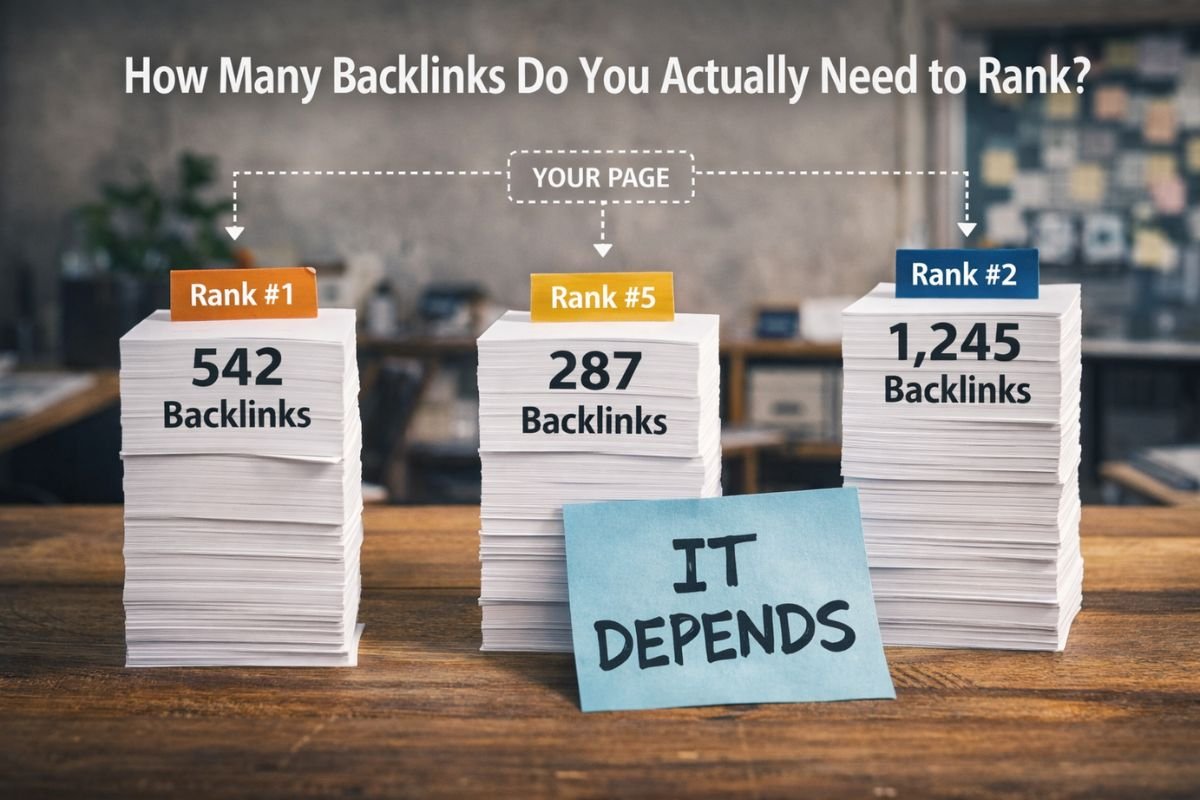
There is no fixed number that answers this question. The number depends on your competition, the pages currently ranking for your target query, and the overall authority level within that space. In some cases, a handful of relevant backlinks may be enough. In others, it may require significantly more. Backlinks needed are relative, not absolute.

Ranking Is Competitive, Not Numerical

When asking how many backlinks you actually need to rank, it is tempting to look for a specific target. But ranking does not operate on a universal threshold. Search visibility is comparative. Your page is evaluated against others targeting the same keyword.

If the pages currently ranking at the top have:

• Strong domain authority
• Multiple referring domains
• Consistent link growth
• Deep topical coverage

Competing requires comparable structural strength, but if competing pages have minimal link profiles, the required threshold may be much lower, since the true benchmark is always your competition.

The Role of Referring Domains

Total backlinks alone do not tell the full story. Referring domains often carry more weight than raw link counts. A page with ten links from ten different domains may outperform a page with fifty links from only two domains.

Diversity signals broader recognition.

When evaluating how many backlinks are needed, consider:

• Number of referring domains
• Relevance of those domains
• Distribution patterns
• Placement context

Focusing only on total links leads to misleading conclusions.

Related Posts

Do High Authority Backlinks Always Improve Rankings?

March 7, 2026
How Backlinks Build Topical Authority

How Backlinks Build Topical Authority

February 9, 2026
What Is Link Equity and How Is It Distributed?

What Is Link Equity and How Is It Distributed?

February 9, 2026

Competition Determines the Threshold

The number of backlinks required generally scales with competitive intensity. For emerging or niche queries, where competition is lighter and link profiles are less developed, the threshold is often lower. For commercial or high visibility queries, established brands dominate, authority clusters are dense, and link profiles are extensive, so the required level of authority increases accordingly. Understanding market saturation provides the necessary perspective.

Benchmarking Instead of Guessing

Rather than guessing a number, benchmarking offers clarity.

A practical approach includes:

• Identifying the top ranking pages for your target keyword
• Analyzing their referring domains
• Evaluating topical alignment
• Observing their growth patterns

The objective is not to copy exact numbers, but to understand the scope of authority in your landscape.

For example, if the top five ranking pages each have 30 to 50 referring domains, competing with two unrelated backlinks is unlikely to close the gap. If they each have fewer than ten referring domains, the threshold may be more accessible. Benchmarking reframes the question from “How many?” to “How much relative authority exists?”

Content Strength Changes the Equation

Backlinks are part of a broader evaluation.

If your content offers:

• Clearer structure
• More comprehensive coverage
• Stronger topical alignment
• Better alignment with search intent

then fewer backlinks may be required. If your content lacks clarity or depth, the number of backlinks needed increases. Link strength and content strength operate together, not separately.

Domain Maturity and Internal Authority

The maturity of your domain also influences the threshold.

A domain with:

• Established topical clusters
• Consistent internal linking
• Prior external recognition

may require fewer new backlinks to rank additional pages. a new domain without established authority may require stronger external validation to compete. Link requirements scale with domain maturity.

The Risk of Chasing Numbers

Prioritizing link quantity over structure introduces risk.

An aggressive focus on numbers can lead to:

• Repetitive anchor concentration
• Artificial link velocity spikes
• Low quality placements

Quantity without distribution integrity can weaken ranking potential rather than strengthen it. structural integrity matters more than numerical parity.

When Fewer Backlinks Are Enough

In many cases, ranking is possible with surprisingly few backlinks. This often occurs when:

• Competition is low
• Content quality clearly exceeds alternatives
• Topical clusters are well organized
• Search intent is highly specific

In these scenarios, relative strength outweighs raw quantity.

When More Backlinks Still Are Not Enough

In highly competitive industries, established brands hold dense authority clusters. Even a significant number of backlinks may not overcome a substantial authority gap.

Here, the threshold expands beyond simple numbers and into brand recognition, content depth, and structural consistency.

A Measured Conclusion

The answer depends on competitive benchmarks, topical strength, domain maturity, and content alignment, as there is no universal number. Ranking is not about accumulating links but about building structural strength relative to the environment you compete in, and backlinks are part of that structure rather than a standalone target.

Tags: Referring domainsSEO competition analysisWeb authority
ShareTweetPin

Related Posts

Finding Outreach Targets

How to Qualify Outreach Prospects: A Non Binary Decision Space

by Backlink Sense
February 25, 2026
0

How to qualify outreach prospects is not a checklist problem. It is a conceptual...

Read moreDetails
Which Website Has the Most Backlinks?

Which Website Has the Most Backlinks?

February 8, 2026
Can I Rank Without Backlinks?

Can I Rank Without Backlinks?

February 8, 2026
  • About Us
  • Terms of Use
  • Use of Cookies
  • Affiliate Disclosure
  • Contact
  • Privacy Policy
2026 BacklinkSense © All rights reserved.

Welcome Back!

Login to your account below

Forgotten Password?

Retrieve your password

Please enter your username or email address to reset your password.

Log In

Accessibility Toolbar

  • Powered with favoriteLove by Codenroll
No Result
View All Result
  • Anchor Text
    • Anchor Text Context
    • Anchor Text Distribution
    • Anchor Text Strategy
    • Types of Anchor Text
  • Backlink Quality and Analysis
    • Authority and Trust Signals
    • Backlink Analysis Tools
    • Link Context
    • Link Placement
    • Link Quality Signals
    • Link Relevance
  • Link Building Basics
    • How Google Ranks Links
    • Types of Backlinks
    • What Are Backlinks
    • Why Backlinks Matter
  • Link Building Methods
    • Asset-Based Link Building
    • Content-Based Link Building
    • Digital PR and Authority Mentions
    • Passive Link Acquisition
    • Resource and Reference Links
  • Link Building Risks
    • Link Penalties
    • Link Velocity
    • Low-Quality Backlinks
    • Over-Optimized Anchor Text
    • Unnatural Link Patterns
  • Link Outreach
    • Finding Outreach Targets
    • Follow Up in Outreach
    • Outreach Email Strategies
    • Outreach Personalization
    • Relationship Based Outreach

2026 BacklinkSense © All rights reserved.

This website uses cookies to improve your experience and analyze site performance. By continuing to browse, you agree to our Privacy and Cookie Policy.