


Sunday, July 19, 2026
BacklinkSense
  • Anchor Text
    • Anchor Text Context
    • Anchor Text Distribution
    • Anchor Text Strategy
    • Types of Anchor Text
  • Backlink Quality and Analysis
    • Authority and Trust Signals
    • Backlink Analysis Tools
    • Link Context
    • Link Placement
    • Link Quality Signals
    • Link Relevance
  • Link Building Basics
    • How Google Ranks Links
    • Types of Backlinks
    • What Are Backlinks
    • Why Backlinks Matter
  • Link Building Methods
    • Asset-Based Link Building
    • Content-Based Link Building
    • Digital PR and Authority Mentions
    • Passive Link Acquisition
    • Resource and Reference Links
  • Link Building Risks
    • Link Penalties
    • Link Velocity
    • Low-Quality Backlinks
    • Over-Optimized Anchor Text
    • Unnatural Link Patterns
  • Link Outreach
    • Finding Outreach Targets
    • Follow Up in Outreach
    • Outreach Email Strategies
    • Outreach Personalization
    • Relationship Based Outreach
No Result
View All Result
  • Anchor Text
    • Anchor Text Context
    • Anchor Text Distribution
    • Anchor Text Strategy
    • Types of Anchor Text
  • Backlink Quality and Analysis
    • Authority and Trust Signals
    • Backlink Analysis Tools
    • Link Context
    • Link Placement
    • Link Quality Signals
    • Link Relevance
  • Link Building Basics
    • How Google Ranks Links
    • Types of Backlinks
    • What Are Backlinks
    • Why Backlinks Matter
  • Link Building Methods
    • Asset-Based Link Building
    • Content-Based Link Building
    • Digital PR and Authority Mentions
    • Passive Link Acquisition
    • Resource and Reference Links
  • Link Building Risks
    • Link Penalties
    • Link Velocity
    • Low-Quality Backlinks
    • Over-Optimized Anchor Text
    • Unnatural Link Patterns
  • Link Outreach
    • Finding Outreach Targets
    • Follow Up in Outreach
    • Outreach Email Strategies
    • Outreach Personalization
    • Relationship Based Outreach
No Result
View All Result
BacklinkSense
No Result
View All Result

Home - Backlink Quality and Analysis - Link Quality Signals - Explanation on Why Search Engines Rely on Multiple Signals When Evaluating Backlinks

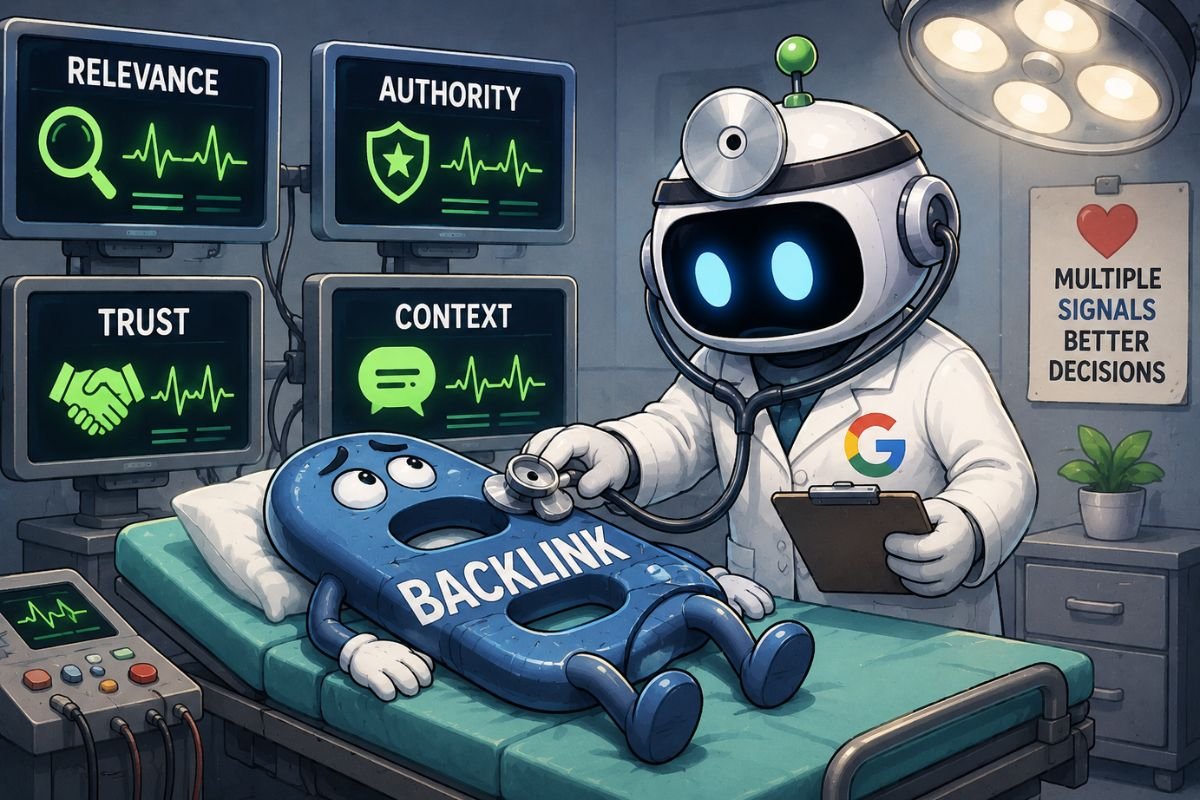
Google-inspired robot examining a backlink patient by analyzing relevance, authority, trust, and context to illustrate why search engines rely on multiple signals.

Explanation on Why Search Engines Rely on Multiple Signals When Evaluating Backlinks

Backlink Sense by Backlink Sense
June 22, 2026
in Link Quality Signals
Reading Time: 3 mins read
Share On FacebookShare On Reddit

Page Contents

  • 1 Incomplete Interpretation Created by Individual Signals
  • 2 Incomplete Signals Require Layered Evaluation
  • 3 Context Signals Can Also Become Insufficient
  • 4 Related Posts
  • 5 Why Is Link Quality Context Dependent?
  • 6 Why Can Backlinks from High Authority Sites Be of Poor Quality?
  • 7 Reasons Some Strong Backlinks May Fail to Pass Much Value
  • 8 Placement Interpretation Depends on Other Signals
  • 9 The Web Contains Many Ambiguous Signals
  • 10 Evaluation Through Multiple Signals Reduces Interpretive Risk
  • 11 Combining Multiple Signals Increases Interpretive Confidence
  • 12 Backlink Evaluation Requires Environmental Analysis
  • 13 Backlinks Require Probabilistic Interpretation

Backlinks likely require evaluation through multiple signals rather than isolated metrics because individual signals rarely provide sufficient interpretive certainty on their own.

A backlink may indicate authority without demonstrating contextual relevance or meaningful relationship clarity. Similarly, a link may imply trust while lacking proper placement or editorial significance. Under such conditions, there may not be enough interpretive certainty to fully understand the nature of the relationship.

Because of this, backlink interpretation appears increasingly probabilistic and environmentally driven.

Incomplete Interpretation Created by Individual Signals

One reason search systems may avoid relying on isolated backlink characteristics is that individual signals often fail to communicate enough information about the relationship itself.

Authority signals may indicate a certain level of trust associated with a backlink while still failing to explain its broader meaning fully. Likewise, semantic similarity alone may become unreliable when the surrounding environment lacks interpretive consistency.

Placement signals may also indicate structural importance without adequately explaining the relationship itself.

Incomplete Signals Require Layered Evaluation

Authority alone may become insufficient when surrounding reinforcement signals remain weak.

A backlink may originate from a trusted environment while still providing limited interpretive confidence because surrounding signals demonstrate weak contextual continuity, structural inconsistency, limited editorial integration, poorly defined semantics or unclear relationships.

Under such circumstances, the authority signal itself still exists while lacking enough reinforcement to justify strong interpretive confidence.

Context Signals Can Also Become Insufficient

A similar problem appears when contextual similarity dominates interpretation while other supporting signals remain weak.

Related Posts

Why Is Link Quality Context Dependent?

Why Is Link Quality Context Dependent?

June 23, 2026

Why Can Backlinks from High Authority Sites Be of Poor Quality?

June 23, 2026
Illustration showing why strong backlinks may fail to pass much value, with a powerful backlink leaking link value before it reaches a website

Reasons Some Strong Backlinks May Fail to Pass Much Value

June 22, 2026

The issue with relying heavily on contextual relevance is that the surrounding environment may still lack enough reinforcement to support interpretation properly.

For example, contextual relevance may appear strong despite weak integration into environments containing insufficient structure, low trust, semantic divergence or broader inconsistency.

As a result, contextual signals alone may fail to compensate for weaknesses elsewhere in the overall link quality context.

Placement Interpretation Depends on Other Signals

Placement itself also requires surrounding reinforcement in order to be interpreted reliably.

A prominently placed backlink may still lack interpretive support if it exists inside an incoherent environment. Conversely, a less prominent placement may still appear meaningful when integrated naturally into a consistent and trustworthy structure.

Because of this, placement interpretation likely depends on factors such as structural consistency, environmental trust, relationship clarity and contextual continuity.

Placement alone therefore does not contain enough information to fully evaluate backlink significance.

The Web Contains Many Ambiguous Signals

Isolated signals become particularly difficult to interpret because the web contains enormous structural diversity.

Different websites organize relationships differently. Some environments are dominated by strong authority structures, while others are not. Likewise, websites vary significantly in how they structure contextual relationships and editorial environments.

Under these conditions, search systems may struggle to interpret backlinks accurately without relying on surrounding signals.

Continue building your understanding with:

  • How Link Quality Signals Are Evaluated
  • How Does Google Assess Link Quality?

Evaluation Through Multiple Signals Reduces Interpretive Risk

Another likely reason for multi-signal evaluation is reduction of interpretive risk.

An isolated signal may appear powerful when it reflects only one characteristic of a backlink such as domain authority, placement, semantics or branding.

At the same time, the backlink may lack broader environmental reinforcement entirely.

In such cases, backlinks become difficult to interpret accurately when supported by only one strong feature.

Combining Multiple Signals Increases Interpretive Confidence

Backlink interpretation likely becomes more reliable because of the cumulative interaction between multiple signals.

While individual signals may contain substantial uncertainty, multiple independent signals working together can increase interpretive confidence significantly.

As a result, backlink evaluation may rely on combinations of authority, context, structure, editorial integrity, placement and relevance simultaneously.

Relationships become easier to interpret when supported by multiple coherent signals rather than isolated characteristics alone.

Backlink Evaluation Requires Environmental Analysis

Backlink evaluation appears increasingly dependent on relationships between surrounding signals.

Instead of evaluating isolated signals independently, search systems seem to analyze how signals interact together throughout the surrounding environment.

This likely includes relationships between authority, contextual reinforcement, structural consistency, editorial coherence, semantic continuity and placement integration.

Interpretive strength therefore, depends heavily on coherence between surrounding signals.

Backlinks Require Probabilistic Interpretation

Modern backlink interpretation appears increasingly probabilistic in nature.

Search systems rarely seem fully confident about understanding a relationship based on a single isolated signal alone. In many cases, interpretive confidence appears to increase gradually through the accumulation of supporting evidence.

As a result, backlink interpretation becomes both environmentally dependent and probabilistic.

Tags: Authority modelingAuthority signalsbacklink analysisLink InterpretationSearch signals
ShareShareShareShareSend

Related Posts

Google Interprets Website Trust Beyond SEO
Authority and Trust Signals

How Google Interprets Website Trust Beyond SEO Metrics

by Backlink Sense
June 13, 2026
How Backlinks Build Topical Authority
Authority and Trust Signals

How Backlinks Build Topical Authority

by Backlink Sense
February 9, 2026
Link Quality Signals

Why Can Backlinks from High Authority Sites Be of Poor Quality?

by Backlink Sense
June 23, 2026
Backlink Analysis Tools

How to Detect Toxic Backlinks Using SEO Tools

by Backlink Sense
May 13, 2026
Digital PR Helps in Earning High Authority Backlinks
Digital PR and Authority Mentions

How Digital PR Helps in Earning High Authority Backlinks

by Backlink Sense
March 19, 2026
Load More
  • About Us
  • Terms of Use
  • Use of Cookies
  • Affiliate Disclosure
  • Contact
  • Privacy Policy
2026 BacklinkSense © All rights reserved.

Welcome Back!

Login to your account below

Forgotten Password?

Retrieve your password

Please enter your username or email address to reset your password.

Log In

Accessibility Toolbar

  • Powered with favoriteLove by Codenroll
No Result
View All Result
  • Anchor Text
    • Anchor Text Context
    • Anchor Text Distribution
    • Anchor Text Strategy
    • Types of Anchor Text
  • Backlink Quality and Analysis
    • Authority and Trust Signals
    • Backlink Analysis Tools
    • Link Context
    • Link Placement
    • Link Quality Signals
    • Link Relevance
  • Link Building Basics
    • How Google Ranks Links
    • Types of Backlinks
    • What Are Backlinks
    • Why Backlinks Matter
  • Link Building Methods
    • Asset-Based Link Building
    • Content-Based Link Building
    • Digital PR and Authority Mentions
    • Passive Link Acquisition
    • Resource and Reference Links
  • Link Building Risks
    • Link Penalties
    • Link Velocity
    • Low-Quality Backlinks
    • Over-Optimized Anchor Text
    • Unnatural Link Patterns
  • Link Outreach
    • Finding Outreach Targets
    • Follow Up in Outreach
    • Outreach Email Strategies
    • Outreach Personalization
    • Relationship Based Outreach

2026 BacklinkSense © All rights reserved.

This website uses cookies to improve your experience and analyze site performance. By continuing to browse, you agree to our Privacy and Cookie Policy.