
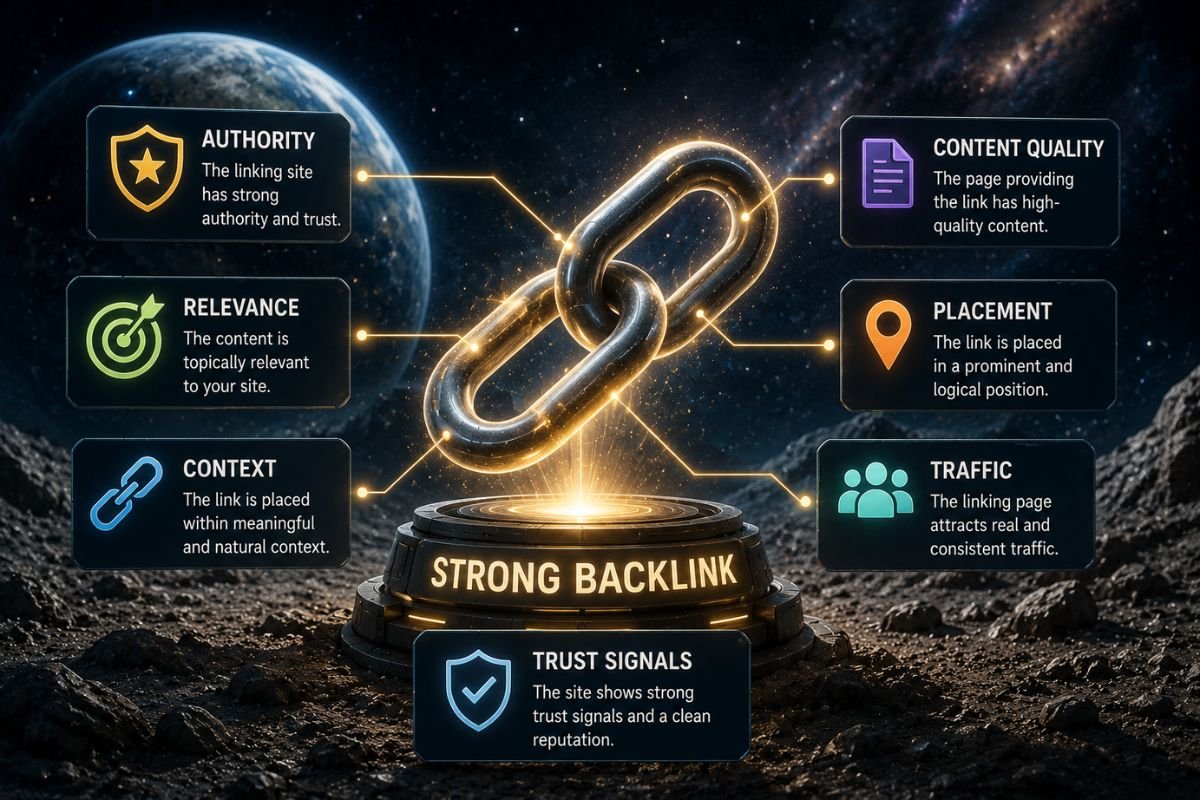

The word “strong” can be confusing when people talk about backlinks. A backlink is simply a link from another website to yours, but what would make one of those links stronger than another?
There is no single feature you can point to and say, “That makes this a strong backlink.” Instead, you need to look at several parts of the link and the page around it. Where does the link appear? What is the page discussing? Does the destination make sense for someone reading that content?
These are the kinds of characteristics commonly described in SEO as backlink quality signals. They do not form a public Google checklist, but they give us a practical way to examine why some backlinks may be more meaningful than others.
Does the Link Make Sense Where It Appears?
A useful place to start is the link itself. Imagine you are reading an article about caring for indoor plants, and one paragraph explains how much sunlight different plants need while linking to a detailed guide about choosing the right light for houseplants. You immediately understand why that link is there.
This is what contextual placement means: the backlink appears within content where the surrounding discussion helps explain its purpose. Now imagine the same link appearing in an unrelated list at the bottom of the page. It is still a backlink to the same destination, but much of the context that explained the relationship has disappeared.
Placement alone does not tell you the quality of a backlink, but it can help you understand how naturally the link fits into the page.
How Closely Are the Two Pages Related?
The next question moves beyond where the link sits and looks at what the two pages are actually about. This relationship is called topical relevance, and it becomes easier to understand with a simple example: if an article about maintaining houseplants links to a guide about plant lighting, the connection between the subjects is straightforward. If that same article suddenly links to a page about car insurance, the reason for the link is much less obvious.
That does not mean two pages must discuss exactly the same subject before a link can make sense. One page may cover a broader topic while linking to another that provides supporting information, an example, a source, or a deeper explanation, so the useful question is whether there is a reasonable relationship between what the reader is currently reading and where the link takes them.
Why Was the Link Added?
A backlink can fit naturally into a sentence and still leave another question: why is it there?
Some links exist because a writer wants to reference a source, support a statement, give an example, or direct readers to useful additional information. These are commonly described as editorial links, because including the link is part of an editorial decision about the content. This is one reason editorial backlinks are generally associated with higher quality.
The distinction is useful because Google explicitly treats links created primarily to manipulate search rankings as link spam. That does not mean we can determine the intention behind every backlink simply by looking at it, but it does give us another useful question to consider: does the link appear to serve a genuine purpose within the content, or does it seem to exist mainly for the link itself?
What About the Website Behind the Link?
The page and its context matter, but they are not the entire picture because you may also want to examine the website where the backlink appears. Is it an established source with useful content? Does the page itself appear to have a genuine purpose? Is the website meaningfully related to the subject being discussed?
SEO tools often provide domain or page metrics to make these comparisons easier, but those metrics are measurements created by the tools themselves rather than Google scores. This is why identifying high-quality backlinks usually requires looking beyond a single authority number.
What If One of These Characteristics Is Missing?
This is where backlink evaluation becomes less convenient, because real backlinks rarely fit perfectly into simple categories. A link might come from a well-known website but appear on an unrelated page, while another might come from a smaller website but sit naturally inside a highly relevant article. A backlink may also have excellent topical relevance while appearing in a less useful location on the page.
That is why one characteristic should not automatically decide whether a backlink is strong or weak. Instead of asking whether it passes a fixed checklist, look at the complete relationship: where the link appears, what surrounds it, how closely the pages are related, why the link appears to be there, and what kind of page is providing it.