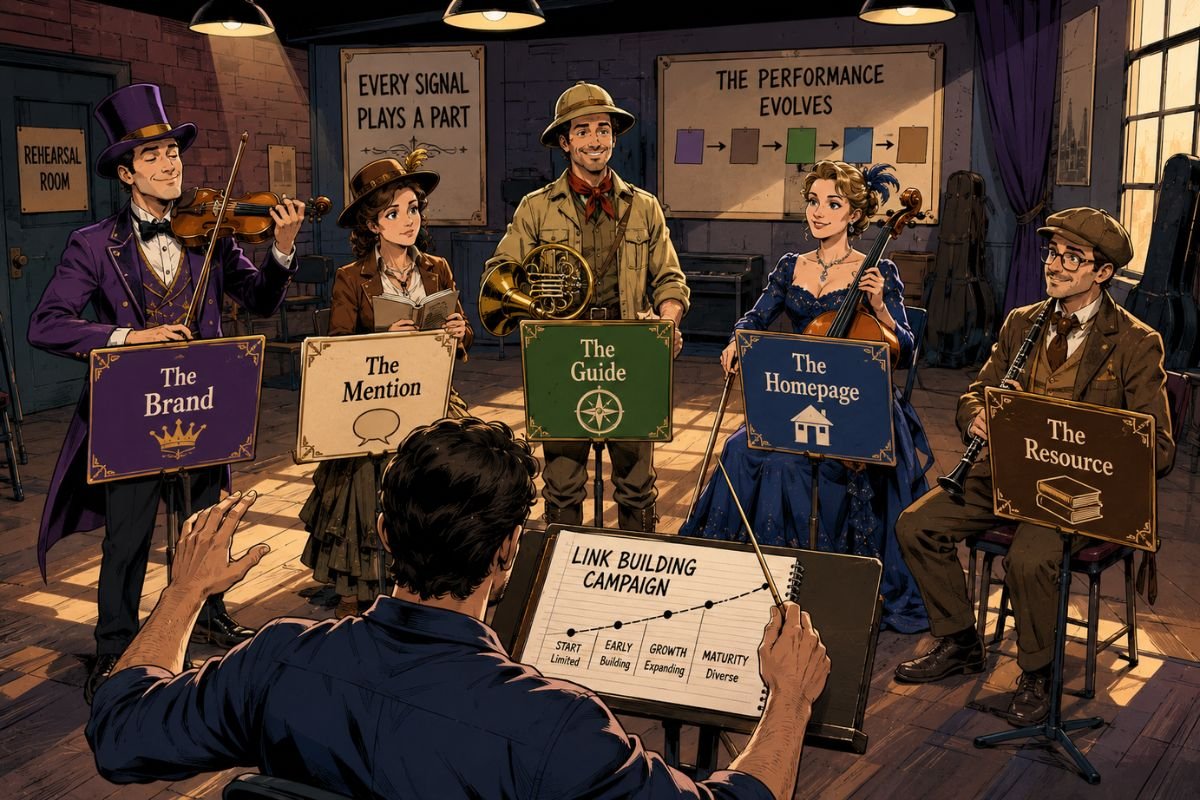

Anchor text distribution can change as a link building campaign progresses. Anchor text is the clickable wording used in a link, while anchor text distribution describes the mix of that wording across the backlinks pointing to a page. For example, some websites may link using a brand name, while others may use a descriptive phrase or the page’s URL.
As new backlinks are added, that mix can change because different websites do not necessarily use the same wording. This is why natural anchor distribution is better understood as something that can develop over time rather than as a fixed ratio that must remain the same throughout a campaign.
Early Campaigns Can Show More Concentrated Patterns
At the beginning of a link building campaign, there may be only a small number of backlinks (links from other pages or websites pointing to the page). When the total is small, just a few links using similar anchor text can make that wording look unusually common within the distribution.
Imagine that a page has ten backlinks and four use similar wording. Those four links represent 40 percent of the current distribution. If the page later receives many additional backlinks using brand names, URLs, and other phrases, the original four links remain, but they represent a smaller share of the total.
The important point is that nothing had to happen to those original links for the distribution to change. New links changed their proportion within the larger group. This is also why safe anchor diversity should not be understood only through a single snapshot of a backlink profile.
Different Sources Can Introduce Different Wording
As more backlinks are added, they may also come from different types of websites and be created by different people, each writing in their own context.
For example, an editorial article might link using a company name because it is discussing the company itself. A resource page might use a phrase describing the information being referenced. Another website may simply use the URL, while someone in a forum could link with more conversational wording.
These differences explain how anchor distribution maturity can develop as a backlink profile grows. The variation does not come simply from having a larger number of links. It can also come from having different people, websites, and contexts behind those links.
Short Term Attention Can Temporarily Change the Pattern
The distribution does not always become more varied in a straight line. A page may suddenly attract several backlinks because people are discussing the same product, event, study, or topic.
Because those new links are being created around the same subject, several publishers may use similar wording. That wording can temporarily account for a larger part of the anchor text distribution.
As later backlinks appear for other reasons, different wording may enter the profile and reduce the relative share of that earlier group. In practice, this means anchor text distribution can become more concentrated for a period and then broaden again as the reasons for linking change.
Familiarity Can Change How a Website Is Referenced
The way someone refers to a website can also depend on how much explanation the reference requires.
For example, when introducing an unfamiliar resource, a writer may use descriptive anchor text so the reader has some idea of what is behind the link. In another context, the website or brand may already be clear from the surrounding discussion, so its name or URL may be enough.
This gives us another reason anchor wording can change over time: the wording is influenced not only by the destination page, but also by the context in which another writer chooses to reference it.
Link Building Methods Can Affect Who Chooses the Anchor Text
Another difference comes from how the backlink is acquired.
Some link building methods involve direct participation, such as contributing content to another website. Other backlinks are created independently when someone discovers a page and chooses to reference it without being asked.
That distinction affects who makes the wording decision. When another publisher creates the link independently, the website receiving the backlink may have little or no influence over the anchor text they choose.
As more independent linking decisions enter the profile, the wording can become harder to predict. This is a simple way to understand the behavioral complexity that can develop when different people make linking decisions in different contexts.
These changes are why an anchor text distribution observed at one point in a campaign does not necessarily describe how it will look later. The existing links may remain exactly the same while new links change their relative proportions, their wording, and the contexts represented in the profile. This changing mix is what matters when examining how different anchor variations accumulate across a link profile.