

A backlink report shows that 40% of your links use the same phrase. Is that something you should be concerned about?
Before answering, you need to know what those numbers actually represent. Are all the links pointing to one page, or does the report combine links to your homepage with links to several different articles? That distinction matters because people may refer to your homepage by its brand name while using descriptive phrases when linking to individual guides.
This is where analyzing anchor text distribution begins. Rather than judging a percentage on its own, you examine which links belong together, how their wording compares, and where they came from. Only then can you begin to understand whether a pattern deserves closer attention.
Step 1: Collect the Anchors Pointing to the Page
Open your backlink report and select the page you want to analyze. This could be your homepage, a product page, or a particular article that has attracted links from other websites.
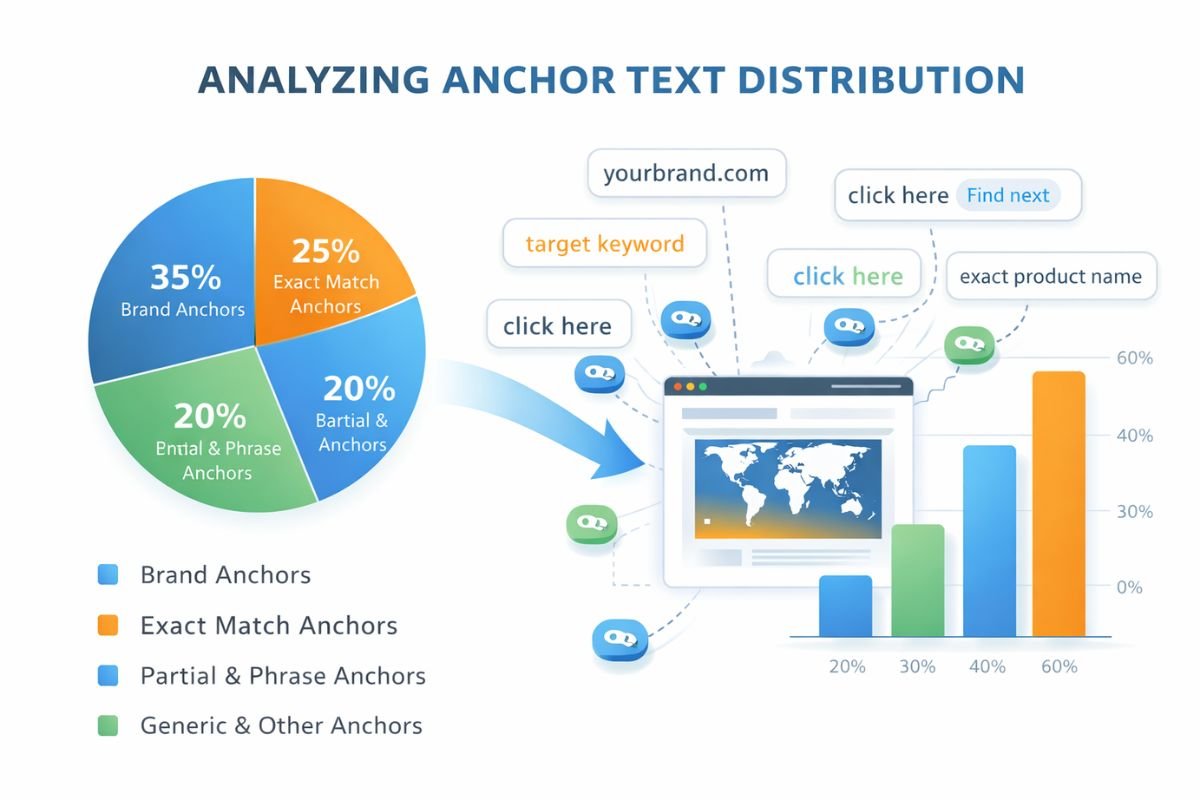
Each backlink can provide anchor text, which is the clickable wording used to link to the destination. Looking at how those words are distributed across a collection of backlinks is what we call anchor text distribution.
For example, imagine you have published a guide about growing basil indoors. Several websites link to it, but they don’t necessarily describe it in the same way. Some use the guide’s title, others mention your website’s name, and a few use different phrases about growing herbs at home.
Collecting those anchors gives you a starting point for understanding how other websites refer to that particular guide.
Keep the destination consistent throughout your analysis. Combining backlinks to the basil guide with links to your homepage could produce misleading percentages because the two pages may be referenced for different reasons.
Also, check what your backlink tool is counting. Ten backlinks from ten independent websites are not the same as ten links appearing across different pages of a single website. You can examine both individual backlinks and referring domains, but you should not mix the two counting methods when comparing percentages.
Step 2: Separate the Anchors Into Meaningful Groups
Once you’ve collected the backlinks, organize their anchor text so you can compare the wording.
Imagine your basil guide has ten backlinks from different websites. For this example, we’ll call your fictional gardening website Basil Basket.
The anchors could be distributed like this:
| Anchor wording | Number of backlinks | Share |
|---|---|---|
| “grow basil indoors” | 4 | 40% |
| “Basil Basket” | 3 | 30% |
| “indoor basil growing tips” and “basil growing advice at home” | 2 | 20% |
| https://example.com/basil-guide | 1 | 10% |
| Total | 10 | 100% |
The table makes it easier to see which wording appears most often. Four links repeat the same phrase, three identify the website, two describe the topic using different language, and one displays the page’s address.
These categories make the data easier to read, but the labels require some care. An anchor containing a brand name and a keyword could reasonably fit more than one description. For a percentage breakdown, decide how you will classify such cases and apply the same rules throughout the report.
You don’t need to turn this step into a detailed study of every anchor text type. The purpose is simply to organize the wording consistently enough to recognize which forms appear frequently and which are less common.
Step 3: Look for Repeated Words and Similar Meanings
With the anchors organized, you can begin examining where the wording becomes concentrated.
In our example, four backlinks use exactly the same phrase: “grow basil indoors.”
That repetition is easy to identify because the words are identical. But before deciding what it means, consider the destination. If the guide explains how to grow basil indoors, those words are an accurate and unsurprising description of the page.
Different writers may independently choose the same phrase simply because it communicates the subject clearly.
Different Words Can Still Describe the Same Thing
Now look at the two other descriptive anchors in the table: “indoor basil growing tips” and “basil growing advice at home.”
Neither repeats the original phrase exactly, yet both communicate closely related information.
If you counted only identical anchors, you would see four repetitions. Looking at meaning as well reveals that six of the ten backlinks describe the same general subject directly.
This is a useful distinction when examining anchor concentration. A profile can contain many different phrases while remaining focused on a narrow set of keywords or closely related meanings.
Still, that concentration is not automatically evidence of manipulation. A guide devoted to a specific topic can naturally attract links that describe that topic.
The more useful observation is that you’ve identified a group of related anchors whose sources you can now examine together.
Step 4: Check Where the Repeated Anchors Come From
Return to the four backlinks using “grow basil indoors” and open the pages containing them.
You may find that four independent gardening websites have linked to your guide while discussing how to grow herbs at home. In that situation, the repeated wording has an understandable relationship with the content surrounding each link.
But the same four anchors could also appear in nearly identical paragraphs published across unrelated websites. That would give you a different reason to investigate.
The number is unchanged. What differs is the context and the way the links may have been created.
Look at the pages containing the links and consider whether the surrounding discussion genuinely relates to the destination. Check whether the links appear naturally within the content or repeatedly in the same type of template, and whether several links come from one domain or from independent publishers.
If you know how the backlinks were acquired, that history can help explain the wording as well.
For example, a publisher who independently discovered your guide may have chosen the anchor without your involvement. A link placed through an arrangement in which you specified the exact words has a different history, even if the wording looks equally natural.
These details do not turn an anchor text report into proof of how Google evaluates each link. They help you understand what produced the pattern you’re seeing.
Step 5: Interpret the Distribution in Its Wider Context
After examining the repeated anchors and their sources, return to the overall distribution. The percentages will be easier to interpret now that you know more about the links behind them.
One of the most important details is the size of the backlink profile.
Why Small Profiles Can Show Large Percentages
Return to the basil guide with ten backlinks. Four identical anchors represent 40% of that small collection.
Now imagine the guide receives another thirty backlinks using different wording. The original four links haven’t changed, but they now represent only 10% of the forty backlinks.
Nothing needed to be edited or removed for that percentage to fall. The larger collection changed what the original four links represented.
This is why the same number of repeated anchors can look very different across websites with different backlink histories.
A relatively new website often has fewer backlinks, making its percentages more sensitive to each additional link. However, the age of a domain doesn’t tell you how many backlinks it has accumulated. An older website with only a handful of links can show the same volatility.
It also helps to understand when the links appeared.
A newly published study, product announcement, or popular article may attract several backlinks over a short period. Because publishers are discussing the same subject, some may independently choose similar wording.
Later, as the page attracts attention from different sources, other descriptions may enter the profile. The distribution can become more varied without any deliberate effort to change its composition.
The page’s purpose can influence the mix as well. A recognizable company’s homepage may receive many links using its brand name, while a detailed tutorial may attract descriptive anchors referring to its subject. As a website becomes more familiar to an audience, the way different writers refer to it may also change.
These are reasons to interpret the figures in context rather than expecting every website or page to display the same proportions.
What Can the Distribution Tell You About Rankings?
Google uses links as signals when evaluating pages, and anchor text can help describe the content of a linked destination. However, an anchor text distribution report cannot tell you how much ranking value Google assigns to a particular phrase or group of backlinks.
There is no publicly documented Google rule stating that a specific percentage of exact-match, branded, or other anchors is automatically safe or unsafe.
Google’s link-spam policies address links created primarily to manipulate search rankings, including certain practices involving optimized anchor text. That is different from saying that a particular percentage proves a violation.
An unusually concentrated pattern may give you a reason to investigate how the links were created, but it cannot establish that the concentration caused a ranking change.
By the end of your analysis, you should be able to explain which anchor phrases dominate the profile, where those backlinks come from, and whether their wording makes sense in the circumstances.