Saturday, March 21, 2026
BacklinkSense
  • Anchor Text
    • Anchor Text Context
    • Anchor Text Distribution
    • Anchor Text Strategy
    • Types of Anchor Text
  • Backlink Quality and Analysis
    • Authority and Trust Signals
    • Backlink Analysis Tools
    • Link Context
    • Link Placement
    • Link Quality Signals
    • Link Relevance
  • Link Building Basics
    • How Google Ranks Links
    • Types of Backlinks
    • What Are Backlinks
    • Why Backlinks Matter
  • Link Building Methods
    • Asset-Based Link Building
    • Content-Based Link Building
    • Digital PR and Authority Mentions
    • Passive Link Acquisition
    • Resource and Reference Links
  • Link Building Risks
    • Link Penalties
    • Link Velocity
    • Low-Quality Backlinks
    • Over-Optimized Anchor Text
    • Unnatural Link Patterns
  • Link Outreach
    • Finding Outreach Targets
    • Follow Up in Outreach
    • Outreach Email Strategies
    • Outreach Personalization
    • Relationship Based Outreach
No Result
View All Result
  • Anchor Text
    • Anchor Text Context
    • Anchor Text Distribution
    • Anchor Text Strategy
    • Types of Anchor Text
  • Backlink Quality and Analysis
    • Authority and Trust Signals
    • Backlink Analysis Tools
    • Link Context
    • Link Placement
    • Link Quality Signals
    • Link Relevance
  • Link Building Basics
    • How Google Ranks Links
    • Types of Backlinks
    • What Are Backlinks
    • Why Backlinks Matter
  • Link Building Methods
    • Asset-Based Link Building
    • Content-Based Link Building
    • Digital PR and Authority Mentions
    • Passive Link Acquisition
    • Resource and Reference Links
  • Link Building Risks
    • Link Penalties
    • Link Velocity
    • Low-Quality Backlinks
    • Over-Optimized Anchor Text
    • Unnatural Link Patterns
  • Link Outreach
    • Finding Outreach Targets
    • Follow Up in Outreach
    • Outreach Email Strategies
    • Outreach Personalization
    • Relationship Based Outreach
No Result
View All Result
BacklinkSense
No Result
View All Result
ADVERTISEMENT
Why Contextual Backlinks Are Stronger Than Non Contextual Links

Why Contextual Backlinks Are Stronger Than Non Contextual Links

Backlink Sense by Backlink Sense
March 15, 2026
in Link Context
Reading Time: 3 mins read
1
Share on FacebookShare on Twitter

Page Contents

  • 1 Contextual Backlinks Inside the Main Content
  • 2 Sidebar and Footer Links
  • 3 Related Posts
  • 4 How Surrounding Content Impacts Backlink Value
  • 5 Examples of Strong vs Weak Link Context
  • 6 Does Content Relevance around the Link Matter for SEO?
  • 7 What Is a Contextual Backlink and Why Does the Placement Matter?
  • 8 Directory Links and Listing Pages
  • 9 The Structural Difference Between Contextual and Non-Contextual Links
  • 10 Why Links Inside Content Are Often Considered Stronger
  • 11 A Practical View of Contextual Backlinks

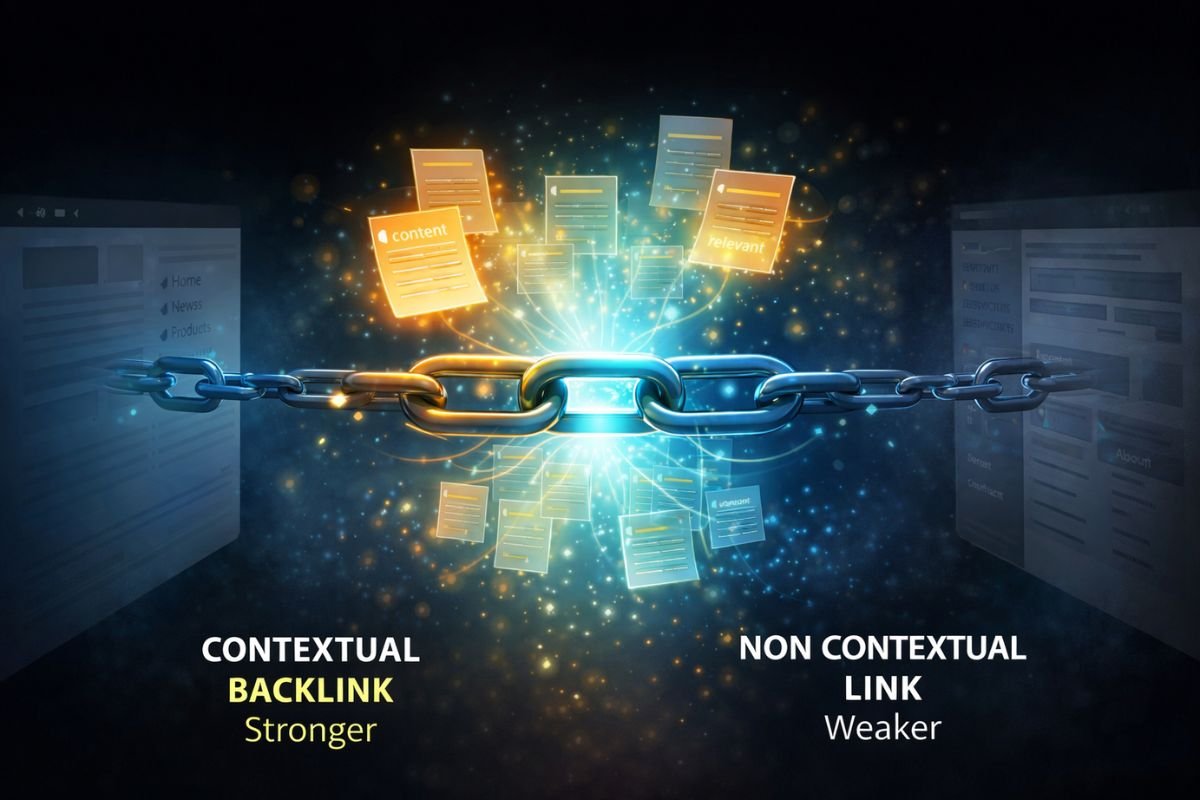
It is often considered that contextual backlinks are stronger than non contextual links because they are placed inside the main content area of a page, where the topic of the discussion is being explained.

Links placed in areas such as the sidebar, footer, or directory sections exist as part of the page structure and are not directly connected to the topic being discussed. This structural difference is one of the main reasons contextual backlinks are often viewed as stronger than non-contextual links.

Contextual Backlinks Inside the Main Content

A contextual backlink is a type of link placed inside the main content area of an article or webpage. This link appears naturally within a paragraph where a concept or topic is being discussed.

Because the link appears within the main content area, it becomes part of the explanation presented in that paragraph. The link is therefore associated with the topic being discussed in the surrounding text.

This is one of the primary reasons contextual backlinks are often considered stronger. They appear within the area of the page where the topic is being explained.

For this reason, contextual links commonly appear within blog posts, articles, guides, and other forms of content where a topic is discussed in detail.

Sidebar and Footer Links

Sidebar and footer links appear in areas that are separate from the main content of a page.

Sidebars often contain navigation items, lists of categories, recent posts, or promotional links. Footers usually contain links to policy pages, navigation pages, or partner websites.

Because these elements are often repeated across many pages of a website, the links they contain are usually part of the site’s structure rather than the main content.

As a result, these links are different from contextual backlinks. Instead of appearing within a paragraph discussing a topic, they appear within structural areas designed for navigation or layout.


Related Posts

How Surrounding Content Impacts Backlink Value

How Surrounding Content Impacts Backlink Value

March 15, 2026

Examples of Strong vs Weak Link Context

March 7, 2026

Does Content Relevance around the Link Matter for SEO?

March 6, 2026
Contextual Backlink and Why Does the Placement Matter?

What Is a Contextual Backlink and Why Does the Placement Matter?

February 9, 2026

Directory Links and Listing Pages

Directory links typically appear on pages that are designed to list websites.

These pages often contain lists of websites organized by category or industry. The main purpose of the page is to present the list of links rather than to explain a topic in detail.

Because of this structure, directory pages often contain limited surrounding text. The links are usually displayed in list or database style formats.

Although directory links may point to relevant websites, they are usually not presented as part of a discussion about the topic.

The Structural Difference Between Contextual and Non-Contextual Links

The main difference between contextual backlinks and non-contextual links is the way they appear within the structure of the webpage.

Contextual backlinks are included in the main body of the page, where the writer is discussing the subject of the content.

Non-contextual links such as those found in sidebars, footers, or directories appear in areas typically reserved for navigation, listings, or repeated structural elements.

These areas of the page serve different purposes than the main content area.

Why Links Inside Content Are Often Considered Stronger

Links placed within the main body of content are often considered stronger because of the context in which they appear.

When a link is included within the content of an article, it appears in the section where the writer is discussing the topic.

Links placed in sidebars, footers, or directories are often located alongside many other links and may be further removed from the main discussion.

However, this does not necessarily mean that all non-contextual links have little value. The difference is that links inside the main content are typically closer to the subject being discussed.

Because of this contextual relationship, contextual backlinks are often considered more valuable within the structure of a webpage.

A Practical View of Contextual Backlinks

One of the most noticeable characteristics of contextual backlinks is their location within the main body of a page’s content.

Contextual links appear within the main content where the topic is explained, while non-contextual links appear in other areas such as sidebars, footers, or directory-style pages.

This structural difference is what distinguishes contextual backlinks from other types of links on the web.

Tags: Link TypesSEO ConceptsSEO fundamentals
ShareTweetPin

Related Posts

Asset-Based Link Building

Are Free Tools the Best Type of Linkable Asset?

by Backlink Sense
March 19, 2026
0

While free tools have the potential to garner a large amount of backlinks in...

Read moreDetails

What Is Link Relevance in SEO?

March 19, 2026

Does Industry Relevance Impact Link Value?

March 19, 2026

Are Niche Relevant Backlinks Better for Rankings?

March 19, 2026

Leave a Reply Cancel reply

Your email address will not be published. Required fields are marked *

  • About Us
  • Terms of Use
  • Use of Cookies
  • Affiliate Disclosure
  • Contact
  • Privacy Policy
2026 BacklinkSense © All rights reserved.

Welcome Back!

Login to your account below

Forgotten Password?

Retrieve your password

Please enter your username or email address to reset your password.

Log In

Accessibility Toolbar

  • Powered with favoriteLove by Codenroll
No Result
View All Result
  • Anchor Text
    • Anchor Text Context
    • Anchor Text Distribution
    • Anchor Text Strategy
    • Types of Anchor Text
  • Backlink Quality and Analysis
    • Authority and Trust Signals
    • Backlink Analysis Tools
    • Link Context
    • Link Placement
    • Link Quality Signals
    • Link Relevance
  • Link Building Basics
    • How Google Ranks Links
    • Types of Backlinks
    • What Are Backlinks
    • Why Backlinks Matter
  • Link Building Methods
    • Asset-Based Link Building
    • Content-Based Link Building
    • Digital PR and Authority Mentions
    • Passive Link Acquisition
    • Resource and Reference Links
  • Link Building Risks
    • Link Penalties
    • Link Velocity
    • Low-Quality Backlinks
    • Over-Optimized Anchor Text
    • Unnatural Link Patterns
  • Link Outreach
    • Finding Outreach Targets
    • Follow Up in Outreach
    • Outreach Email Strategies
    • Outreach Personalization
    • Relationship Based Outreach

2026 BacklinkSense © All rights reserved.

This website uses cookies to improve your experience and analyze site performance. By continuing to browse, you agree to our Privacy and Cookie Policy.