

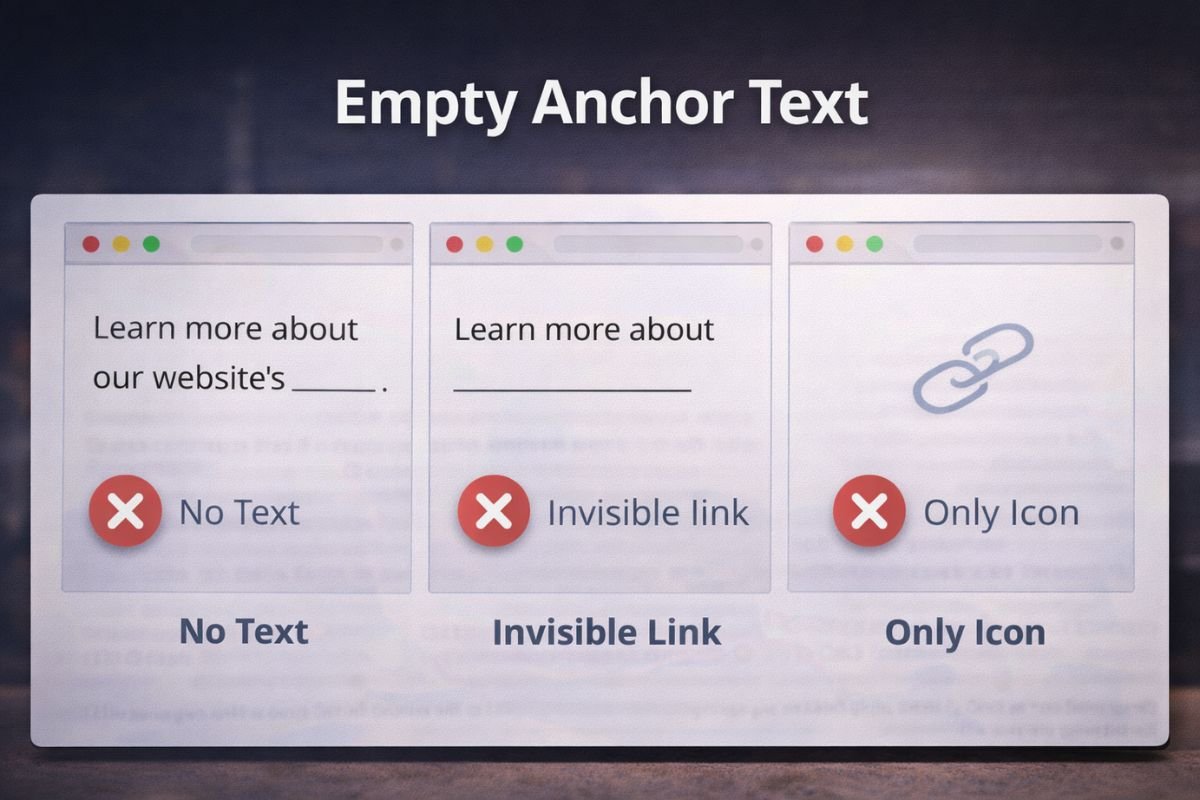

Empty anchor text refers to links that contain no visible text inside the anchor element. Instead of a word or phrase acting as the clickable part of the link, the anchor may contain an icon, a button, or no readable content at all.
In these situations, the link still exists in the page’s HTML structure, but there is no textual phrase describing the destination.
Because anchor text normally helps indicate what a link points to, empty anchors provide little or no direct textual context.
How Empty Anchor Text Appears on a Page
Empty anchor text often appears in interfaces where links are represented visually rather than through written text.
Common examples include:
- navigation icons
- social media icons
- clickable buttons
- decorative interface elements
- links wrapping images or symbols
For instance, a website may display a small envelope icon that links to a contact page. The clickable element is the icon itself, not a written phrase like “contact us.”
Similarly, many sites include rows of social media icons linking to platforms such as Instagram, LinkedIn, or YouTube. Each icon is a link, but there may be no visible text within the anchor.
Examples of Empty Anchor Links
An empty anchor may appear in different forms within a page structure.
Some links contain only an icon inside the anchor tag.



Others contain a button element or a graphical symbol.
In certain cases, the anchor element may technically contain no content at all and instead relies entirely on CSS styling or JavaScript to create the clickable area.
Despite these variations, the defining characteristic remains the same: the link has no visible text describing its destination.
Why Empty Anchors Exist
Empty anchors often appear because designers prioritize visual elements in navigation or interface design.
Icons and buttons can communicate meaning quickly without requiring written labels. This is especially common in modern user interface design, where compact visual elements are used to keep layouts clean, unlike visible URL references that rely on the address itself to communicate the destination.
For example, a magnifying glass icon may represent search functionality, while a shopping cart icon may represent a checkout page.
These design patterns rely on visual recognition rather than written text.
As a result, the underlying link may not include anchor text.
How Search Engines Interpret Empty Anchor Text
Search engines analyze anchor text to understand the relationship between a linking page and the destination page.
When anchor text is missing, the search engine cannot rely on that signal to interpret the link.
Instead, the algorithm looks at other surrounding signals to understand the link’s meaning.
These signals can include:
- the surrounding text on the page
- the page title of the destination
- the context of the surrounding content
- the attributes associated with the element
If the link wraps an image, the alt text of the image may help provide descriptive context.
If the link contains an icon or button, the system may rely on nearby text or structural signals to interpret the purpose of the link.
Because empty anchors lack descriptive wording, they typically carry less direct semantic information than anchors that contain text.
Conclusion
Empty anchor text is primarily a technical interface pattern, not a linking strategy.
It usually appears in navigation components, interactive buttons, and icon based links rather than in editorial content.
Since these links do not include descriptive phrases, they provide limited keyword or topical information.
Search engines therefore depend on the broader page context to understand their meaning.
While empty anchors function normally for navigation and interface design, they also show how links can still carry meaning through images used as anchors across the web.