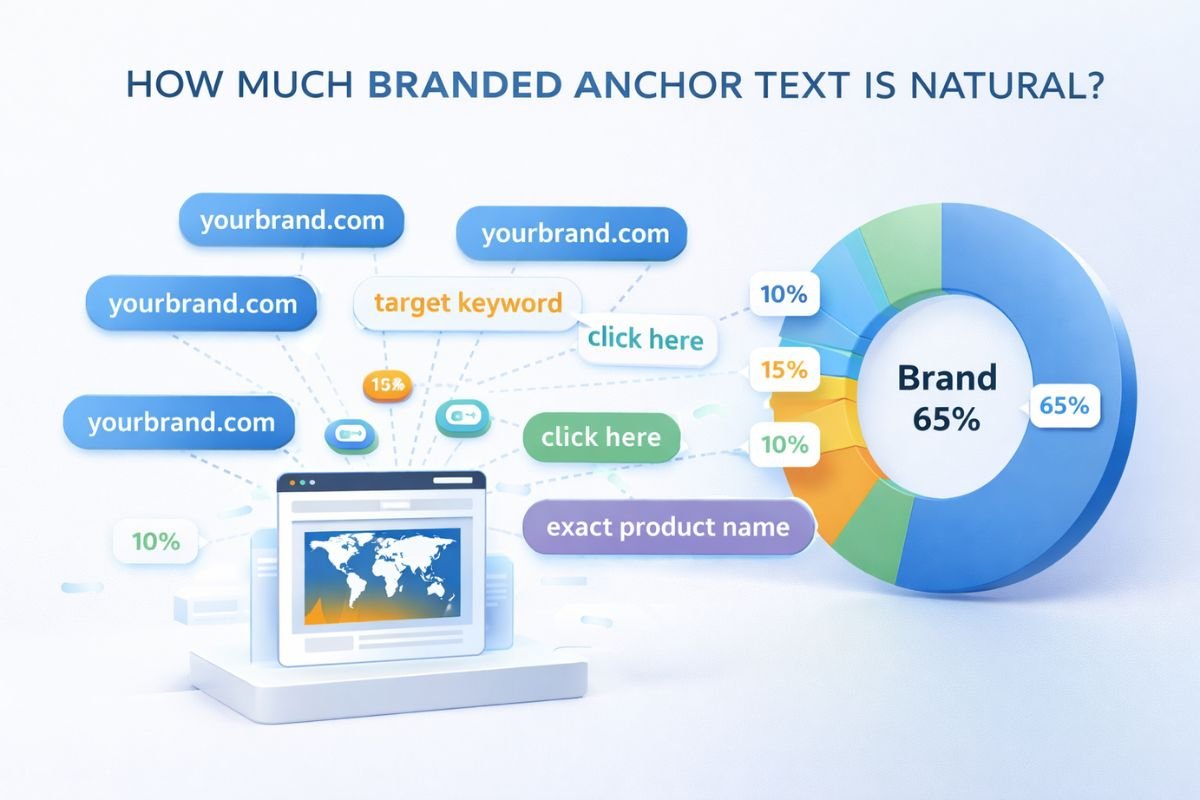

When someone mentions a company, publication, or platform, the most natural way to link to it is by using the brand name itself. For this reason, branded anchors are often the most common anchor type in natural backlink profiles.
Rather than being an exception, branded anchors usually form the foundation of how links appear across the web.
Understanding this requires looking at why branded anchors appear so often in backlink profiles.
Why Branded Anchors Form the Foundation of Natural Profiles
Branded anchors appear frequently because they reflect the natural way people reference sources.
When writers mention a company, publication, or platform, the brand name is typically already part of the sentence. Turning that mention into a link requires no structural change to the sentence.
This makes branded anchors a natural outcome of writing rather than a deliberate optimization choice, especially when using brand-based anchors.
Because many references to websites begin with the brand name, branded anchors naturally accumulate in backlink profiles over time.
Why Branded Anchors Appear Frequently in Real Link Profiles
The frequency of branded anchors is largely a result of how information flows across the web.
People link to sources when referencing companies, tools, research, or publications. In many of these situations, the brand name is already present in the sentence. Turning that name into a link simply converts an existing reference into a clickable citation.



Over time, these references accumulate. As more articles mention the same brand, the number of branded anchors pointing to that site increases.
This is particularly common for sites that publish research, tools, or informational content that other writers frequently cite.
The more often a brand is mentioned, the more opportunities exist for branded links to appear.
How Branded Anchors Emerge Naturally
Branded anchors usually emerge as a byproduct of writing rather than as a deliberate linking decision.
A writer may be discussing a topic and choose to reference another article, company, or resource related to that subject. When explaining the reference, the brand name naturally appears in the sentence.
Once the brand name is present, turning it into a link becomes the simplest way to provide a reference.
This mirrors the original function of hyperlinks within written content. Links were designed to act as references embedded within language, allowing readers to access additional information connected to the topic being discussed.
Brand Recognition and Link Language
Brand recognition also contributes to the frequency of branded anchors.
When a brand is widely recognized within a field, mentioning the brand name becomes a clear and efficient way to reference a source. Readers already associate the name with a specific publication, platform, or organization.
Using the brand name as the anchor, therefore provides clarity for the reader. The reference is immediately understood as pointing to a specific entity.
As recognition increases, writers become more comfortable referencing the brand directly. These references often appear across many independent sites and publications.
Over time, this repeated referencing produces a large number of branded anchors within the backlink profile, which can be a sign of imbalance.
Why Branded Anchors Signal Natural Referencing Behavior
Search engines analyze patterns in how links appear across the web. Branded anchors often resemble natural citation behavior because they originate from independent sources referencing the same entity.
Each link is created within its own environment, written by different authors and embedded within different contexts. This diversity reflects how brands are mentioned in real discussions across the internet.
Because these references occur naturally and across many sources, branded anchors tend to form a stable component of backlink profiles.
Branded Anchors as a Common Reference Pattern
Branded anchors are one of the most common reference patterns found on the web. Writers frequently mention organizations, tools, publications, and platforms as part of their explanations.
When these references are linked, the brand name naturally becomes the anchor text.
Over time, these references appear across many different sources and environments, illustrating how anchors are selected in context. The backlink profile begins to reflect a repeated pattern of brand mentions converted into links.
This pattern mirrors how information spreads online. People reference sources they trust, and those references often become hyperlinks within the content.
For this reason, branded anchor text remains one of the most predictable and stable elements of a natural backlink profile.