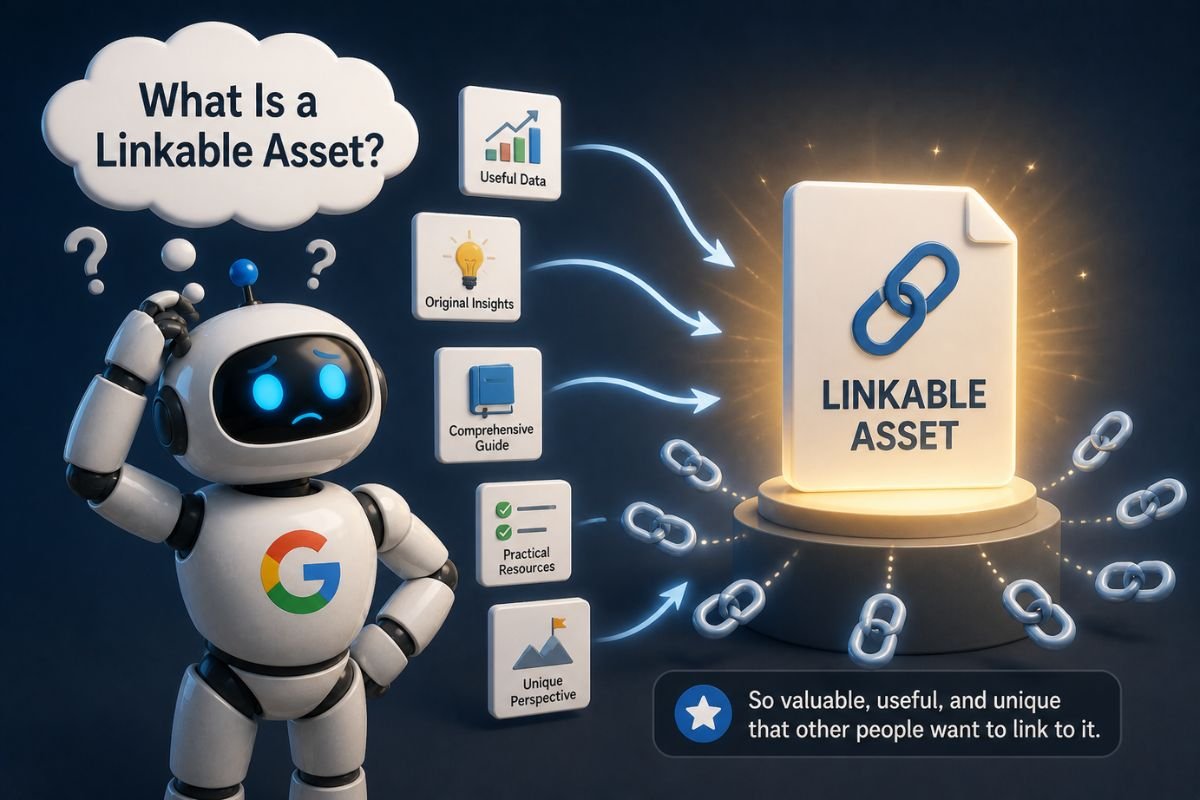

A linkable asset is a page or resource that gives other websites a clear reason to link to it.
The term may sound complicated, but the idea behind it is simple.
Someone writing an article may need something they do not have on their own page. They might need a statistic to support a point, a tool their readers can use, or a helpful resource that explains part of the subject in more detail.
If your website provides what they need, they may link to your page so their readers can use it too.
That page can become a linkable asset.
So when you hear the term linkable asset, think of a page that gives another website a useful reason to send its readers there.
What Can Be a Linkable Asset?
There is no single format a linkable asset has to follow.
It could be original research that provides new information, a calculator that helps people work something out, a collection of resources that saves people from searching in many different places, or a visual that makes complicated information easier to understand.
Even a detailed guide can become a linkable asset when it provides something that other writers want their readers to see.
This means you do not need to choose a particular content format simply because it is commonly used for link building. What matters is whether the resource provides something people are likely to need when creating or reading other content.
How Is a Linkable Asset Different From a Regular Article?
This difference becomes easier to see with a simple situation.
Imagine an article explaining how exchange rates work. The article might answer the reader’s questions perfectly.
Next to it is a currency converter. Instead of explaining exchange rates, the converter lets people enter an amount and see its value in another currency.
Both pages can be useful, but they are useful in different ways.
The first page mainly provides an explanation. The second performs a task that another article may not be able to provide on its own.
That gives a writer a practical reason to send readers to the converter.
The distinction is not absolute. A regular article can also attract backlinks, and a detailed guide can itself become a linkable asset. The important difference is that a linkable asset provides something another page may benefit from referring readers to.
Common Types of Linkable Assets
Once the idea is clear, the different types become much easier to recognize.
| Type | What does it provide? | A simple example |
|---|---|---|
| Original research | Information people can reference | A survey showing how people use social media |
| Free tool | A way to complete a task | A currency converter |
| Chart or visual | An easier way to see information | A chart showing how prices changed over time |
| Resource collection | Information gathered in one place | A collection of free language-learning resources |
| Detailed guide | A deeper explanation of a subject | A step-by-step guide to completing a difficult task |
These formats work in different ways. Research can provide evidence, while a free tool can help someone complete a task.
A resource collection can save searching time, while a detailed guide can give another writer somewhere to send readers who need more information than their own article provides.
The format changes because the need changes.
Why Would Another Website Link to One?
A backlink usually needs a purpose within the page where it appears.
Consider a writer who says that a certain percentage of people use a particular social media platform. Readers may reasonably want to know where that number came from. Linking to the original research gives them a way to check the source.
Now consider a tutorial that asks readers to convert a measurement. A link to a calculator gives them a way to do it.
The purpose of the link is different in each case, but both links help the page do something it could not do as easily on its own.
This is why simply publishing more content does not necessarily create a strong linkable asset. The page needs to provide something that fits naturally into situations where another website may want to reference, show, calculate, check, or explain something.
Does a Linkable Asset Have to Be Original?
Not always.
Original information can provide a strong reason for people to reference the source because they cannot find exactly the same information somewhere else. A survey your company conducted is one example.
But originality can also come from what the resource allows people to do.
A calculator may use a calculation that is already widely known. Its value can come from making that calculation quick and easy for the user.
A resource collection may contain information that already exists elsewhere. Its value can come from organizing that information so people do not have to find every part separately.
So creating a linkable asset does not always mean inventing something completely new. Sometimes it means making existing information much easier to use.
Does Creating a Linkable Asset Guarantee Backlinks?
No.
You can create an excellent calculator, study, guide, or visual and still receive no backlinks.
Other websites first need to discover the resource. It also needs to be relevant to what they are writing, and they still decide whether linking to it would help their readers.
This distinction matters because linkable does not mean guaranteed to get links.
The word describes the potential of the resource. It has characteristics that can give other websites a reason to link, but the backlink only exists when another website actually chooses to create it.
What Makes an Asset More Likely to Earn Links?
Start by asking what someone else would actually come to the page for.
Would they find a number they can use as evidence? Can they complete a task? Can they understand something more easily? Can they find information that would otherwise take much longer to collect?
A clear answer to one of those questions is more important than making the page look like a particular type of linkable asset.
This is also why successful linkable assets can look very different from one another. A research study and a calculator may have almost nothing in common visually, yet each can provide something another page cannot easily provide by itself.
That is the simplest way to think about a linkable asset: not as a special kind of SEO page, but as a resource that another website has a genuine reason to use or reference.