
Monday, July 27, 2026
BacklinkSense
  • Anchor Text
    • Anchor Text Context
    • Anchor Text Distribution
    • Anchor Text Strategy
    • Types of Anchor Text
  • Backlink Quality and Analysis
    • Authority and Trust Signals
    • Backlink Analysis Tools
    • Link Context
    • Link Placement
    • Link Quality Signals
    • Link Relevance
  • Link Building Basics
    • How Google Ranks Links
    • Types of Backlinks
    • What Are Backlinks
    • Why Backlinks Matter
  • Link Building Methods
    • Asset-Based Link Building
    • Content-Based Link Building
    • Digital PR and Authority Mentions
    • Passive Link Acquisition
    • Resource and Reference Links
  • Link Building Risks
    • Link Penalties
    • Link Velocity
    • Low-Quality Backlinks
    • Over-Optimized Anchor Text
    • Unnatural Link Patterns
  • Link Outreach
    • Finding Outreach Targets
    • Follow Up in Outreach
    • Outreach Email Strategies
    • Outreach Personalization
    • Relationship Based Outreach
No Result
View All Result
  • Anchor Text
    • Anchor Text Context
    • Anchor Text Distribution
    • Anchor Text Strategy
    • Types of Anchor Text
  • Backlink Quality and Analysis
    • Authority and Trust Signals
    • Backlink Analysis Tools
    • Link Context
    • Link Placement
    • Link Quality Signals
    • Link Relevance
  • Link Building Basics
    • How Google Ranks Links
    • Types of Backlinks
    • What Are Backlinks
    • Why Backlinks Matter
  • Link Building Methods
    • Asset-Based Link Building
    • Content-Based Link Building
    • Digital PR and Authority Mentions
    • Passive Link Acquisition
    • Resource and Reference Links
  • Link Building Risks
    • Link Penalties
    • Link Velocity
    • Low-Quality Backlinks
    • Over-Optimized Anchor Text
    • Unnatural Link Patterns
  • Link Outreach
    • Finding Outreach Targets
    • Follow Up in Outreach
    • Outreach Email Strategies
    • Outreach Personalization
    • Relationship Based Outreach
No Result
View All Result
BacklinkSense
No Result
View All Result

Home - Link Building Risks - Low-Quality Backlinks - Can Competitors Create Damaging Backlinks?

Can Competitors Create Damaging Backlinks?

Backlink Sense by Backlink Sense
July 27, 2026
in Low-Quality Backlinks
Reading Time: 3 mins read
Share On FacebookShare On Reddit

Page Contents

  • 1. Why Negative SEO Is a Valid Concern
  • 2. What Can Search Algorithms Do With Suspicious Backlinks?
  • 3. Related Posts
  • 4. Can You Remove Backlinks?
  • 5. It Is Often Simpler To Ignore Than To Punish
  • 6. Receiving a Backlink Does Not Always Mean Creating It
  • 7. Risks Should Be Viewed Realistically
  • 8. How the Modern Approach Protects Rankings
  • 9. Backlink Attacks and Ranking Damage Are Different Things

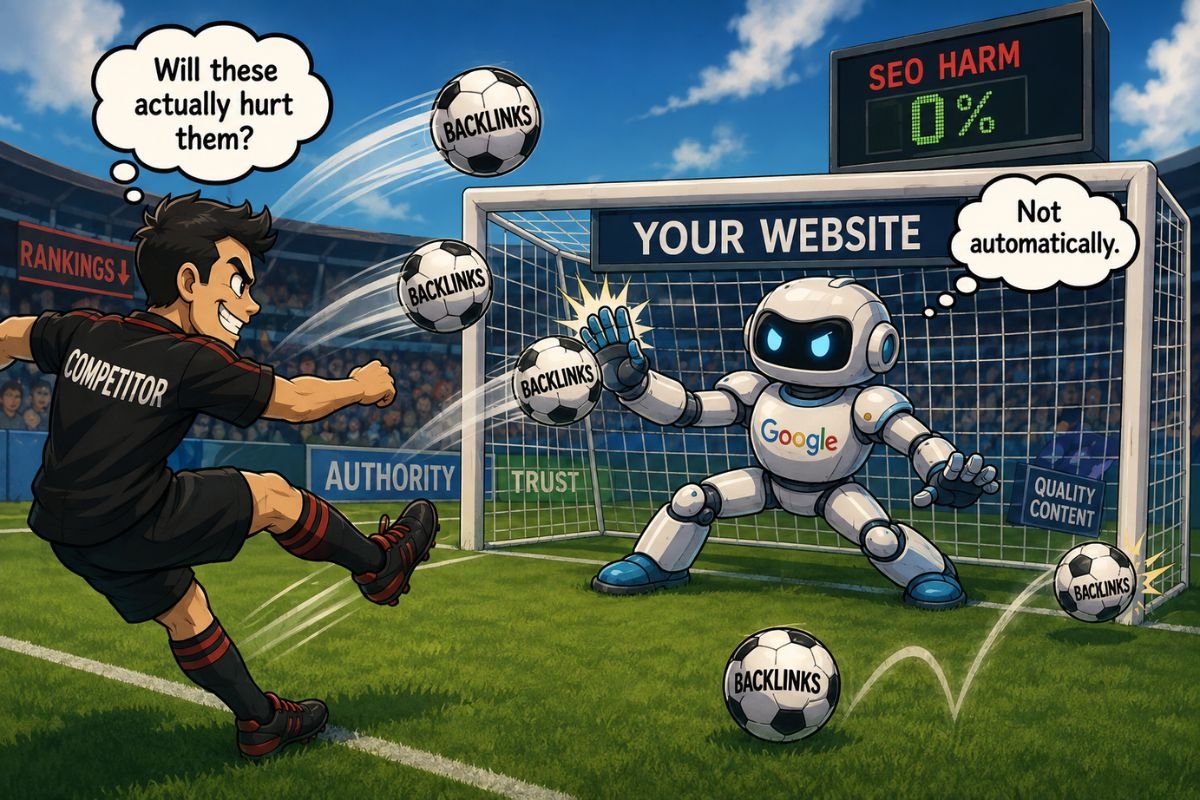
While competitors can create backlinks that point to another website, it doesn’t automatically mean that such backlinks will cause SEO harm.

Modern search algorithms seem increasingly interested in evaluating the quality and credibility of backlink signals rather than treating every incoming link as equally influential. It means that there can be many low-quality third-party backlinks that simply provide no SEO value.

There are important differences between the existence of backlinks that appear suspicious and their actual ability to cause damage.

Why Negative SEO Is a Valid Concern

There is nothing new about the concept of negative SEO.

Website owners often assume that competitors can create many low-quality backlinks to damage their rankings.

This concern seems logical since backlinks still play an important role in how search algorithms understand relationships across the web.

If every incoming link affected rankings in the same way, pointing low-quality links at competitors’ websites would become an effective method of manipulating search results.

Modern search algorithms are clearly designed to prevent that.

What Can Search Algorithms Do With Suspicious Backlinks?

Search algorithms don’t simply count backlinks.

They seem able to evaluate whether an incoming link provides meaningful information.

Related Posts

Can You Remove Backlinks?

Can You Remove Backlinks?

February 8, 2026

If a backlink lacks context, editorial value, structure, or other elements that contribute to interpretation, its significance may already be minimal before it influences rankings.

Such an approach helps separate meaningful backlinks from weaker ones.

Unlike many years ago, modern search algorithms appear much more selective in this respect.

It Is Often Simpler To Ignore Than To Punish

There is another reason why modern search algorithms are more resilient when handling backlinks.

There are millions of backlinks pointing to websites without the website owners requesting or controlling them.

Treating all these links as evidence against the receiving website would create unnecessary instability in search results.

Instead, search algorithms seem able to minimize the influence of such backlinks.

This approach is more balanced than punishing websites based on the assumption of malicious intent behind every suspicious backlink.

Receiving a Backlink Does Not Always Mean Creating It

Another important factor is that websites do not control who creates backlinks pointing to them.

Whether a competitor, a scraper, an abandoned website, or an unrelated directory creates a backlink, the receiving website has nothing to do with it.

Search algorithms appear to recognize this.

Receiving a backlink does not mean creating it.

This understanding helps make modern backlink evaluation easier to understand, since it focuses primarily on the credibility of the relationship across the web.

Risks Should Be Viewed Realistically

This does not mean that search algorithms ignore all backlinks or never take them into account.

However, it suggests that the idea of easily damaging rankings simply by creating random low-quality backlinks is often exaggerated.

Search algorithms seem increasingly capable of distinguishing between relationships that deserve consideration and those providing little or no value.

From this perspective, the actual risk of being harmed by poor-quality backlinks appears much lower than many older SEO discussions suggest.

There is always a possibility of receiving poor-quality backlinks, but the likelihood that every such backlink will lead to ranking harm appears much smaller.

How the Modern Approach Protects Rankings

This broader approach to backlink evaluation appears designed to protect ranking systems from unreliable signals.

Instead of treating every backlink in the same way, search algorithms seem to evaluate whether the relationship deserves consideration.

This approach contributes to more stable search results.

If low-quality third-party backlinks automatically caused severe negative effects, search rankings would become much easier for competitors to manipulate.

Selective evaluation helps solve this problem by emphasizing trustworthy relationships while giving little weight to untrustworthy ones.

Backlink Attacks and Ranking Damage Are Different Things

It is possible for someone to create poor-quality backlinks pointing to another website.

However, this does not necessarily mean that ranking damage will occur.

Modern search algorithms appear focused on evaluating the credibility of the available evidence.

This distinction separates the existence of a backlink attack from its actual effect on rankings.

Tags: algorithmic penaltybacklink analysisNegative SEOSearch signalsSEO fundamentalsSEO risk management
ShareShareShareShareSend

Related Posts

Illustration showing why Google uses multiple link signals, with a team evaluating site credibility, topical fit, content environment, source strength, and position value before making a final backlink assessment.
How Google Ranks Links

Why Google Uses Multiple Link Signals

by Backlink Sense
July 12, 2026
How to Create Content That Earns Backlinks Naturally?
Content-Based Link Building

How to Create Content That Earns Backlinks Naturally?

by Backlink Sense
February 13, 2026
Google-inspired robot examining a backlink patient by analyzing relevance, authority, trust, and context to illustrate why search engines rely on multiple signals.
Link Quality Signals

Explanation on Why Search Engines Rely on Multiple Signals When Evaluating Backlinks

by Backlink Sense
June 22, 2026
Website Authoritative for Backlinks
Authority and Trust Signals

What Makes a Website Authoritative for Backlinks?

by Backlink Sense
April 23, 2026
Person evaluating a puzzle piece to illustrate whether irrelevant links have any SEO benefits by considering relevance, authority, trust, context, and traffic signals
Link Relevance

Do Irrelevant Links Have Any SEO Benefits?

by Backlink Sense
June 23, 2026
Load More
  • About Us
  • Terms of Use
  • Use of Cookies
  • Affiliate Disclosure
  • Contact
  • Privacy Policy
2026 BacklinkSense © All rights reserved.

Welcome Back!

Login to your account below

Forgotten Password?

Retrieve your password

Please enter your username or email address to reset your password.

Log In

Accessibility Toolbar

  • Powered with favoriteLove by Codenroll
No Result
View All Result
  • Anchor Text
    • Anchor Text Context
    • Anchor Text Distribution
    • Anchor Text Strategy
    • Types of Anchor Text
  • Backlink Quality and Analysis
    • Authority and Trust Signals
    • Backlink Analysis Tools
    • Link Context
    • Link Placement
    • Link Quality Signals
    • Link Relevance
  • Link Building Basics
    • How Google Ranks Links
    • Types of Backlinks
    • What Are Backlinks
    • Why Backlinks Matter
  • Link Building Methods
    • Asset-Based Link Building
    • Content-Based Link Building
    • Digital PR and Authority Mentions
    • Passive Link Acquisition
    • Resource and Reference Links
  • Link Building Risks
    • Link Penalties
    • Link Velocity
    • Low-Quality Backlinks
    • Over-Optimized Anchor Text
    • Unnatural Link Patterns
  • Link Outreach
    • Finding Outreach Targets
    • Follow Up in Outreach
    • Outreach Email Strategies
    • Outreach Personalization
    • Relationship Based Outreach

2026 BacklinkSense © All rights reserved.

This website uses cookies to improve your experience and analyze site performance. By continuing to browse, you agree to our Privacy and Cookie Policy.