
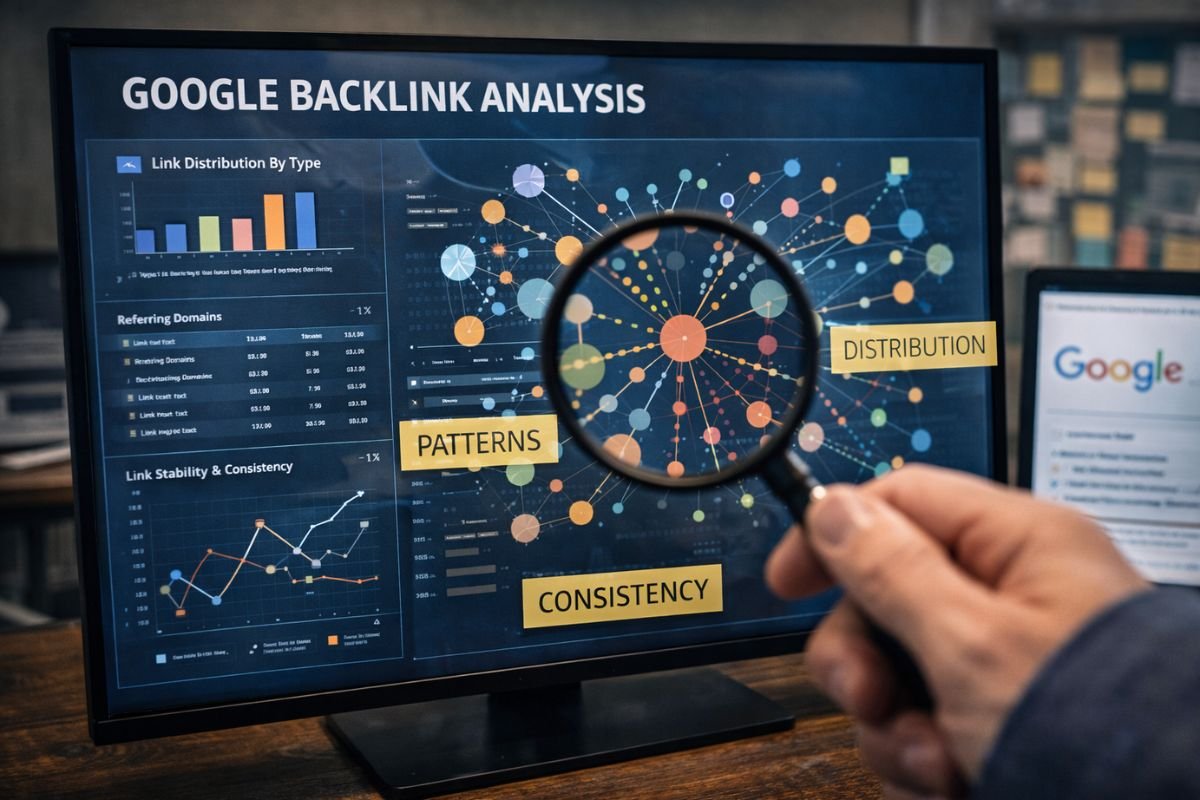

Google does not evaluate backlinks individually. Instead, it looks at backlink patterns, their distribution, and their behavioral consistency. Backlinks are evaluated relationally, not mechanically.
What Is Google’s Interpretation of Backlinks?
Google interprets backlinks as part of a broader system that includes content quality, topical distribution, and entity relationships. The pattern of backlinks plays a central role in determining their weight.
How Google Interprets Backlinks
A single backlink is not a determining factor in visibility. Google evaluates backlinks as a network rather than as isolated events.
The backlink network structure includes:
-
Referring domains
-
Interlinking relationships
-
Anchor text usage
-
Topical distribution
-
Temporal patterns
Evaluation focuses on how domains behave together over time rather than how any one link behaves in isolation.


Anchor Text as a Pattern
Anchor text is one of the most visible elements in a backlink pattern. However, it is not assessed independently.
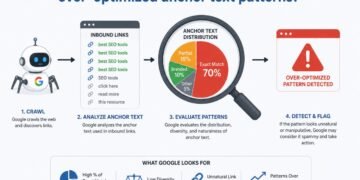
Google evaluates anchor text distribution by examining:
-
Diversity
-
Frequency concentration
-
Repetition patterns
-
Commercial usage
The issue is not the presence of exact match anchors. The issue is anchor distribution integrity. Patterns that resemble editorial independence are more credible than repetitive concentration.
Domain Relationships and Clustering
Google analyzes how linking domains relate to one another. Patterns that may influence interpretation include shared ownership signals, similar hosting environments, repeated cross-linking between small groups of domains, or sudden clusters of structurally similar sites.
When backlinks originate from independent domains with distinct structures and voices, the pattern appears more organic. Network diversity strengthens credibility.
Topical Coherence
Temporal Growth Patterns
Google also evaluates backlink development over time. This includes rate of acquisition, consistency, spikes, and correlation with publishing activity. Gradual growth aligned with content production appears natural. Sudden spikes without visible context may raise scrutiny. Velocity alone is not decisive; context determines interpretation.
When link acquisition aligns with media exposure or increased visibility, the pattern is more coherent. When growth lacks any observable trigger, interpretation may shift, time is embedded into evaluation.
Link Placement and Contextual Signals
Google evaluates not only the presence of links but also their placement. Contextual links embedded within relevant paragraphs provide clearer relational meaning than sitewide, template-based, or repetitive structural links, because context clarifies intent.
Independence and Coordination
One of the core aspects of backlink evaluation is independence.
Independence may appear as:
-
Varied anchor phrasing
-
Diverse placement contexts
-
Different linking frequencies
Coordination may appear as:
-
Repetitive anchors
-
Similar structural placements
-
Tight domain clusters
Pattern recognition systems are designed to detect uniformity among actors who would otherwise behave independently. Independence supports trust modeling. Coordination weakens it.
Signals, Not Secrets
The evaluation process is not secret in principle, even if exact weighting is undisclosed. Interpretation has evolved from simple counting to pattern recognition.
Key signal categories include:
-
Anchor diversity
-
Domain authority signals
-
Topical alignment
-
Consistency
-
Structural integration
-
Independence
These signals are not isolated. They are interpreted in relation to broader web behavior.
When Patterns Trigger Risk
Risk does not stem from a single link but from abnormal distribution. Heavy anchor concentration, structurally related domain clusters, synchronized growth, or repetitive placement patterns may shift interpretation toward manipulation. Even links from strong domains may send weaker signals if patterns appear transactional rather than editorial.
Backlinks in the Larger Ranking System
Backlink patterns are evaluated alongside content quality, technical structure, internal linking, user interaction patterns, and entity recognition. A strong backlink pattern reinforces existing strengths but does not compensate for structural weaknesses.
A Structural View
So, how does Google assess backlink patterns?
Through relational modeling, semantic clustering, temporal analysis, and distribution analysis. It is not about how many links exist, but how they behave collectively across domains.
Patterns that reflect independence, topical consistency, and organic growth appear more natural. Patterns marked by concentration, coordination, and structural repetition lean toward risk. The distinction between link counting and link interpretation explains how authority builds over time.