
Thursday, July 16, 2026
BacklinkSense
  • Anchor Text
    • Anchor Text Context
    • Anchor Text Distribution
    • Anchor Text Strategy
    • Types of Anchor Text
  • Backlink Quality and Analysis
    • Authority and Trust Signals
    • Backlink Analysis Tools
    • Link Context
    • Link Placement
    • Link Quality Signals
    • Link Relevance
  • Link Building Basics
    • How Google Ranks Links
    • Types of Backlinks
    • What Are Backlinks
    • Why Backlinks Matter
  • Link Building Methods
    • Asset-Based Link Building
    • Content-Based Link Building
    • Digital PR and Authority Mentions
    • Passive Link Acquisition
    • Resource and Reference Links
  • Link Building Risks
    • Link Penalties
    • Link Velocity
    • Low-Quality Backlinks
    • Over-Optimized Anchor Text
    • Unnatural Link Patterns
  • Link Outreach
    • Finding Outreach Targets
    • Follow Up in Outreach
    • Outreach Email Strategies
    • Outreach Personalization
    • Relationship Based Outreach
No Result
View All Result
  • Anchor Text
    • Anchor Text Context
    • Anchor Text Distribution
    • Anchor Text Strategy
    • Types of Anchor Text
  • Backlink Quality and Analysis
    • Authority and Trust Signals
    • Backlink Analysis Tools
    • Link Context
    • Link Placement
    • Link Quality Signals
    • Link Relevance
  • Link Building Basics
    • How Google Ranks Links
    • Types of Backlinks
    • What Are Backlinks
    • Why Backlinks Matter
  • Link Building Methods
    • Asset-Based Link Building
    • Content-Based Link Building
    • Digital PR and Authority Mentions
    • Passive Link Acquisition
    • Resource and Reference Links
  • Link Building Risks
    • Link Penalties
    • Link Velocity
    • Low-Quality Backlinks
    • Over-Optimized Anchor Text
    • Unnatural Link Patterns
  • Link Outreach
    • Finding Outreach Targets
    • Follow Up in Outreach
    • Outreach Email Strategies
    • Outreach Personalization
    • Relationship Based Outreach
No Result
View All Result
BacklinkSense
No Result
View All Result

Home - Backlink Quality and Analysis - Link Quality Signals - How to Evaluate Backlink Quality

How to Evaluate Backlink Quality

Backlink Sense by Backlink Sense
May 20, 2026
in Link Quality Signals
Reading Time: 4 mins read
Share On FacebookShare On Reddit

Page Contents

  • 1 Start with the Source’s Authority
  • 2 Evaluate Topical Relevance
  • 3 Related Posts
  • 4 Why Is Link Quality Context Dependent?
  • 5 Why Can Backlinks from High Authority Sites Be of Poor Quality?
  • 6 Reasons Some Strong Backlinks May Fail to Pass Much Value
  • 7 Examine Placement Within the Page
  • 8 Assess Trust Signals
  • 9 Bringing the Evaluation Together
  • 10 Where Evaluation Often Leads to Inconsistency
  • 11 A Structured Way of Evaluating Backlinks

The evaluation of backlink quality is a scientific analysis that seeks to understand how a given backlink performs within its given environment, as well as its overall relevance to the intended destination. The evaluation of a backlink is not dependent on a single variable but rather on a series of variables that collectively paint a complete picture.

Start with the Source’s Authority

The evaluation begins with a consideration of the authority of the source.

Authority is a general term that seeks to understand how a website that is providing a given backlink performs as a whole. It is a consideration of whether or not the website has a clear focus on a given subject area, as well as whether or not it presents a clear structure in terms of content.

When a website has a clear focus on a given subject area, it is easier to understand how a given backlink performs within that environment. The content is more structured, with a clear pattern that is easily recognizable.

However, when a website has content that is not clearly focused on a specific subject area, it is difficult to understand how a given backlink performs within that environment.

Authority is not easily quantified but rather is more easily recognizable through general patterns and the quality signals they reveal.

Evaluate Topical Relevance

This is done by comparing the subject of the linking page with the subject of the destination page. When the same subject is used by the two pages, the connection between them is more meaningful.

Relevance can also be determined by looking at the language used in the content, the themes used in the article, and the general subject matter of the page.

A link used within a page that discusses related ideas can be seen as naturally fitting within the content of the article.

If the subject matter of the linking page is different from the subject matter of the destination page, the connection between the two pages is not as meaningful.

Related Posts

Why Is Link Quality Context Dependent?

Why Is Link Quality Context Dependent?

June 23, 2026

Why Can Backlinks from High Authority Sites Be of Poor Quality?

June 23, 2026
Illustration showing why strong backlinks may fail to pass much value, with a powerful backlink leaking link value before it reaches a website

Reasons Some Strong Backlinks May Fail to Pass Much Value

June 22, 2026

Expand on what you’ve learned with:

  • How Google Determines Link Quality
  • Why Are Multiple Signals Used to Assess Backlink Quality?

Examine Placement Within the Page

Placement is the next step in evaluating the backlink.

This step entails looking at the placement of the link within the page and its connection to the content of the article. When the link is within the article, it can be seen as naturally fitting within the content.

A link within the article can be seen as naturally fitting within the content because the content discusses related ideas.

A link outside the article may not necessarily be connected to any idea within the article.

Placement entails looking at the connection between the link and the content of the article.

Assess Trust Signals

This is the final step in evaluating the backlink.

Trust signals are related to the reliability and credibility of the page and the domain in which the link is located. Trust signals can be observed in terms of the content structure, authorship, and content topic.

A page with well-organized content, proper attribution, and a clear subject focus is likely a better environment for links.

Indicators of trust may include:

  • Consistent subject focus across the site
  • Well-organized, readable content
  • Presence of identifiable authors or contributors
  • Lack of excessive, unrelated external links

When these conditions are met, the link is within a more stable environment.

Bringing the Evaluation Together

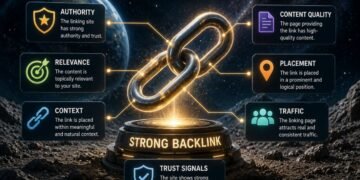
The evaluation of a backlink is not a simple checklist, with different factors determining the overall assessment.

  • Authority is an indicator of the credibility of the source.
  • Relevance is an assessment of the similarity between the subjects.
  • Placement is an assessment of the link’s position within the content.
  • Trust is an assessment of the reliability of the environment.

When these conditions are met, the link creates a structure that is consistent across the different aspects of the assessment.

When these conditions are not met, the assessment of the link is not as clear-cut. The link may come from a credible source, but may not be relevant, or may be well-placed, but not within the most reliable environment.

The way this works is by observing the interaction of these factors, not as individual entities.

Where Evaluation Often Leads to Inconsistency

A problem that is commonly experienced is evaluating links based on a single dimension.

For instance, evaluating links purely on the basis of authority may not consider the relevance of the link. Similarly, purely evaluating the link on the basis of the position may not consider the authority of the domain.

Another problem is that the evaluation is not viewed as a formula, as the value of the individual factors may vary according to the environment in which the link is placed.

For consistency, multiple elements need to be evaluated.

A Structured Way of Evaluating Backlinks

When evaluating the quality of backlinks, it is necessary to consider the environment of the link at multiple levels.

Authority is the measure of the strength of the source, while relevance is the alignment of the topics. Placement is the connection of the link with the content, while trust is the credibility of the source.

Together, these individual elements form a framework for understanding what makes a backlink high quality.

Tags: backlink analysisBacklink evaluationBacklink QualityDomain AuthoritySEO Concepts
ShareShareShareShareSend

Related Posts

Why Backlinks Matter

Why Are Backlinks Important for SEO?

by Backlink Sense
June 17, 2026
How to Analyze Anchor Text Distribution in a Backlink Profile
Anchor Text Distribution

How to Analyze Anchor Text Distribution in a Backlink Profile

by Backlink Sense
March 15, 2026
Backlink Analysis Tools

How to Analyze Backlinks Using SEO Tools

by Backlink Sense
March 7, 2026
Backlink Analysis Tools

Comparing Backlinks Across SEO Tools

by Backlink Sense
June 8, 2026
Which Tool Is Best for Backlinks?
Backlink Analysis Tools

Which Tool Is Best for Backlinks?

by Backlink Sense
February 8, 2026
Load More
  • About Us
  • Terms of Use
  • Use of Cookies
  • Affiliate Disclosure
  • Contact
  • Privacy Policy
2026 BacklinkSense © All rights reserved.

Welcome Back!

Login to your account below

Forgotten Password?

Retrieve your password

Please enter your username or email address to reset your password.

Log In

Accessibility Toolbar

  • Powered with favoriteLove by Codenroll
No Result
View All Result
  • Anchor Text
    • Anchor Text Context
    • Anchor Text Distribution
    • Anchor Text Strategy
    • Types of Anchor Text
  • Backlink Quality and Analysis
    • Authority and Trust Signals
    • Backlink Analysis Tools
    • Link Context
    • Link Placement
    • Link Quality Signals
    • Link Relevance
  • Link Building Basics
    • How Google Ranks Links
    • Types of Backlinks
    • What Are Backlinks
    • Why Backlinks Matter
  • Link Building Methods
    • Asset-Based Link Building
    • Content-Based Link Building
    • Digital PR and Authority Mentions
    • Passive Link Acquisition
    • Resource and Reference Links
  • Link Building Risks
    • Link Penalties
    • Link Velocity
    • Low-Quality Backlinks
    • Over-Optimized Anchor Text
    • Unnatural Link Patterns
  • Link Outreach
    • Finding Outreach Targets
    • Follow Up in Outreach
    • Outreach Email Strategies
    • Outreach Personalization
    • Relationship Based Outreach

2026 BacklinkSense © All rights reserved.

This website uses cookies to improve your experience and analyze site performance. By continuing to browse, you agree to our Privacy and Cookie Policy.