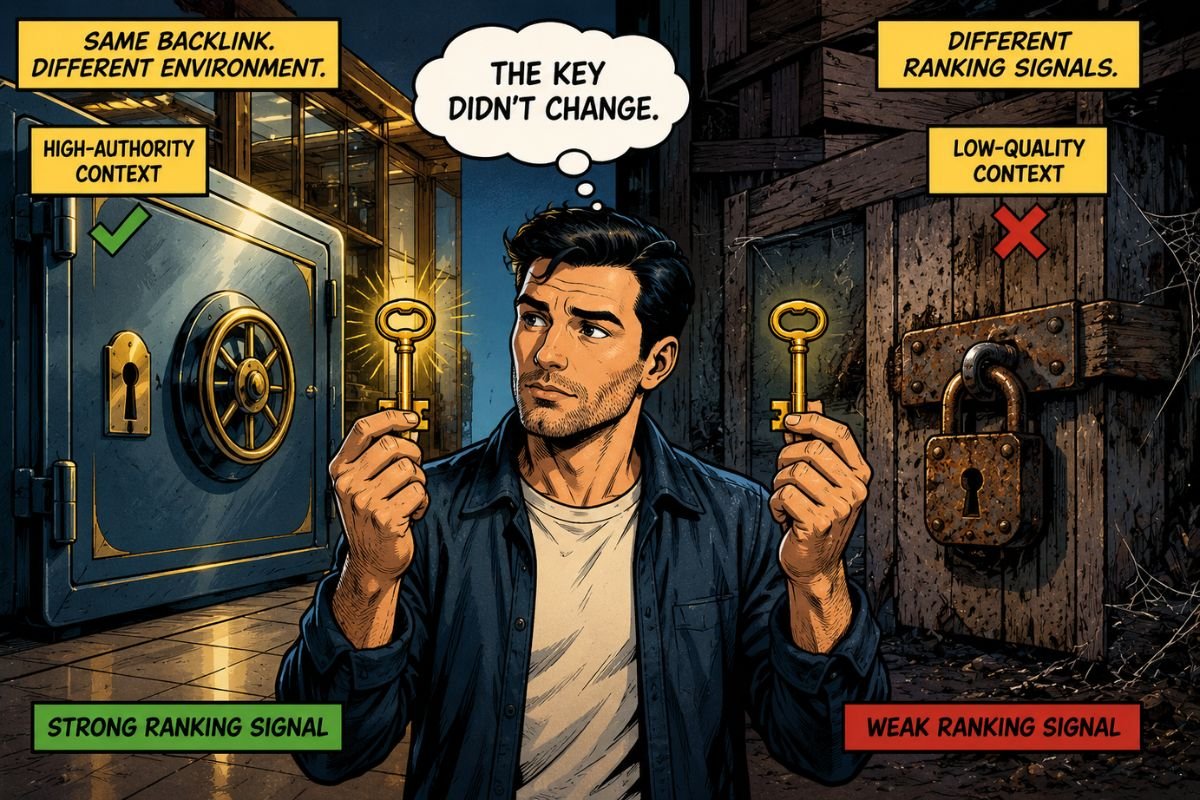

You open a backlink report and notice something curious. Two links point to the same page on your website, and they even use the same clickable words.
At first, there does not seem to be much separating them.
But a backlink report can only show you certain details about a link. Open the pages where those backlinks actually appear and the picture may start to change. One link could be part of a discussion that naturally leads to your page, while the other may appear in a completely different conversation.
The links looked similar in the report because you were looking at only part of the story.
This is an important idea when thinking about ranking signals, which are simply pieces of information that a search system can use when deciding how to understand and rank pages.
Google does not publish a formula showing exactly how every detail of an individual backlink affects rankings. What we do know is that its ranking systems use many signals and that links are among the information those systems can use.
So instead of assuming that two similar-looking backlinks must send identical signals, it makes more sense to look at what is happening around each link.
What Can Be the Same About Two Backlinks?
Suppose two websites both link to a guide about choosing a laptop using the clickable words how to choose a laptop.
Those clickable words are called anchor text in SEO.
So far, the two backlinks seem almost identical. They use the same anchor text and lead to exactly the same guide. Now let’s keep those two details the same and change only the article in which each link appears.
| What are we comparing? | Backlink A | Backlink B |
|---|---|---|
| What words can you click? | How to choose a laptop | How to choose a laptop |
| Where do you go after clicking? | A guide about choosing a laptop | A guide about choosing a laptop |
| What is the article about? | Buying a computer for college | Decorating a living room |
| Does the guide fit the discussion? | Yes. The article is already discussing computers | Not clearly. The article is about a different subject |
The first two rows are the same. Both backlinks use the same clickable words and take the reader to a guide about choosing a laptop. The difference appears when we look at the articles containing them. One is already discussing computers, while the other is discussing something completely different.
The discussion surrounding a link is part of what SEO professionals call link context. So even though the backlinks themselves look almost identical, the context around them is clearly different.
That is the central idea behind why similar backlinks can provide different signals.
Why Does the Content Around the Link Matter?
The words and ideas surrounding a link can help explain why one page is connecting its readers to another.
In our example, a guide about choosing a laptop fits naturally into an article about buying a computer for college. A reader can easily understand why the writer might include it.
Put that same link inside an article about decorating a living room and the connection becomes much less obvious. The anchor text has not changed and the reader still reaches the same guide, but the conversation around the link has.
This does not give us a formula for calculating how much ranking value either backlink receives. Google does not publish such a calculation for individual links. What we can see is that the backlink is only one part of the page containing it.
The Same Anchor Text Can Appear in Different Conversations
This difference can be easy to miss when looking at backlinks inside an SEO tool.
The tool might show how to choose a laptop as the anchor text for both backlinks. If you stop there, the two links may appear very similar. Once you open the actual articles, however, you can see what each writer was discussing when the link appeared.
The anchor text stayed the same. The conversation around it did not.
Similar Topics Can Still Produce Different Context
The difference does not always have to be as obvious as computers versus living room decoration.
Two articles could both discuss computers while using the same backlink in different ways. One might be specifically helping college students choose a laptop and link to the guide while explaining what to look for. Another might broadly discuss dozens of electronic devices and mention laptops only briefly.
Both articles are related to technology, but that does not make the role of the link identical.
This is why simply deciding that two pages are about a similar subject does not tell you everything about the context surrounding their backlinks.
Does This Mean We Know How Google Values Each Backlink?
No.
Google explains that its ranking systems use many signals and that it has systems, including PageRank, for understanding how pages link to one another.
That tells us that links are part of a much larger ranking process. It does not give us a public formula showing exactly how Google weighs every characteristic surrounding an individual backlink.
For that reason, seeing two backlinks with the same anchor text and destination is not enough to conclude that they will have exactly the same ranking effect.
Opening the pages themselves gives you information that a backlink report may not show at first glance. You can see what each article is discussing, why the link appears there, and how naturally the destination fits into that discussion.
The links may look similar in a backlink report. The pages around them can tell very different stories.