

Sunday, March 15, 2026
BacklinkSense
  • Anchor Text
    • Anchor Text Context
    • Anchor Text Distribution
    • Anchor Text Strategy
    • Types of Anchor Text
  • Backlink Quality and Analysis
    • Authority and Trust Signals
    • Backlink Analysis Tools
    • Link Context
    • Link Placement
    • Link Quality Signals
    • Link Relevance
  • Link Building Basics
    • How Google Ranks Links
    • Types of Backlinks
    • What Are Backlinks
    • Why Backlinks Matter
  • Link Building Methods
    • Asset-Based Link Building
    • Content-Based Link Building
    • Digital PR and Authority Mentions
    • Passive Link Acquisition
    • Resource and Reference Links
  • Link Building Risks
    • Link Penalties
    • Link Velocity
    • Low-Quality Backlinks
    • Over-Optimized Anchor Text
    • Unnatural Link Patterns
  • Link Outreach
    • Finding Outreach Targets
    • Follow Up in Outreach
    • Outreach Email Strategies
    • Outreach Personalization
    • Relationship Based Outreach
No Result
View All Result
  • Anchor Text
    • Anchor Text Context
    • Anchor Text Distribution
    • Anchor Text Strategy
    • Types of Anchor Text
  • Backlink Quality and Analysis
    • Authority and Trust Signals
    • Backlink Analysis Tools
    • Link Context
    • Link Placement
    • Link Quality Signals
    • Link Relevance
  • Link Building Basics
    • How Google Ranks Links
    • Types of Backlinks
    • What Are Backlinks
    • Why Backlinks Matter
  • Link Building Methods
    • Asset-Based Link Building
    • Content-Based Link Building
    • Digital PR and Authority Mentions
    • Passive Link Acquisition
    • Resource and Reference Links
  • Link Building Risks
    • Link Penalties
    • Link Velocity
    • Low-Quality Backlinks
    • Over-Optimized Anchor Text
    • Unnatural Link Patterns
  • Link Outreach
    • Finding Outreach Targets
    • Follow Up in Outreach
    • Outreach Email Strategies
    • Outreach Personalization
    • Relationship Based Outreach
No Result
View All Result
BacklinkSense
No Result
View All Result
ADVERTISEMENT
What Is a Manual Link Penalty?

What Is a Manual Link Penalty?

Backlink Sense by Backlink Sense
February 18, 2026
in Link Penalties
Reading Time: 2 mins read
0
Share on FacebookShare on Twitter

Page Contents

  • 1 What Is a Manual Action?
  • 2 How a Manual Link Penalty Appears
  • 3 How It Differs From an Algorithmic Penalty
  • 4 Related Posts
  • 5 Can Algorithmic Penalties Be Reversed?
  • 6 How to Recover from a Link Penalty?
  • 7 What Triggers a Google Link Penalty?
  • 8 Why Manual Link Penalties Occur
  • 9 Scope and Severity
  • 10 A Structural Perspective

A manual link penalty is a manual action taken by Google’s review team after a site’s backlink profile has been identified as violating spam or link-related guidelines. Unlike automatic ranking fluctuations, it results from a human review and the imposition of a specific action on a site. Its defining characteristic is direct intervention.

What Is a Manual Action?

A manual action occurs when a human reviewer assesses a site and determines that it does not comply with Google’s quality guidelines. In the context of backlinks, this typically relates to unnatural link patterns.

A manual action differs from algorithmic ranking changes. Algorithmic systems apply automated evaluations across the web without issuing specific notifications. A manual action, by contrast, is applied directly to a particular site following human review.

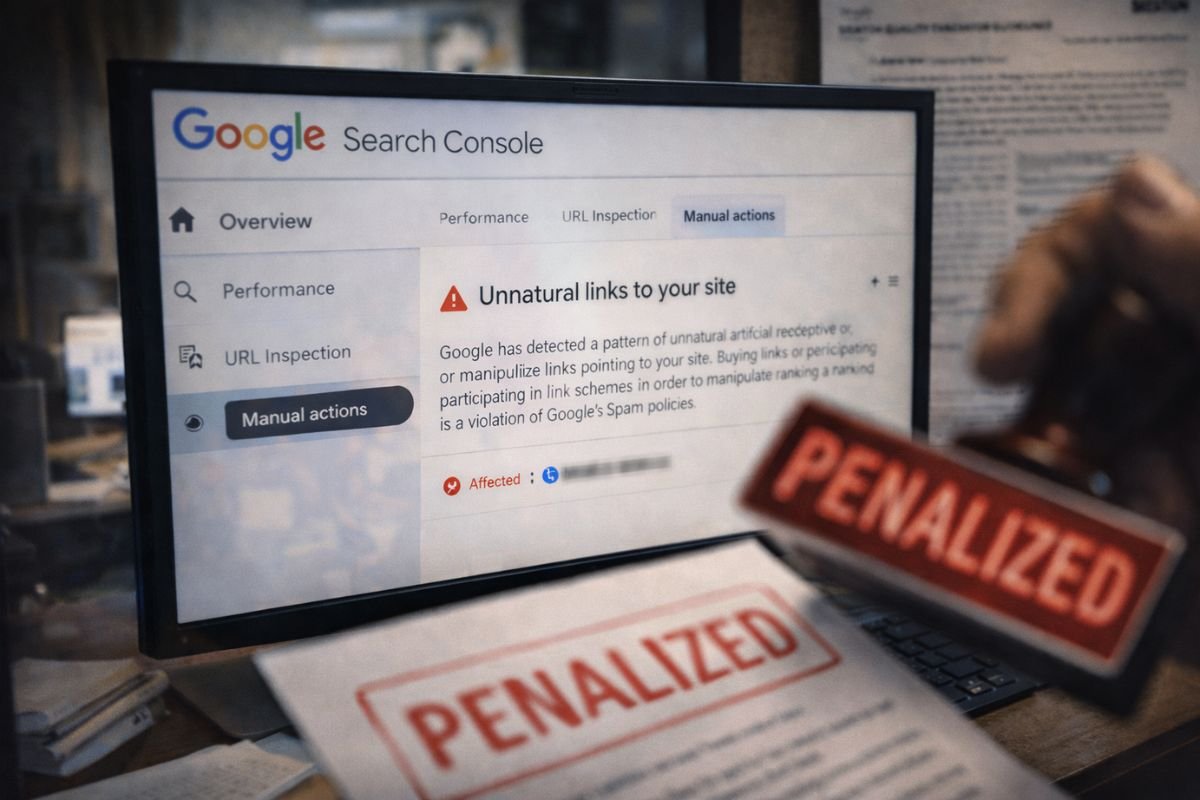
In cases involving backlinks, the action appears in the “Manual Actions” section of Google Search Console.

How a Manual Link Penalty Appears

A manual link penalty is explicit.

It is communicated through a message in Google Search Console stating that a manual action has been taken. The notice may reference:

  • “Unnatural links to your site”
  • “Unnatural links from your site”

The scope of the action may apply to:

  • A specific section of the site
  • A subset of pages
  • The entire domain

Its impact can range from demotion in rankings to significant visibility loss.

The defining feature is formal notification.

How It Differs From an Algorithmic Penalty

The central difference is human intervention.

Related Posts

Can Algorithmic Penalties Be Reversed?

March 3, 2026
How to Recover from a Link Penalty?

How to Recover from a Link Penalty?

February 22, 2026
What Triggers a Google Link Penalty?

What Triggers a Google Link Penalty?

February 20, 2026

Algorithmic systems operate continuously and automatically. They do not issue notifications or apply labeled penalties. When rankings shift due to algorithmic changes, there is no direct message confirming the cause.

By contrast, a manual link penalty involves:

  • Documented confirmation
  • A defined issue
  • A reconsideration process

Manual actions are procedural. Algorithmic changes are systemic.

Why Manual Link Penalties Occur

Manual link penalties occur when backlink patterns are deemed to violate established guidelines.

They are typically triggered in cases of intentional manipulation rather than minor or ambiguous fluctuations. While algorithmic systems may detect suspicious patterns, a manual review allows direct intervention when violations appear clear and substantial.

Manual penalties are not applied for routine volatility. They are used in more evident cases of policy breaches.

Scope and Severity

A manual link penalty does not always result in complete removal from search results.

It may target specific pages, keywords, or broader site sections depending on the nature and extent of the issue.

Severity reflects both the scale of the violation and how deeply it affects the overall link pattern, which means the scope of a manual action can vary accordingly.

A Structural Perspective

A manual link penalty is fundamentally a review-based enforcement process related to link guideline violations.

It is distinct from algorithmic ranking changes, which occur automatically and continuously without formal notice.

Manual link penalties are observable, procedural, and subject to reconsideration, whereas algorithmic shifts represent ongoing systemic recalculations that operate at a different level within search evaluation systems.

Tags: Google manual actionSEO risk signals
ShareTweetPin

Related Posts

Over-Optimized Anchor Text

Can Over-Optimization Cause Ranking Drops?

by Backlink Sense
March 3, 2026
0

Yes, over-optimization can cause ranking drops, but typically through algorithmic signal recalibration rather than...

Read moreDetails

Structural Errors in Link Prospecting Logic: A Quiet Risk Analysis

February 28, 2026

Signs Your Anchor Text Profile Looks Manipulative

February 26, 2026

What Is Anchor Text Over-Optimization?

February 26, 2026

Leave a Reply Cancel reply

Your email address will not be published. Required fields are marked *

  • About Us
  • Terms of Use
  • Use of Cookies
  • Affiliate Disclosure
  • Contact
  • Privacy Policy
2026 BacklinkSense © All rights reserved.

Welcome Back!

Login to your account below

Forgotten Password?

Retrieve your password

Please enter your username or email address to reset your password.

Log In

Accessibility Toolbar

  • Powered with favoriteLove by Codenroll
No Result
View All Result
  • Anchor Text
    • Anchor Text Context
    • Anchor Text Distribution
    • Anchor Text Strategy
    • Types of Anchor Text
  • Backlink Quality and Analysis
    • Authority and Trust Signals
    • Backlink Analysis Tools
    • Link Context
    • Link Placement
    • Link Quality Signals
    • Link Relevance
  • Link Building Basics
    • How Google Ranks Links
    • Types of Backlinks
    • What Are Backlinks
    • Why Backlinks Matter
  • Link Building Methods
    • Asset-Based Link Building
    • Content-Based Link Building
    • Digital PR and Authority Mentions
    • Passive Link Acquisition
    • Resource and Reference Links
  • Link Building Risks
    • Link Penalties
    • Link Velocity
    • Low-Quality Backlinks
    • Over-Optimized Anchor Text
    • Unnatural Link Patterns
  • Link Outreach
    • Finding Outreach Targets
    • Follow Up in Outreach
    • Outreach Email Strategies
    • Outreach Personalization
    • Relationship Based Outreach

2026 BacklinkSense © All rights reserved.

This website uses cookies to improve your experience and analyze site performance. By continuing to browse, you agree to our Privacy and Cookie Policy.