

You have several websites that could potentially go on your outreach list. How do you decide which ones should stay?
One website covers almost exactly the same subject as you. Another has an impressive score in an SEO tool. A third links to several of your competitors.
Each one looks interesting for a different reason. The difficult part is deciding which reasons actually matter.
That decision-making is part of link prospecting. You are not only discovering possible websites. You are deciding which ones deserve further attention and which ones do not.
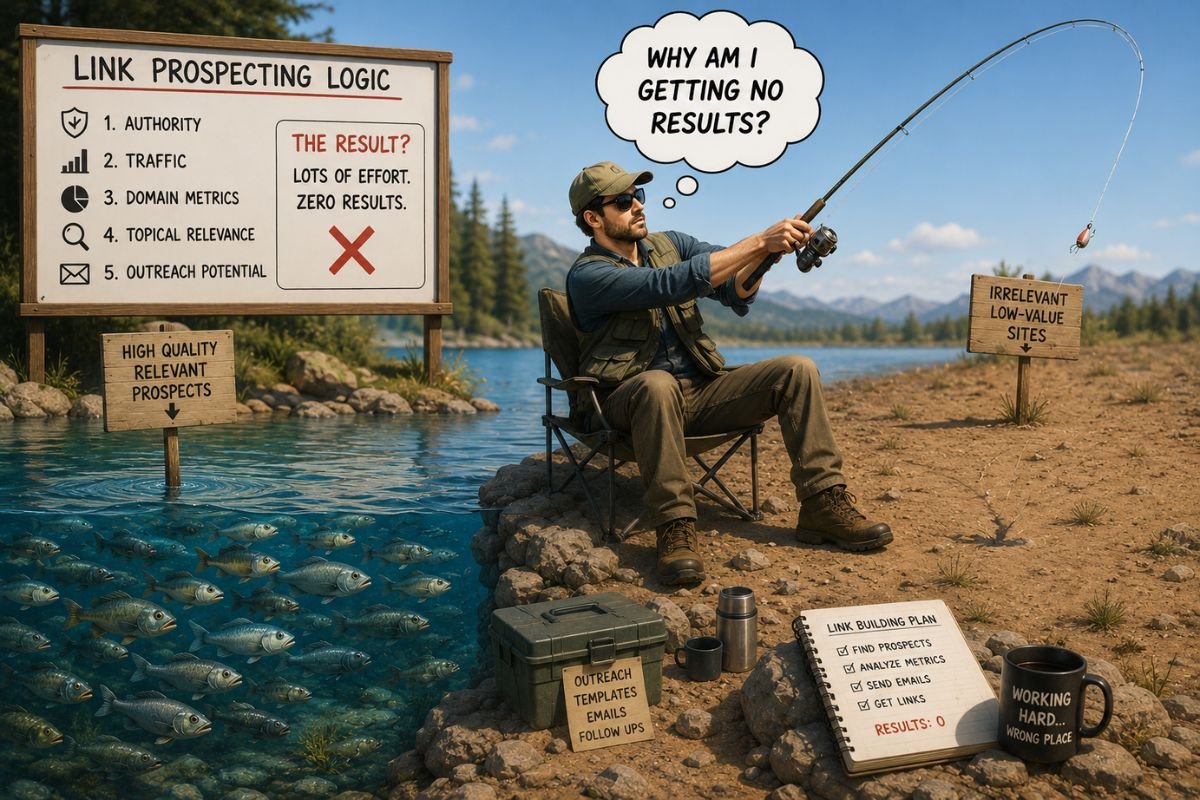
The reasoning behind those decisions is your prospecting logic, the set of rules you use to decide whether a website belongs on your list.
Now suppose your rule is simple: any website with a high enough SEO metric stays on the list.
The problem is not that every website selected this way will be a bad choice. The problem is that one number is making the decision while other useful information is being ignored.
That is a structural error in your prospecting logic. The problem is not one website you happened to judge incorrectly. It is a decision rule that can repeat the same weakness across your prospect list.
Is a Bigger Prospect List Really Better?
It can feel productive to watch your list grow.
But the number of websites on the list tells you very little about whether those websites make sense for your outreach.
If increasing the size of the list means accepting websites after only a quick check, the problem is not that the list became large. The problem is that the standard for getting onto it became weaker.
A large list can be perfectly useful if the websites on it were chosen for sensible reasons. A smaller list can be poor if those websites were chosen carelessly.
So volume itself is not the mistake. Allowing volume to replace careful selection is.
Are You Checking the Websites You Discover?
Finding a website gives you a possibility. It does not tell you whether that possibility is good.
Suppose a website appears because it links to one of your competitors. That gives you a reason to investigate it, but not necessarily a reason to contact it.
Open the website. Look at what it publishes. See where the competitor’s link actually appears and why it was included.
This distinction between discovering a website and checking whether it makes sense is important throughout the process of finding outreach targets.
Skipping that check can turn a useful discovery method into a weak decision rule:
“My competitor has a link from this website, so I should try to get one too.”
The competitor backlink gave you the lead. It did not make the decision for you.
Can One SEO Metric Make the Decision?
SEO tools can give you useful information about a website, but their metrics answer particular questions based on each tool’s own data and methodology.
They do not replace looking at the website itself.
A high authority-style score, for example, does not automatically tell you whether the website is closely related to your subject or whether contacting it makes sense. A lower score does not automatically make a highly relevant specialist website useless.
The structural error appears when the metric stops being one piece of information and becomes the rule:
“Above this number, keep it. Below this number, reject it.”
That makes the process easy to repeat, but ease is not the same as good judgment.
What About Websites That Link to Several Competitors?
Seeing the same website link to several competitors can be a useful clue.
It tells you there is something worth examining. Perhaps the website regularly covers your field. Perhaps your competitors created resources that were useful to its writers. Or the links may have appeared for completely different reasons.
You do not know until you look.
This is why patterns in competitor backlink profiles are more useful as questions to investigate than instructions to copy.
Instead of asking:
“How can I get the same link?”
Ask:
“Why are these websites being linked to here?”
The answer gives you something a repeated domain or metric alone cannot: context.
The Mistake Is Often in the Rule, Not the Website
A website does not need to be obviously bad for your prospecting process to have a problem.
The weakness may be in the rule that keeps putting websites on your list.
“Keep it because the metric is high.”
“Keep it because a competitor has a link.”
“Keep it because we need more prospects.”
Each rule takes one useful clue and asks it to do too much.
Good prospecting does not require a complicated formula. It requires recognizing that discovery signals are starting points. Before a website becomes an outreach target, there should be a sensible reason for choosing it that goes beyond the single clue that helped you find it.