

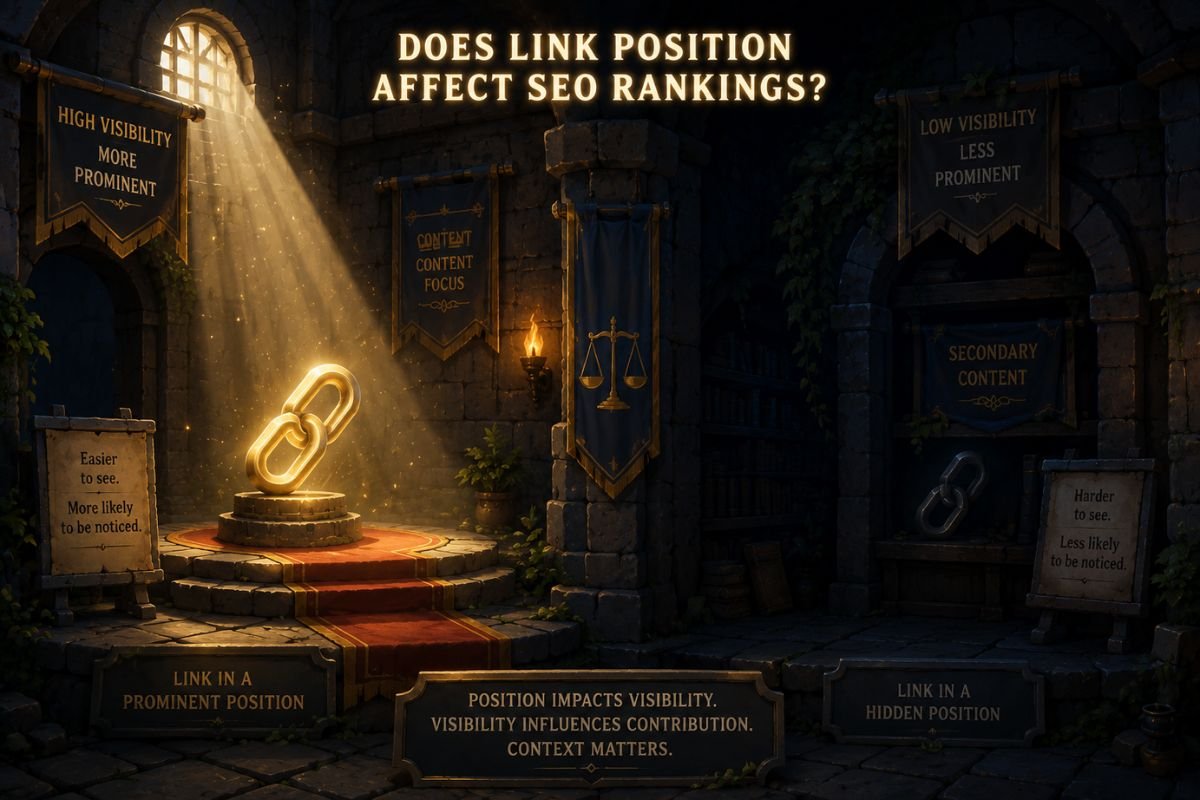

If two articles link to your website, you might notice that one link appears near the beginning of the article, while the other is closer to the end. It’s easy to assume that the first link must be more valuable for SEO simply because it appears higher on the page.
But does Google actually give more ranking value to a backlink because of where it appears? What about a link placed in the middle of an article?
These are reasonable questions, but the answers aren’t as straightforward as they might seem. Google hasn’t publicly confirmed a fixed ranking advantage for links based only on their position. To understand what link placement might mean for SEO, we need to separate what Google has actually explained from the theories that have developed around it.
Does the Beginning, Middle, or End Make a Difference?
A link near the beginning of an article may be easier for visitors to notice because they encounter it earlier. A link farther down requires readers to reach that part of the page first.
This can affect how people interact with a website, but it doesn’t establish that Google gives the first link more ranking value.
The middle of an article has attracted particular attention in SEO. You may come across advice suggesting that backlinks placed halfway through the content are stronger than links near the introduction or conclusion.
There is no publicly confirmed Google rule supporting that specific advantage.
The important distinction is between where readers encounter a link and how much ranking value Google’s systems may assign to it. We can observe the first, but we cannot directly measure the second.
What Does Google’s Reasonable Surfer Patent Tell Us?
One reason link position became a topic in SEO is a Google patent describing an approach commonly known as the Reasonable Surfer Model.
The idea is that people aren’t equally likely to click every link on a webpage. Some links may attract more attention because of how and where they appear.
The patent describes a model that can assign different weights to links based on features associated with them and the likelihood that users would follow them.
This helps explain why SEO professionals have explored the possibility that link characteristics, including placement, could influence how links are evaluated.
But there is an important limitation: a patent describes a possible technical approach, not proof that Google’s current ranking systems use it in the same way.
The patent doesn’t establish a rule that the first link in an article passes more ranking value than one in the middle, or that a link near the end receives less.
Those conclusions go beyond what the public evidence confirms.
The following table separates common placement theories from what Google’s public information actually establishes.
| Link Position or Concept | Common SEO Theory | What Google Has Publicly Confirmed |
|---|---|---|
| Beginning of an Article | Links near the top may carry more ranking value because readers are more likely to notice them. | Google has not published a fixed ranking advantage for backlinks simply because they appear near the beginning. |
| Middle of an Article | Links within the main body may carry more weight than links elsewhere on the page. | Google has not confirmed a specific ranking bonus for links placed in the middle of an article. |
| Footer or Sidebar | Links in these areas may receive less ranking weight because they often serve navigation or appear repeatedly. | Google has not published a universal ranking value for these positions or confirmed that every such link is worth less. |
| Reasonable Surfer Concept | Links that people are more likely to click may receive different weights in link analysis. | Google has patented approaches involving different probabilities of following links, but a patent does not establish how its current ranking systems use them. |
Can You Measure the SEO Effect of Moving a Link?
Suppose a backlink to your website originally appears near the bottom of an article. The publisher later moves it closer to the beginning, and your search rankings improve.
It might be tempting to credit the improvement to the new position.
But rankings can change for many reasons, including changes elsewhere on the web or updates to Google’s ranking systems. Seeing two events happen around the same time doesn’t establish that one caused the other.
Website analytics may help you examine whether visitors are arriving through links on other websites. However, referral traffic and ranking value are different measurements.
Even if moving a link makes it easier for people to find and click, that doesn’t tell you exactly how Google evaluates the backlink.
This is why individual ranking changes should not be treated as proof of a universal link-placement rule.
Should You Ask for a Backlink to Be Moved Higher?
There may be practical reasons to change where a link appears, particularly when the new position makes it easier for visitors to notice or use.
But requesting a higher position solely because you expect it to pass more SEO value isn’t supported by a confirmed Google ranking rule.
A link near the beginning, middle, or end of an article can be useful to readers. What we cannot reliably determine from its position alone is the amount of ranking value it contributes.
For now, there is no established best position for a backlink that guarantees stronger SEO rankings. Claims that a particular part of an article always passes more value should be treated as theories unless they are supported by reliable evidence.