



Page Contents
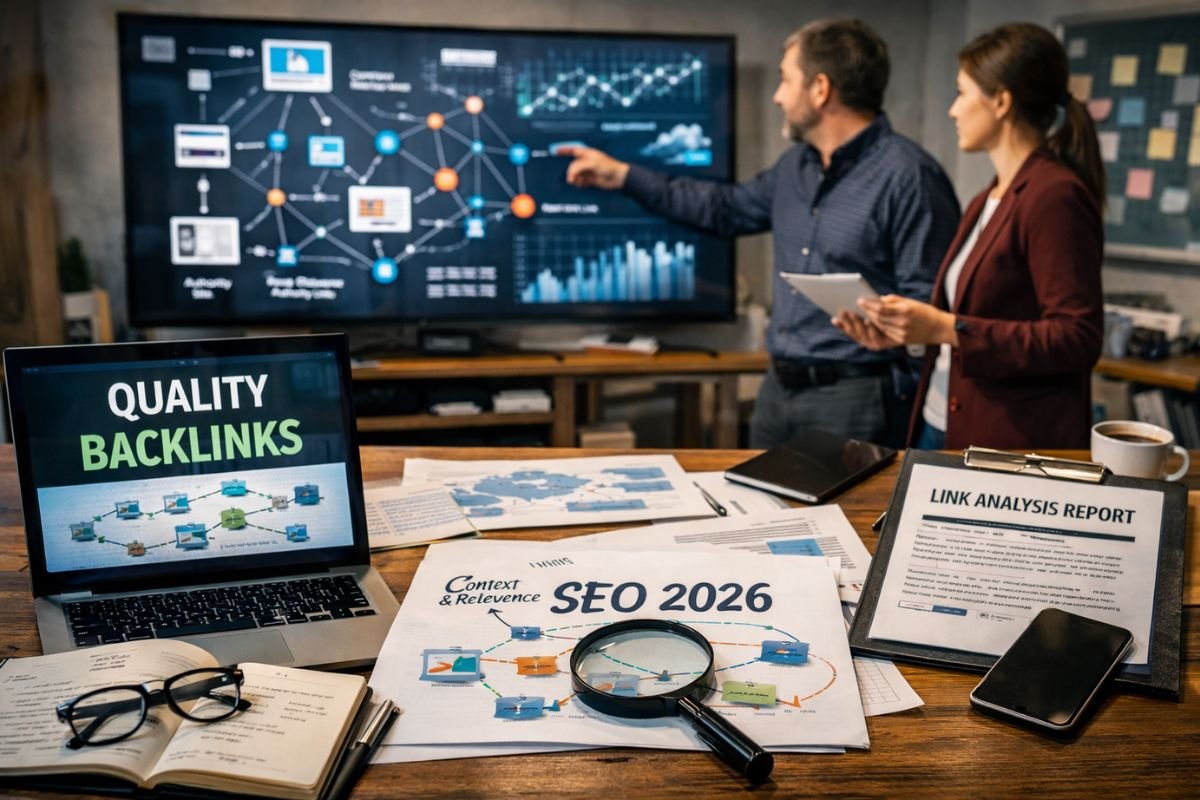
Yes, backlinks still work in 2026, but not in the same way they once did. Their role has shifted from quantity to contextual quality. Backlinks remain part of how search engines analyze relationships between pages, yet the signal has evolved and the associated risk has increased.
Backlinks still function within search systems, but the model underlying their evaluation is no longer the same.
Quantity vs. Quality
In earlier stages of search engine development, backlink quantity had a stronger correlation with rankings. That relationship has weakened over time.
In 2026, sheer volume is no longer decisive. A large number of backlinks does not automatically improve visibility. In some cases, excessive volume without context may even weaken the signal.
Quality, however, remains significant.
Backlink quality extends beyond the referring domain itself. It includes factors such as:
- Topical relevance
- Editorial placement
- Contextual alignment
- Natural integration
- Credibility of the link origin
A single strong backlink may outweigh hundreds of weaker ones. The transition from quantity to contextual integrity explains why backlinks still matter.
The Evolution of the Backlink Signal
Originally, backlinks operated as structural indicators of page importance. Over time, additional evaluation layers were introduced:
- Spam detection models
- Pattern recognition systems
- Entity-based evaluation
- Contextual content analysis
- Link network mapping
In 2026, backlinks function as:
- Confirmation signals
- Authority reinforcement
- Topical clustering indicators
- Relationship markers between domains
They do not compensate for weak content or poor user experience. They enhance existing strength. The signal has evolved from countable votes to contextual relationships.
Related Posts


When Backlinks Still Matter Most
Backlinks retain significant weight in certain environments.
Competitive Niches
In highly competitive spaces, differentiation often relies on external validation. When many domains provide similar answers, backlinks influence hierarchy.
Trust Sensitive Industries
In finance, healthcare, and technology, external references contribute to credibility assessment.
Authority-Based Publishing
In sectors where authority is foundational, backlink networks act as proxies for recognition within topic clusters.
In these contexts, backlinks remain part of the competitive ecosystem.
When Backlinks Matter Less
Backlinks play a smaller role in other scenarios
Low Competition Queries
When few domains target a keyword, relevance and clarity may outweigh external references.
Highly Specific Informational Queries
For narrow queries, precision and intent alignment may be more influential than link strength.
Strong Brand Signals
Established brands may rank due to recognition and navigational demand.
In these cases, backlinks contribute signals but do not dictate outcomes.
Risk in 2026
The risk associated with manipulative link practices has increased.
Search systems now detect:
- Coordinated link schemes
- Repetitive anchor patterns
- Artificial velocity spikes
- Isolated link networks
Because evaluation now emphasizes pattern behavior, aggressive link building carries a greater risk than in previous years. Backlinks still work. Manipulative patterns still work against you.
Backlinks as Reinforcement, Not Replacement
The most important shift in perspective is this:
Backlinks reinforce strength. They do not create strength from nothing.
If content is:
Thin
Misaligned with intent
Poorly structured
Technically flawed
Backlinks may offer limited benefit.
If content is:
Clear
Contextually aligned
Structurally sound
Strategically positioned
Backlinks can accelerate authority recognition. In 2026, backlinks act as amplifiers, not shortcuts.
Myth vs. Reality
Myth: Backlinks are outdated.
Reality: They remain part of authority modeling in a more nuanced form.
Myth: More backlinks automatically improve rankings.
Reality: Contextual quality determines impact.
Myth: Backlinks guarantee long-term rankings.
Reality: They operate alongside content, technical, user, and brand signals.
Misjudgment often results from viewing a dynamic system through a static lens.
A Measured Conclusion
Do backlinks still work in 2026?
- Yes, as contextual authority signals within a broader ranking framework.
- No, they are neither obsolete nor dominant in isolation.
- Yes, their effectiveness depends on quality, relevance, and pattern integrity.
The signal still functions. The interpretation has matured.