

A restaurant recommendation is more useful when it fits the meal you have in mind. A well-known food magazine might recommend excellent restaurants in your city, but if you need somewhere to eat with young children, a local guide that explains which places have children’s menus and room for a stroller may answer your question more directly.
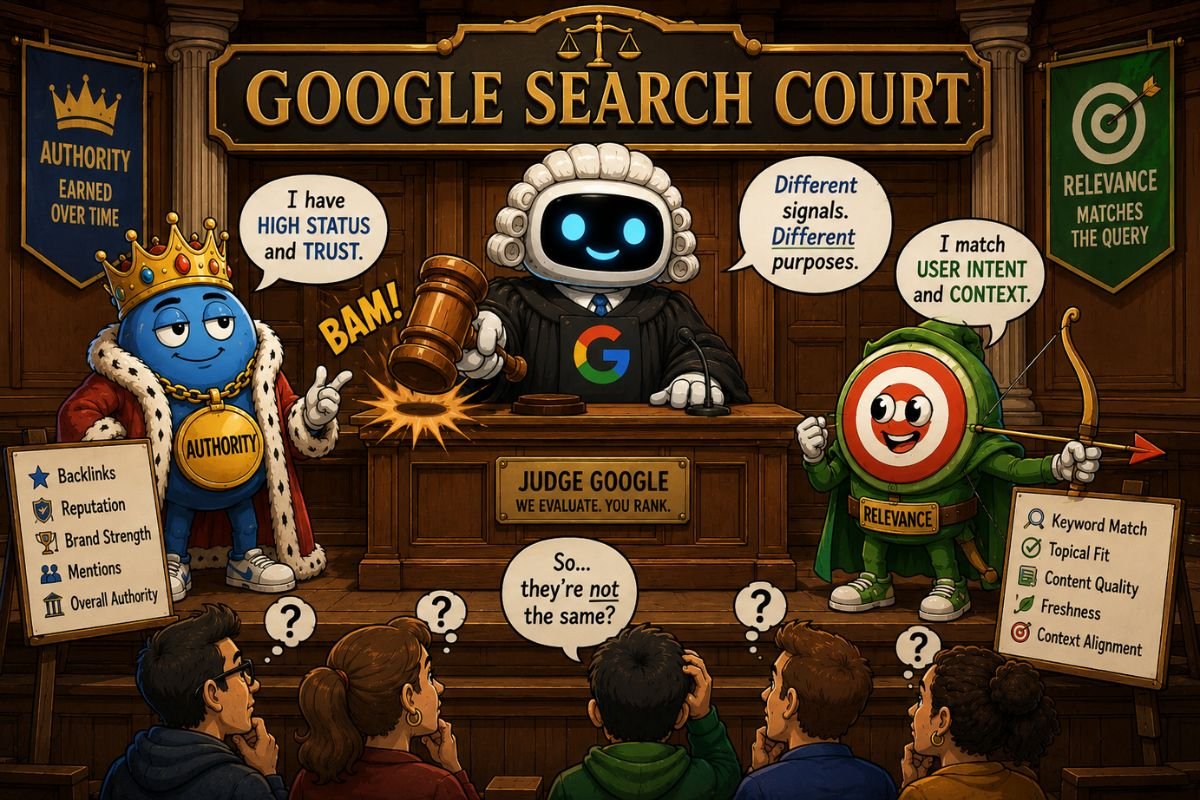
The magazine’s reputation gives you a reason to take its recommendations seriously. The local guide provides details that matter to this particular outing. That difference introduces two ideas used in discussions about search: authority, meaning the reputation or standing of a source, and relevance, meaning how closely its content addresses what someone needs to know.
What Gives a Source Authority?
The food magazine may have earned recognition through knowledgeable reviewers, well-supported reporting, and recommendations that readers have found useful. Other publications might cite its restaurant coverage when discussing where to eat.
These are reasons someone might regard it as an authoritative source on food. Recognition is more meaningful when it rests on relevant work than when a name is simply familiar.
Search engines cannot rely on your personal familiarity with a publication. Google describes using signals to identify content that demonstrates expertise, authoritativeness, and trustworthiness. One example it gives is whether other prominent websites link or refer to that content.
Google also uses link analysis systems, including PageRank, to understand relationships between pages and which pages may be helpful. This does not mean a website’s reputation can be reduced to the number of links it receives.
In this discussion, “authority” is a way to describe the standing of a source or page, not a single Google score that tells us where it must appear in search results.
What Makes a Page Relevant to a Search?
Now consider someone searching for “restaurants to visit with young children.” A review praising a restaurant’s creative dishes could be accurate and carefully researched, yet say nothing about whether there are suitable meals or seating for children.
The local guide addresses those practical questions. Its usefulness comes from the information it supplies, not merely from discussing restaurants in the same city.
Change the search to “restaurants with tasting menus,” and different details become important. The magazine’s review might now be the closer match. The quality of the two articles has not necessarily changed; the reader is asking a different question.
This is why relevance belongs to the relationship between a particular search and a page. A page is not equally relevant to every question about its broad subject.
Relevance Goes Beyond Matching Words
A guide does not need to repeat “restaurants to visit with young children” in every section to address that search. It could use “family-friendly dining” and explain the available children’s meals, high chairs, and seating arrangements.
Google says its systems can recognize related wording and find relevant content even when a page does not contain the exact words used in a search. Matching keywords can provide a clue, but relevance involves more than their presence.
For the reader, the difference is easy to see. A page that repeatedly calls restaurants “family-friendly” without explaining why leaves important questions open. A guide that provides concrete details gives the reader something to use when choosing a place.
Those details still need to be accurate. If the guide lists a children’s menu that the restaurant no longer offers, its apparent fit to the search does not make its advice dependable. Relevance helps establish whether the page addresses the question; checking the information helps establish whether the answer deserves confidence.
Does Relevance Matter More Than Authority?
The restaurant comparison does not establish that smaller websites should outrank well-known publications, or that a narrowly focused page always deserves the highest position. A respected publication can also produce the most directly useful guide, while a smaller site can publish an incomplete or inaccurate one.
Google describes ranking as involving many factors, including relevance, usability, and source expertise. Their importance varies with the search. Its public guidance does not provide a formula for deciding how much one can outweigh the other.