

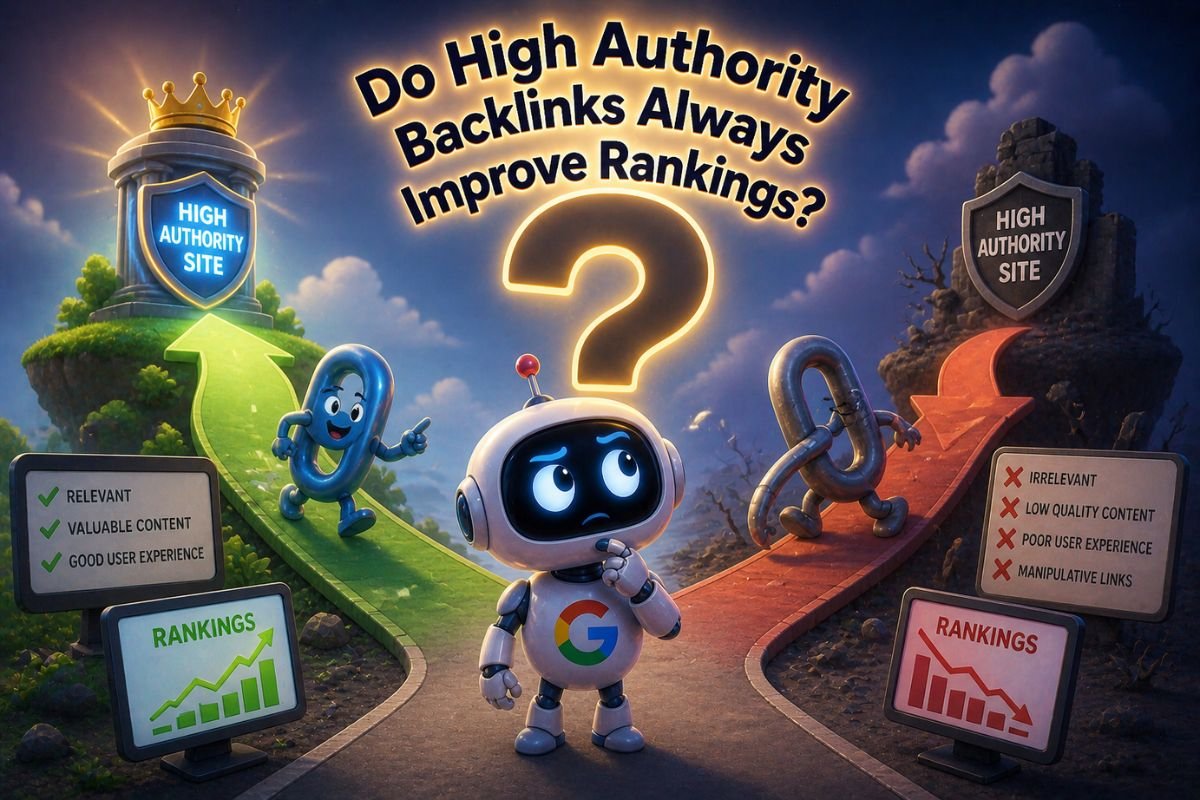

High authority backlinks do not always improve rankings. While links from well-known or widely cited websites can carry strong signals, their effect depends on the context in which the link appears.
Search engines evaluate links through multiple layers of interpretation. Authority of the linking site is only one part of that evaluation. The surrounding context, the relationship between topics, and the way the link appears inside the content can all influence how the link is interpreted.
A link from a strong site can contribute value, but it does not automatically translate into ranking improvement.

Relevance Between the Linking Page and the Topic
One of the most important factors influencing how a link is interpreted is topical relevance.
If the linking page discusses a subject closely related to the destination page, the connection between the two pages becomes clearer. The link appears as a natural reference within the discussion, where topical relevance matters more than authority alone.
When the topics align, the link reinforces the semantic relationship between the pages.
However, if the linking page focuses on an unrelated subject, the connection becomes weaker. Even if the site itself is widely recognized, a link that appears outside the natural context of the topic may carry less interpretive weight.
Search engines attempt to understand why the link exists within the content. Relevance between the two pages helps clarify that purpose.
The Context Surrounding the Link
The text surrounding a backlink often provides important signals about its meaning.



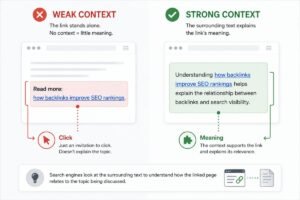
Links that appear within sentences explaining a concept or referencing a resource tend to be easier to interpret. The surrounding language helps search systems understand how the destination page relates to the topic being discussed.
If the surrounding text supports the link and refers to a relevant idea, the link becomes part of the informational structure of the content.
In contrast, links that appear in unrelated sections or in content that does not reference the destination topic may provide weaker contextual signals.
Even when the linking site is highly recognized, the interpretation of the link still depends on how it fits within the surrounding content.
Natural Placement Within the Content
Another factor influencing how a link is interpreted is whether the link appears naturally within the structure of the page.
Links embedded inside editorial content usually appear as references supporting a specific point. These placements often emerge from the writing itself.
When a link appears in a way that aligns with the narrative of the article, it becomes easier for search systems to interpret its purpose.
Links placed in isolated sections of a page may not carry the same level of contextual clarity. The algorithm evaluates how the link fits within the structure of the content.
Natural placement strengthens the interpretive connection between the linking page and the destination page.
additional perspective on authority and trust evaluation can be explored through link quality analysis
The Position of the Link on the Page
Where a link appears within a page can also influence how it is interpreted.
Links located inside the main body of an article typically appear within sentences that discuss relevant ideas. The surrounding text provides context that helps search engines understand why the link exists.
When links appear outside the main content, such as in navigation sections or repeated site elements, the surrounding context may be less descriptive.
This difference does not necessarily mean the link is ignored, but it may change how much information the algorithm can extract from the surrounding language.
Position within the content therefore, contributes to how clearly the link communicates its purpose.
Why Authority Alone Is Not Enough
A common assumption in link building is that a backlink from a widely recognized site will automatically influence rankings.
In practice, search engines analyze links through a broader set of signals.
Authority can contribute to the credibility of the source, but it does not override other factors such as relevance, contextual alignment, or placement within the page, where topical relevance becomes a determining factor.
If a link appears disconnected from the topic, lacks supporting context, or sits outside the main content, its interpretive value may be limited.
Search systems attempt to understand not only where a link comes from but also why it appears within the content.
Interpreting High Authority Links in Context
High authority backlinks can contribute meaningful signals when they appear within relevant, well integrated contexts.
When the linking page discusses a related topic, references the destination naturally, and places the link within the body of the content, the connection becomes easier to interpret beyond authority metrics alone.
However, authority alone does not guarantee that a link will influence rankings.
Search engines interpret backlinks as part of a larger network of signals that includes relevance, context, and placement within the page.
Understanding this broader interpretation helps explain why not every link from a well-known site carries the same backlink trust signals.