


Sunday, March 15, 2026
BacklinkSense
  • Anchor Text
    • Anchor Text Context
    • Anchor Text Distribution
    • Anchor Text Strategy
    • Types of Anchor Text
  • Backlink Quality and Analysis
    • Authority and Trust Signals
    • Backlink Analysis Tools
    • Link Context
    • Link Placement
    • Link Quality Signals
    • Link Relevance
  • Link Building Basics
    • How Google Ranks Links
    • Types of Backlinks
    • What Are Backlinks
    • Why Backlinks Matter
  • Link Building Methods
    • Asset-Based Link Building
    • Content-Based Link Building
    • Digital PR and Authority Mentions
    • Passive Link Acquisition
    • Resource and Reference Links
  • Link Building Risks
    • Link Penalties
    • Link Velocity
    • Low-Quality Backlinks
    • Over-Optimized Anchor Text
    • Unnatural Link Patterns
  • Link Outreach
    • Finding Outreach Targets
    • Follow Up in Outreach
    • Outreach Email Strategies
    • Outreach Personalization
    • Relationship Based Outreach
No Result
View All Result
  • Anchor Text
    • Anchor Text Context
    • Anchor Text Distribution
    • Anchor Text Strategy
    • Types of Anchor Text
  • Backlink Quality and Analysis
    • Authority and Trust Signals
    • Backlink Analysis Tools
    • Link Context
    • Link Placement
    • Link Quality Signals
    • Link Relevance
  • Link Building Basics
    • How Google Ranks Links
    • Types of Backlinks
    • What Are Backlinks
    • Why Backlinks Matter
  • Link Building Methods
    • Asset-Based Link Building
    • Content-Based Link Building
    • Digital PR and Authority Mentions
    • Passive Link Acquisition
    • Resource and Reference Links
  • Link Building Risks
    • Link Penalties
    • Link Velocity
    • Low-Quality Backlinks
    • Over-Optimized Anchor Text
    • Unnatural Link Patterns
  • Link Outreach
    • Finding Outreach Targets
    • Follow Up in Outreach
    • Outreach Email Strategies
    • Outreach Personalization
    • Relationship Based Outreach
No Result
View All Result
BacklinkSense
No Result
View All Result
ADVERTISEMENT

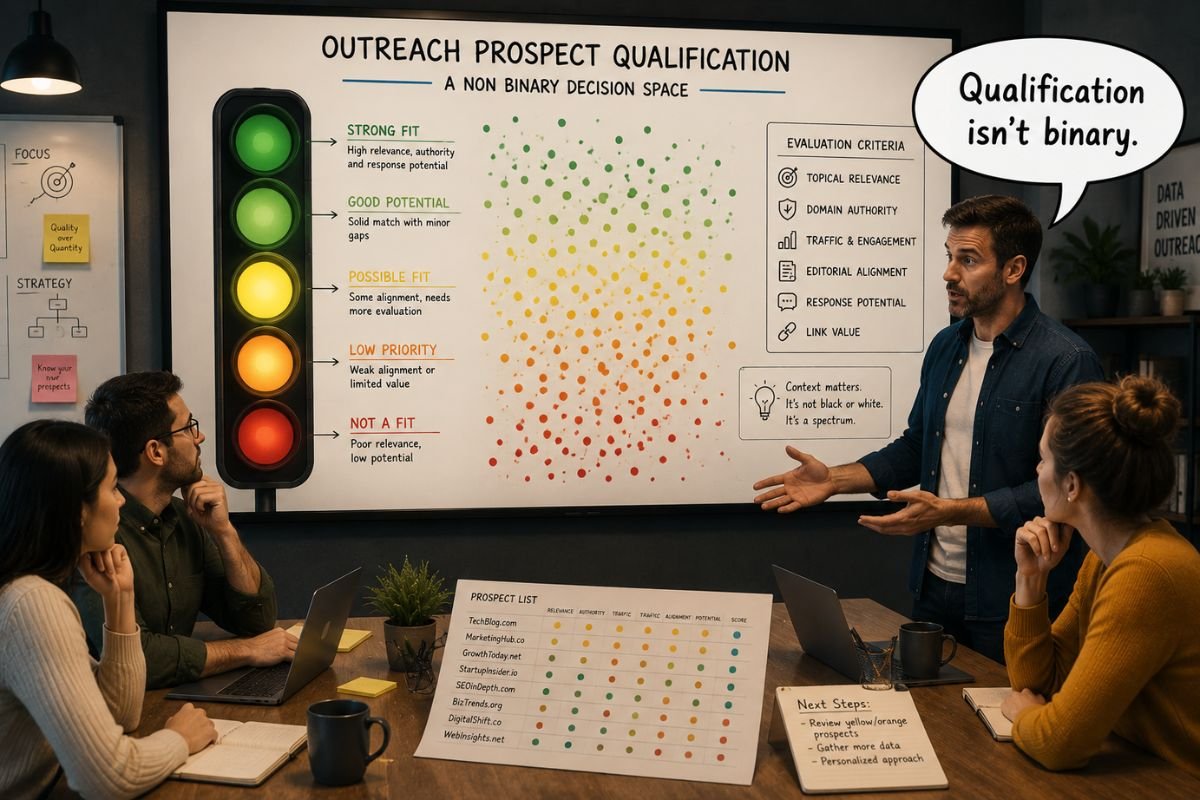
How to Qualify Outreach Prospects: A Non Binary Decision Space

Backlink Sense by Backlink Sense
February 25, 2026
in Finding Outreach Targets
Reading Time: 5 mins read
0
Share on FacebookShare on Twitter

Page Contents

  • 1 Why Authority Often Misleads
  • 2 Related Posts
  • 3 Common Link Prospecting Mistakes to Avoid: Execution-Level Errors
  • 4 Prospect Scoring Framework for Link Building Campaigns: A Computation Model
  • 5 How to Qualify Outreach Prospects – Relevance vs Authority
  • 6 How to Analyze Competitor Backlinks for Outreach Prospects: A Technical Workflow
  • 7 When Relevance Becomes the Decisive Signal
  • 8 Competitive Dependence Alters the Standard
  • 9 The Stage of the Site Alters Absorption Capacity
  • 10 The Dilemma That Never Fully Resolves
  • 11 What This Means in Practice
  • 12 Closing Perspective

How to qualify outreach prospects is not a checklist problem. It is a conceptual problem built on a series of tradeoffs. The difficulty exists because the signals used in qualification often conflict with one another.

Authority may be strong while relevance is weak.
Relevance may be perfect while the environment is unstable.
Competitive pressure may make a marginal prospect rational.
A new site may misjudge what it can absorb.

There is no rule here. Qualifying prospects is a form of conditional reasoning.

Why Authority Often Misleads

Authority is tempting because it feels quantifiable. It feels safe.

Authority is not a promise of alignment. It measures accumulated strength within an ecosystem. It does not measure fit.

Authority becomes misleading when it is treated as inherent value.

A strong authority site is not necessarily a strong outreach prospect if:

  • The topical gap is wide

  • Audience intent does not match

  • The editorial environment does not support contextual integration
    Related Posts

    Common Link Prospecting Mistakes to Avoid: Execution-Level Errors

    February 28, 2026

    Prospect Scoring Framework for Link Building Campaigns: A Computation Model

    February 28, 2026

    How to Qualify Outreach Prospects – Relevance vs Authority

    February 28, 2026

    How to Analyze Competitor Backlinks for Outreach Prospects: A Technical Workflow

    February 28, 2026

In this scenario, the placement may look impressive but remain structurally weak.

Authority is often mistaken for quality. It is not.

Quality is contextual.
Authority is relative.

When Relevance Becomes the Decisive Signal

Relevance is harder to quantify, yet often more meaningful.

It determines whether a link functions as signal or noise.

Relevance becomes decisive when the goal is topical continuity rather than visibility. In early phases especially, relevance may contribute more to thematic territory than authority metrics that sit outside the narrative.

Relevance, however, can also be deceptive.

A site may appear relevant at the category level while operating as a generic publishing platform structurally. If relevance exists only at the surface while the broader ecosystem lacks coherence, misalignment remains.

Relevance must be evaluated in depth, not at the surface.

Competitive Dependence Alters the Standard

Outreach qualification does not occur in isolation. In low-competition environments, structural purity can be maintained, and patience is affordable. In high-competition environments, the qualification standard shifts. This does not justify irresponsibility; it acknowledges constraint.

If competitors operate within adjacent ecosystems while your site remains isolated, relevance alone may not protect visibility. In such cases, a non-ideal prospect may become rational.

This is competitive dependence.

Qualification standards are not defined by theoretical ideals. They are defined by environmental sustainability.

The same prospect may be unacceptable in one ecosystem and essential in another.

The Stage of the Site Alters Absorption Capacity

A new site cannot qualify prospects in the same way an established site can.

New sites have limited buffering capacity. Signals accumulate quickly. Each placement carries disproportionate weight.

For a new site, topically distant prospects can distort early structural signals. Prospects that appear strong but carry mixed contextual alignment may introduce ambiguity.

For an established site, the same placement may integrate into a broader, stabilized topological map.

Qualification is not only about the prospect. It is about the relationship between the prospect and the existing structure.

A prospect can be objectively strong and still misaligned with the site’s developmental stage.

The Dilemma That Never Fully Resolves

Outreach qualification is rarely binary. It cannot be.

It is a decision about risk distribution.

Do you prioritize authority? You risk dilution.
Do you prioritize relevance? You risk constrained expansion.
Do you prioritize speed? You risk pattern formation.
Do you prioritize purity? You risk stagnation.

The correct decision depends on what the site is becoming.

This is why formulas fail.

Formulas assume static conditions. Outreach qualification operates within dynamic environments.

What This Means in Practice

How to qualify outreach prospects ultimately comes down to the quality of the questions asked.

  • What happens if this prospect type is repeated ten times?
  • What structural signal am I reinforcing?
  • Does this move the site toward its core space or toward noise?
  • Is this decision driven by strategy or pressure?

These questions do not create a checklist. They create clarity.

The objective is not to score prospects. It is to understand how they reshape structure over time.

Closing Perspective

Outreach qualification is not a filtering exercise. It is a positioning exercise.

Authority is not always the highest value, relevance is not always sufficient, competition is not always decisive, and site stage is not always dominant. The process resists binary framing because the environment is conditional. The objective is not certainty, but disciplined selection across tradeoffs.

Tags: backlink strategyOutreach QualificationRelevance Versus AuthoritySEO competition analysis
ShareTweetPin

Related Posts

Anchor Text Distribution

How to Fix an Unnatural Anchor Text Distribution

by Backlink Sense
March 5, 2026
0

An unnatural anchor text distribution occurs when the anchor text used in backlinks becomes...

Read moreDetails

How to Qualify Outreach Prospects – Relevance vs Authority

February 28, 2026

What Is a Linkable Asset?

February 13, 2026

What Is Content-Based Link Building?

February 13, 2026

Leave a Reply Cancel reply

Your email address will not be published. Required fields are marked *

  • About Us
  • Terms of Use
  • Use of Cookies
  • Affiliate Disclosure
  • Contact
  • Privacy Policy
2026 BacklinkSense © All rights reserved.

Welcome Back!

Login to your account below

Forgotten Password?

Retrieve your password

Please enter your username or email address to reset your password.

Log In

Accessibility Toolbar

  • Powered with favoriteLove by Codenroll
No Result
View All Result
  • Anchor Text
    • Anchor Text Context
    • Anchor Text Distribution
    • Anchor Text Strategy
    • Types of Anchor Text
  • Backlink Quality and Analysis
    • Authority and Trust Signals
    • Backlink Analysis Tools
    • Link Context
    • Link Placement
    • Link Quality Signals
    • Link Relevance
  • Link Building Basics
    • How Google Ranks Links
    • Types of Backlinks
    • What Are Backlinks
    • Why Backlinks Matter
  • Link Building Methods
    • Asset-Based Link Building
    • Content-Based Link Building
    • Digital PR and Authority Mentions
    • Passive Link Acquisition
    • Resource and Reference Links
  • Link Building Risks
    • Link Penalties
    • Link Velocity
    • Low-Quality Backlinks
    • Over-Optimized Anchor Text
    • Unnatural Link Patterns
  • Link Outreach
    • Finding Outreach Targets
    • Follow Up in Outreach
    • Outreach Email Strategies
    • Outreach Personalization
    • Relationship Based Outreach

2026 BacklinkSense © All rights reserved.

This website uses cookies to improve your experience and analyze site performance. By continuing to browse, you agree to our Privacy and Cookie Policy.