


Sunday, March 15, 2026
BacklinkSense
  • Anchor Text
    • Anchor Text Context
    • Anchor Text Distribution
    • Anchor Text Strategy
    • Types of Anchor Text
  • Backlink Quality and Analysis
    • Authority and Trust Signals
    • Backlink Analysis Tools
    • Link Context
    • Link Placement
    • Link Quality Signals
    • Link Relevance
  • Link Building Basics
    • How Google Ranks Links
    • Types of Backlinks
    • What Are Backlinks
    • Why Backlinks Matter
  • Link Building Methods
    • Asset-Based Link Building
    • Content-Based Link Building
    • Digital PR and Authority Mentions
    • Passive Link Acquisition
    • Resource and Reference Links
  • Link Building Risks
    • Link Penalties
    • Link Velocity
    • Low-Quality Backlinks
    • Over-Optimized Anchor Text
    • Unnatural Link Patterns
  • Link Outreach
    • Finding Outreach Targets
    • Follow Up in Outreach
    • Outreach Email Strategies
    • Outreach Personalization
    • Relationship Based Outreach
No Result
View All Result
  • Anchor Text
    • Anchor Text Context
    • Anchor Text Distribution
    • Anchor Text Strategy
    • Types of Anchor Text
  • Backlink Quality and Analysis
    • Authority and Trust Signals
    • Backlink Analysis Tools
    • Link Context
    • Link Placement
    • Link Quality Signals
    • Link Relevance
  • Link Building Basics
    • How Google Ranks Links
    • Types of Backlinks
    • What Are Backlinks
    • Why Backlinks Matter
  • Link Building Methods
    • Asset-Based Link Building
    • Content-Based Link Building
    • Digital PR and Authority Mentions
    • Passive Link Acquisition
    • Resource and Reference Links
  • Link Building Risks
    • Link Penalties
    • Link Velocity
    • Low-Quality Backlinks
    • Over-Optimized Anchor Text
    • Unnatural Link Patterns
  • Link Outreach
    • Finding Outreach Targets
    • Follow Up in Outreach
    • Outreach Email Strategies
    • Outreach Personalization
    • Relationship Based Outreach
No Result
View All Result
BacklinkSense
No Result
View All Result
ADVERTISEMENT
What Triggers a Google Link Penalty?

What Triggers a Google Link Penalty?

Backlink Sense by Backlink Sense
February 20, 2026
in Link Penalties
Reading Time: 3 mins read
0
Share on FacebookShare on Twitter

Page Contents

  • 1 Unnatural Link Patterns
  • 2 Over-Optimized Anchor Text
  • 3 Related Posts
  • 4 Can Algorithmic Penalties Be Reversed?
  • 5 How to Recover from a Link Penalty?
  • 6 What Is a Manual Link Penalty?
  • 7 Paid and Undisclosed Link Schemes
  • 8 Low-Quality Network Clustering
  • 9 Sudden Link Velocity Spikes
  • 10 Why These Patterns Are Considered Manipulative
  • 11 Algorithmic Versus Manual Outcomes
  • 12 A Risk-Based Perspective

A Google link penalty is typically triggered by patterns that indicate intentional attempts to manipulate rankings through backlinks. It is not triggered by a single weak link or an isolated irregularity. It arises when link behavior, in aggregate, conflicts with established spam and link policies.

Understanding what triggers a Google link penalty requires examining patterns collectively rather than individually.

Unnatural Link Patterns

One of the primary triggers is the presence of unnatural backlink patterns.

These may include:

  • A high concentration of backlinks from unrelated domains
  • Repeated structural similarities across referring domains
  • Interlinking between commonly controlled sites
  • Compressed growth patterns that lack natural variation

Natural backlink growth is uneven and irregular. Manipulative growth often appears structured, patterned, or statistically uniform.

It is the pattern, not the isolated link, that triggers concern.

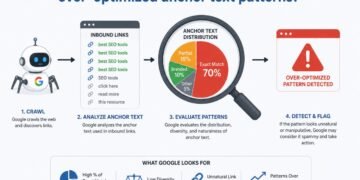
Over-Optimized Anchor Text

Over-optimized anchor text is another common trigger.

If a backlink profile is dominated by identical commercial phrases, the pattern may appear engineered rather than organic.

Natural linking tends to vary because different publishers reference the same topic differently. When anchor usage lacks variation and clusters around precise keyword targets, the pattern becomes measurable.

Over-optimization is not the use of keywords. It is the excessive and repetitive use of them in a coordinated manner.

Related Posts

Can Algorithmic Penalties Be Reversed?

March 3, 2026
How to Recover from a Link Penalty?

How to Recover from a Link Penalty?

February 22, 2026
What Is a Manual Link Penalty?

What Is a Manual Link Penalty?

February 18, 2026

Paid and Undisclosed Link Schemes

Link schemes involving compensation without proper disclosure may also trigger penalties.

These situations can involve:

  • Exchanged links designed primarily to influence rankings
  • Paid placements are lacking appropriate attribution
  • Coordinated campaigns focused on ranking impact rather than editorial value

The underlying issue is intent. When link acquisition prioritizes ranking manipulation over genuine reference logic, it conflicts with policy guidelines.

Search systems evaluate not only whether compensation exists but whether structural patterns reflect artificial promotion.

Low-Quality Network Clustering

Backlinks originating from tightly connected networks of low-quality sites may signal manipulation.

If a large portion of inbound links comes from structurally similar or low-trust domains, the pattern may resemble an artificially constructed network.

Search systems evaluate the broader network. When link sources cluster around low-confidence environments, interpretive trust decreases.

Sudden Link Velocity Spikes

Sudden increases in backlink volume can raise concern when combined with other irregularities.

Rapid acquisition alone is not inherently problematic. However, repetitive velocity spikes paired with anchor uniformity or low-quality domains may indicate coordination.

Historical acquisition patterns matter, as gradual growth differs significantly from abrupt, repeated surges, and velocity becomes meaningful only when evaluated in combination with other signals.

Why These Patterns Are Considered Manipulative

Penalties are not triggered merely by technical rule violations but by the appearance of coordinated influence.

Search systems are designed to detect attempts to override ranking mechanisms artificially.

When link acquisition deviates from editorial logic and reflects control rather than citation, risk increases.

Patterns characterized by uniformity, repetition, and structural engineering suggest manipulation. Precision in unnatural growth often signals deliberate orchestration rather than organic reference.

Algorithmic Versus Manual Outcomes

Not all problematic patterns result in manual penalties. Algorithmic systems may reduce the value of suspicious links without issuing formal actions, whereas a manual penalty typically arises when manipulation appears explicit and substantial. The underlying triggers may be similar, but the difference lies in how the system responds.

A Risk-Based Perspective

When asking what triggers a Google link penalty, the answer lies in pattern convergence.

A single questionable link rarely results in direct action. Risk emerges when multiple signals align:

  • Unnatural growth patterns
  • Anchor over-optimization
  • Network clustering
  • Evidence of coordinated manipulation

Penalties do not arise from isolated mistakes. They arise when patterns consistently reflect manipulation rather than reference.

The trigger is not randomness. It is a structured intent.

Tags: anchor text over optimizationlink penaltylink spamSEO risk signalsUnnatural links
ShareTweetPin

Related Posts

Over-Optimized Anchor Text

Can Over-Optimization Cause Ranking Drops?

by Backlink Sense
March 3, 2026
0

Yes, over-optimization can cause ranking drops, but typically through algorithmic signal recalibration rather than...

Read moreDetails

Structural Errors in Link Prospecting Logic: A Quiet Risk Analysis

February 28, 2026

Signs Your Anchor Text Profile Looks Manipulative

February 26, 2026

What Is Anchor Text Over-Optimization?

February 26, 2026

Leave a Reply Cancel reply

Your email address will not be published. Required fields are marked *

  • About Us
  • Terms of Use
  • Use of Cookies
  • Affiliate Disclosure
  • Contact
  • Privacy Policy
2026 BacklinkSense © All rights reserved.

Welcome Back!

Login to your account below

Forgotten Password?

Retrieve your password

Please enter your username or email address to reset your password.

Log In

Accessibility Toolbar

  • Powered with favoriteLove by Codenroll
No Result
View All Result
  • Anchor Text
    • Anchor Text Context
    • Anchor Text Distribution
    • Anchor Text Strategy
    • Types of Anchor Text
  • Backlink Quality and Analysis
    • Authority and Trust Signals
    • Backlink Analysis Tools
    • Link Context
    • Link Placement
    • Link Quality Signals
    • Link Relevance
  • Link Building Basics
    • How Google Ranks Links
    • Types of Backlinks
    • What Are Backlinks
    • Why Backlinks Matter
  • Link Building Methods
    • Asset-Based Link Building
    • Content-Based Link Building
    • Digital PR and Authority Mentions
    • Passive Link Acquisition
    • Resource and Reference Links
  • Link Building Risks
    • Link Penalties
    • Link Velocity
    • Low-Quality Backlinks
    • Over-Optimized Anchor Text
    • Unnatural Link Patterns
  • Link Outreach
    • Finding Outreach Targets
    • Follow Up in Outreach
    • Outreach Email Strategies
    • Outreach Personalization
    • Relationship Based Outreach

2026 BacklinkSense © All rights reserved.

This website uses cookies to improve your experience and analyze site performance. By continuing to browse, you agree to our Privacy and Cookie Policy.