

Sunday, March 15, 2026
BacklinkSense
  • Anchor Text
    • Anchor Text Context
    • Anchor Text Distribution
    • Anchor Text Strategy
    • Types of Anchor Text
  • Backlink Quality and Analysis
    • Authority and Trust Signals
    • Backlink Analysis Tools
    • Link Context
    • Link Placement
    • Link Quality Signals
    • Link Relevance
  • Link Building Basics
    • How Google Ranks Links
    • Types of Backlinks
    • What Are Backlinks
    • Why Backlinks Matter
  • Link Building Methods
    • Asset-Based Link Building
    • Content-Based Link Building
    • Digital PR and Authority Mentions
    • Passive Link Acquisition
    • Resource and Reference Links
  • Link Building Risks
    • Link Penalties
    • Link Velocity
    • Low-Quality Backlinks
    • Over-Optimized Anchor Text
    • Unnatural Link Patterns
  • Link Outreach
    • Finding Outreach Targets
    • Follow Up in Outreach
    • Outreach Email Strategies
    • Outreach Personalization
    • Relationship Based Outreach
No Result
View All Result
  • Anchor Text
    • Anchor Text Context
    • Anchor Text Distribution
    • Anchor Text Strategy
    • Types of Anchor Text
  • Backlink Quality and Analysis
    • Authority and Trust Signals
    • Backlink Analysis Tools
    • Link Context
    • Link Placement
    • Link Quality Signals
    • Link Relevance
  • Link Building Basics
    • How Google Ranks Links
    • Types of Backlinks
    • What Are Backlinks
    • Why Backlinks Matter
  • Link Building Methods
    • Asset-Based Link Building
    • Content-Based Link Building
    • Digital PR and Authority Mentions
    • Passive Link Acquisition
    • Resource and Reference Links
  • Link Building Risks
    • Link Penalties
    • Link Velocity
    • Low-Quality Backlinks
    • Over-Optimized Anchor Text
    • Unnatural Link Patterns
  • Link Outreach
    • Finding Outreach Targets
    • Follow Up in Outreach
    • Outreach Email Strategies
    • Outreach Personalization
    • Relationship Based Outreach
No Result
View All Result
BacklinkSense
No Result
View All Result
ADVERTISEMENT
How Does Google Evaluate Backlinks Algorithmically?

How Does Google Evaluate Backlinks Algorithmically?

Backlink Sense by Backlink Sense
February 17, 2026
in How Google Ranks Links
Reading Time: 4 mins read
0
Share on FacebookShare on Twitter

Page Contents

  • 1 Backlinks as Graph Signals
  • 2 Evaluation Begins with Structure
  • 3 Related Posts
  • 4 How Does Page Authority Affect Link Strength?
  • 5 Do All Links Pass the Same Value?
  • 6 Does Link Position Affect Rankings?
  • 7 What Signals Make a Backlink Powerful?
  • 8 Contextual Relevance Modeling
  • 9 Algorithmic Evaluation as a Combined System
  • 10 Pattern Recognition Across Profiles
  • 11 Historical Data and Temporal Signals
  • 12 Integration With Other Ranking Systems
  • 13 Signal Dampening and Uncertainty
  • 14 Systemic Rather Than Mechanical
  • 15 A System-Level Perspective
  • 16 Strategic Understanding

Google evaluates backlinks algorithmically. This means backlinks are not simply counted; they are interpreted within a broader framework designed to capture signals such as trust, authority, and relevance.

Backlink evaluation is not a standalone metric. It is embedded within larger ranking systems. Only within that broader system can link evaluation be properly understood, without oversimplification.

Backlinks as Graph Signals

At a foundational level, the web functions as a graph.

  • Pages are nodes.

  • Links are connections between nodes.

Backlinks deepen this structure. They help search systems understand relationships between pages, patterns of reference, and structural positioning within the network.

The value of a page is not derived from a single backlink. It emerges from how the page is positioned within the larger web graph.

Evaluation Begins with Structure

Authority is not assigned directly; it emerges from structure, as a page becomes interpreted as more important within the information network when many distinct pages link to it.

This interpretation is recursive. A backlink’s value is partially influenced by the importance of the linking page. That linking page’s importance, in turn, depends on its own backlink structure.

Importance flows through the graph.

Related Posts

How Does Page Authority Affect Link Strength?

How Does Page Authority Affect Link Strength?

February 17, 2026
Do All Links Pass the Same Value?

Do All Links Pass the Same Value?

February 17, 2026
Does Link Position Affect Rankings?

Does Link Position Affect Rankings?

February 17, 2026
What Signals Make a Backlink Powerful?

What Signals Make a Backlink Powerful?

February 17, 2026

Contextual Relevance Modeling

Structural connection alone is insufficient. If two linked pages share thematic consistency, the link may carry stronger contextual weight. If the relationship appears disconnected from the content, the interpretive significance changes.

This is not keyword matching. It is semantic modeling. Modern systems detect patterns across language usage, entity relationships, and conceptual clustering. Backlinks participate in that clustering process.

Algorithmic Evaluation as a Combined System

Link structures do not operate independently from topical modeling. Algorithmic evaluation combines:

  • Structural signals

  • Contextual signals

  • Behavioral signals

Backlinks are integrated into this multi-layered interpretation.

Pattern Recognition Across Profiles

Backlinks are rarely evaluated in isolation.

Search systems examine patterns across an entire link profile, including:

  • Distribution of link sources

  • Growth dynamics

  • Diversity

  • Interconnectivity structures

Natural growth tends to appear uneven and distributed. Artificial construction often appears uniform or concentrated.

Evaluation focuses on statistical consistency rather than rigid rules.

Historical Data and Temporal Signals

Backlink interpretation also incorporates time.

Search systems evaluate how link structures evolve. A gradual and stable expansion differs significantly from abrupt structural shifts.

Temporal signals help identify irregularities because link systems are interpreted relative to historical baselines and broader web behavior.

Backlinks therefore, function not only as relational signals but also as temporal signals within a dynamic system.

Integration With Other Ranking Systems

Backlinks are not evaluated independently from other ranking signals.

They interact with:

  • Content relevance

  • Entity modeling

  • User behavior signals

  • Spam detection systems

A backlink can strengthen interpretive signals around a page’s importance, but it does not override broader quality assessments.

Link data is integrated into a unified ranking system rather than operating as a dominant standalone factor.

Signal Dampening and Uncertainty

Modern search systems are built to manage noise.

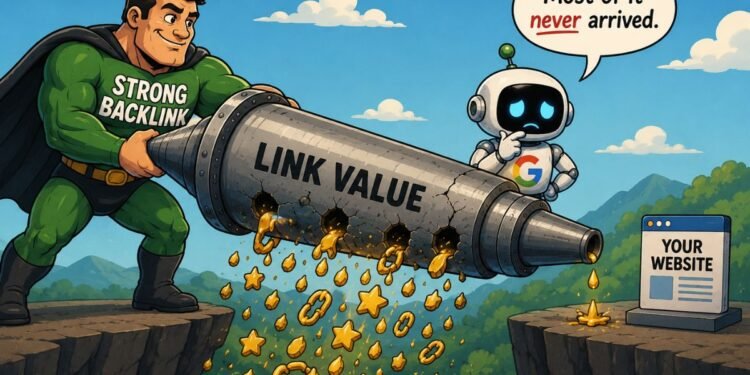
Not all backlinks carry equal weight, and influence is not linear. Some signals may be dampened when they conflict with broader systemic patterns.

Rather than reacting mechanically to anomalies, systems often reduce signal strength probabilistically. Backlink evaluation is dynamic. Confidence and consistency influence how signals are interpreted over time.

Systemic Rather Than Mechanical

Understanding how Google evaluates backlinks algorithmically requires avoiding mechanical thinking.

There is no simple equation such as:

X backlinks = Y ranking increase.

Instead, backlinks are incorporated into machine learning systems that evaluate multiple signals simultaneously.

Each backlink contributes marginally within a complex signal environment. Interpretation occurs at the system level, not at the individual link level.

A System-Level Perspective

Backlink evaluation operates across three interacting dimensions:

  • Structural modeling: positioning within the web graph

  • Contextual modeling: thematic and semantic alignment

  • Pattern analysis: consistency across profiles and time

These dimensions continuously interact.

Backlinks matter not because of quantity alone, but because they influence how a page is positioned within a dynamic informational ecosystem.

Strategic Understanding

At a strategic level, backlinks can be understood as relational signals within a probabilistic system.

They do not exist independently. They influence positioning, interpretation, and systemic credibility.

Algorithmic backlink evaluation is interpretive rather than mechanical. It reflects how structure, context, and temporal behavior converge within a unified ranking environment.

Tags: Authority modelingBacklink evaluationSearch signals
ShareTweetPin

Related Posts

Types of Anchor Text

What is Image Anchor Text?

by Backlink Sense
March 15, 2026
0

Image anchor text is a type of link wherein the anchor is not text...

Read moreDetails

What Is Compound Anchor Text?

March 9, 2026

What Is Citation Anchor Text?

March 9, 2026

Examples of Strong vs Weak Link Context

March 7, 2026

Leave a Reply Cancel reply

Your email address will not be published. Required fields are marked *

  • About Us
  • Terms of Use
  • Use of Cookies
  • Affiliate Disclosure
  • Contact
  • Privacy Policy
2026 BacklinkSense © All rights reserved.

Welcome Back!

Login to your account below

Forgotten Password?

Retrieve your password

Please enter your username or email address to reset your password.

Log In

Accessibility Toolbar

  • Powered with favoriteLove by Codenroll
No Result
View All Result
  • Anchor Text
    • Anchor Text Context
    • Anchor Text Distribution
    • Anchor Text Strategy
    • Types of Anchor Text
  • Backlink Quality and Analysis
    • Authority and Trust Signals
    • Backlink Analysis Tools
    • Link Context
    • Link Placement
    • Link Quality Signals
    • Link Relevance
  • Link Building Basics
    • How Google Ranks Links
    • Types of Backlinks
    • What Are Backlinks
    • Why Backlinks Matter
  • Link Building Methods
    • Asset-Based Link Building
    • Content-Based Link Building
    • Digital PR and Authority Mentions
    • Passive Link Acquisition
    • Resource and Reference Links
  • Link Building Risks
    • Link Penalties
    • Link Velocity
    • Low-Quality Backlinks
    • Over-Optimized Anchor Text
    • Unnatural Link Patterns
  • Link Outreach
    • Finding Outreach Targets
    • Follow Up in Outreach
    • Outreach Email Strategies
    • Outreach Personalization
    • Relationship Based Outreach

2026 BacklinkSense © All rights reserved.

This website uses cookies to improve your experience and analyze site performance. By continuing to browse, you agree to our Privacy and Cookie Policy.