


Tuesday, July 14, 2026
BacklinkSense
  • Anchor Text
    • Anchor Text Context
    • Anchor Text Distribution
    • Anchor Text Strategy
    • Types of Anchor Text
  • Backlink Quality and Analysis
    • Authority and Trust Signals
    • Backlink Analysis Tools
    • Link Context
    • Link Placement
    • Link Quality Signals
    • Link Relevance
  • Link Building Basics
    • How Google Ranks Links
    • Types of Backlinks
    • What Are Backlinks
    • Why Backlinks Matter
  • Link Building Methods
    • Asset-Based Link Building
    • Content-Based Link Building
    • Digital PR and Authority Mentions
    • Passive Link Acquisition
    • Resource and Reference Links
  • Link Building Risks
    • Link Penalties
    • Link Velocity
    • Low-Quality Backlinks
    • Over-Optimized Anchor Text
    • Unnatural Link Patterns
  • Link Outreach
    • Finding Outreach Targets
    • Follow Up in Outreach
    • Outreach Email Strategies
    • Outreach Personalization
    • Relationship Based Outreach
No Result
View All Result
  • Anchor Text
    • Anchor Text Context
    • Anchor Text Distribution
    • Anchor Text Strategy
    • Types of Anchor Text
  • Backlink Quality and Analysis
    • Authority and Trust Signals
    • Backlink Analysis Tools
    • Link Context
    • Link Placement
    • Link Quality Signals
    • Link Relevance
  • Link Building Basics
    • How Google Ranks Links
    • Types of Backlinks
    • What Are Backlinks
    • Why Backlinks Matter
  • Link Building Methods
    • Asset-Based Link Building
    • Content-Based Link Building
    • Digital PR and Authority Mentions
    • Passive Link Acquisition
    • Resource and Reference Links
  • Link Building Risks
    • Link Penalties
    • Link Velocity
    • Low-Quality Backlinks
    • Over-Optimized Anchor Text
    • Unnatural Link Patterns
  • Link Outreach
    • Finding Outreach Targets
    • Follow Up in Outreach
    • Outreach Email Strategies
    • Outreach Personalization
    • Relationship Based Outreach
No Result
View All Result
BacklinkSense
No Result
View All Result

Home - Link Building Basics - How Google Ranks Links - How Similar Backlinks Create Different Ranking Signals

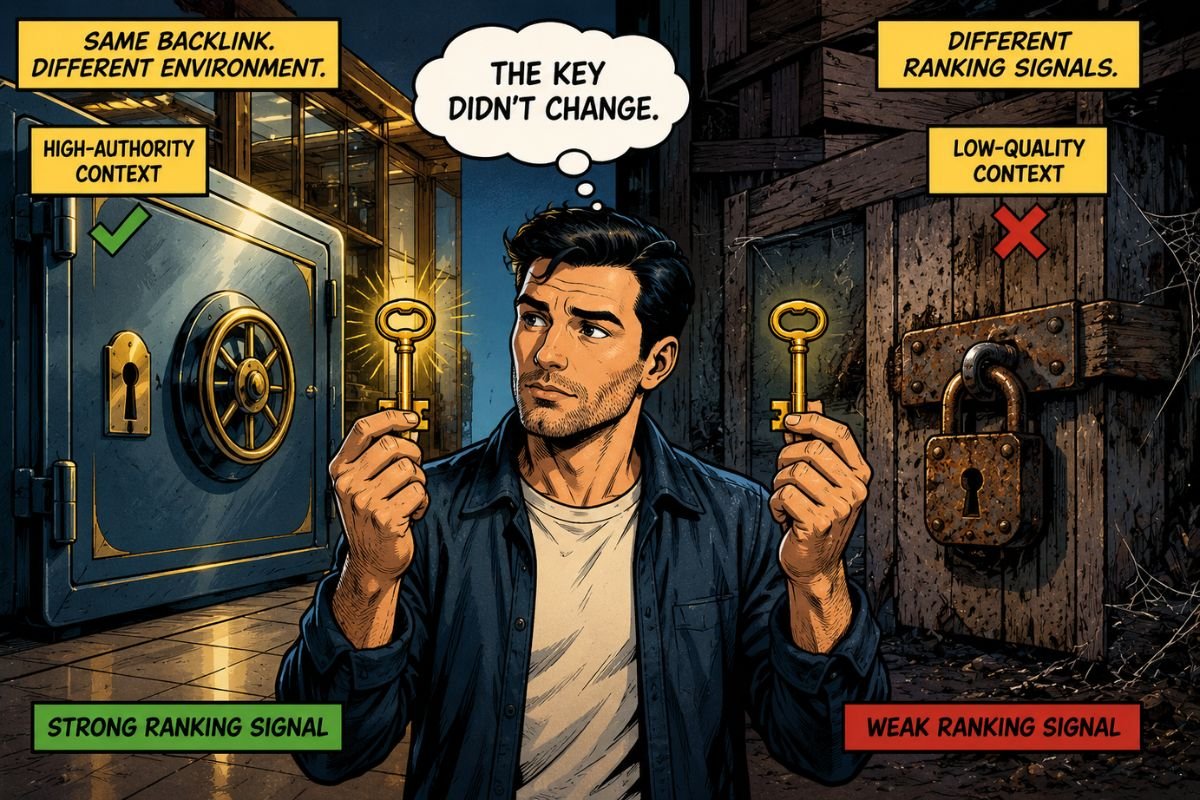
Illustration showing how similar backlinks create different ranking signals when the same backlink appears in high authority and low quality content environments.

How Similar Backlinks Create Different Ranking Signals

Backlink Sense by Backlink Sense
July 11, 2026
in How Google Ranks Links
Reading Time: 3 mins read
Share On FacebookShare On Reddit

Page Contents

  • 1 Similar Appearance Does Not Mean Similar Interpretation
  • 2 Minor Environmental Differences Can Change the Interpretation
  • 3 Related Posts
  • 4 Why Google Uses Multiple Link Signals
  • 5 Reasons Why Some Backlinks Transmit More Signals Than Others
  • 6 How Does Google Interpret Link Relationships?
  • 7 Environmental Distinctions May Remain Unseen
  • 8 Ranking Signals Are Developed With Supporting Evidence
  • 9 Similar Backlinks Occur in Different Informational Environments
  • 10 Variations Do Not Have To Be Obvious To Create Differences
  • 11 Search Systems Interpret Relationships Instead of Patterns Alone
  • 12 Similar Backlinks Rarely Occur Under Identical Conditions

Similar backlinks cannot create identical ranking signals because search systems consider the environment in which backlinks occur instead of evaluating the links themselves.

Even backlinks that look nearly identical can still be interpreted differently in terms of ranking signals because the information that surrounds and supports the relationship between the two pages differs.

That explains how similar backlinks can contribute different ranking signals.

Similar Appearance Does Not Mean Similar Interpretation

Backlinks can be analyzed in terms of features that are easy to see.

Links can look similar because of the same website, placement, or anchor text. But there is much more information surrounding each backlink.

Environmental differences may be difficult to notice when two links are compared, yet they can still change their interpretation.

As a result, two links that look similar can contribute different degrees of confidence to the interpretation of the connection between the pages.

Minor Environmental Differences Can Change the Interpretation

The context almost never stays the same across different environments.

A backlink can be supported by an environment that emphasizes the relationship more strongly than another backlink.

The difference may be relatively small but still influence the interpretation of the relationship.

Related Posts

Illustration showing why Google uses multiple link signals, with a team evaluating site credibility, topical fit, content environment, source strength, and position value before making a final backlink assessment.

Why Google Uses Multiple Link Signals

July 12, 2026

Reasons Why Some Backlinks Transmit More Signals Than Others

June 28, 2026

How Does Google Interpret Link Relationships?

June 27, 2026

Differences in the surrounding discussion, editorial flow, and referencing can influence how clearly the relationship between the pages is expressed.

These environmental differences may be negligible in terms of visual comparison but still change the interpretation of the backlink.

Environmental Distinctions May Remain Unseen

Sometimes, the most significant differences between backlinks cannot be seen immediately.

It means that differences in the surrounding environment may also go unnoticed because they do not affect the physical backlink itself.

For instance, the surrounding content may demonstrate different degrees of consistency in referencing, the connection between the pages may be emphasized more naturally, or the reference may be placed more consistently with the page’s purpose.

Environmental differences like these remain unseen because they exist beyond the physical backlink.

This is one more reason why visually similar backlinks can contribute different ranking signals.

Ranking Signals Are Developed With Supporting Evidence

Search systems interpret relationships based on the evidence surrounding them rather than relying only on information about the backlinks themselves.

Backlinks are not isolated from the pages they belong to.

Instead, the relationship can become clearer because of the growing amount of supporting evidence.

In such a case, a backlink surrounded by more supporting elements can contribute more interpretive confidence than another backlink with fewer supporting elements.

The difference occurs because of accumulated interpretation rather than any obvious feature.

Similar Backlinks Occur in Different Informational Environments

Two pages discussing the same subject can still create different informational environments.

One page can place the backlink as part of a broader discussion, while another page may include the reference with much less explanation.

Neither backlink appears unusual.

But the surrounding environment can tell us more about the level of certainty used to justify the connection.

Search systems consider broader informational environments when interpreting backlinks.

Variations Do Not Have To Be Obvious To Create Differences

Not all differences have to be noticeable to change interpretation.

Several small variations can accumulate.

Differences in surrounding context, editorial continuity, page focus, and relationship clarity can create a different overall impression.

Individual variations may seem negligible.

Combined together, they can create enough evidence to interpret two visually similar backlinks differently.

This explains why backlinks that look the same may not contribute the same ranking signals.

Search Systems Interpret Relationships Instead of Patterns Alone

Comparing backlinks by looking only at their visible features may seem like the best option.

But search systems are interested in interpreting the relationships represented by backlinks.

The same structural pattern may represent two different relationships because of differences in the surrounding environment.

One backlink may emphasize the connection between the pages, while another may simply confirm the existence of the link.

Although the backlink itself may look the same, the underlying relationship may still be interpreted differently.

Similar Backlinks Rarely Occur Under Identical Conditions

Identical backlinks are uncommon on the web.

Each page develops within its own structure of editorial flow, purpose, and surrounding environment.

Since every environment is unique, visually similar backlinks are rarely created under identical conditions.

That is why visually similar backlinks should not create the same ranking signals.

Tags: backlink analysisLink RelationshipsRanking signalsSearch Engine InterpretationSEO fundamentals
ShareShareShareShareSend

Related Posts

Authority from Relevance in Search Systems
Authority and Trust Signals

Reasons for Distinguishing Authority from Relevance in Search Systems

by Backlink Sense
June 2, 2026
Types of Anchor Text

What Is Partial Match Anchor Text?

by Backlink Sense
March 5, 2026
Content-Based Link Building

What Is Content-Based Link Building?

by Backlink Sense
February 13, 2026
Backlink Analysis Tools

How to Detect Toxic Backlinks Using SEO Tools

by Backlink Sense
May 13, 2026
Content-Based Link Building

Reasons Why Original Research Gets Backlinks

by Backlink Sense
June 28, 2026
Load More
  • About Us
  • Terms of Use
  • Use of Cookies
  • Affiliate Disclosure
  • Contact
  • Privacy Policy
2026 BacklinkSense © All rights reserved.

Welcome Back!

Login to your account below

Forgotten Password?

Retrieve your password

Please enter your username or email address to reset your password.

Log In

Accessibility Toolbar

  • Powered with favoriteLove by Codenroll
No Result
View All Result
  • Anchor Text
    • Anchor Text Context
    • Anchor Text Distribution
    • Anchor Text Strategy
    • Types of Anchor Text
  • Backlink Quality and Analysis
    • Authority and Trust Signals
    • Backlink Analysis Tools
    • Link Context
    • Link Placement
    • Link Quality Signals
    • Link Relevance
  • Link Building Basics
    • How Google Ranks Links
    • Types of Backlinks
    • What Are Backlinks
    • Why Backlinks Matter
  • Link Building Methods
    • Asset-Based Link Building
    • Content-Based Link Building
    • Digital PR and Authority Mentions
    • Passive Link Acquisition
    • Resource and Reference Links
  • Link Building Risks
    • Link Penalties
    • Link Velocity
    • Low-Quality Backlinks
    • Over-Optimized Anchor Text
    • Unnatural Link Patterns
  • Link Outreach
    • Finding Outreach Targets
    • Follow Up in Outreach
    • Outreach Email Strategies
    • Outreach Personalization
    • Relationship Based Outreach

2026 BacklinkSense © All rights reserved.

This website uses cookies to improve your experience and analyze site performance. By continuing to browse, you agree to our Privacy and Cookie Policy.