

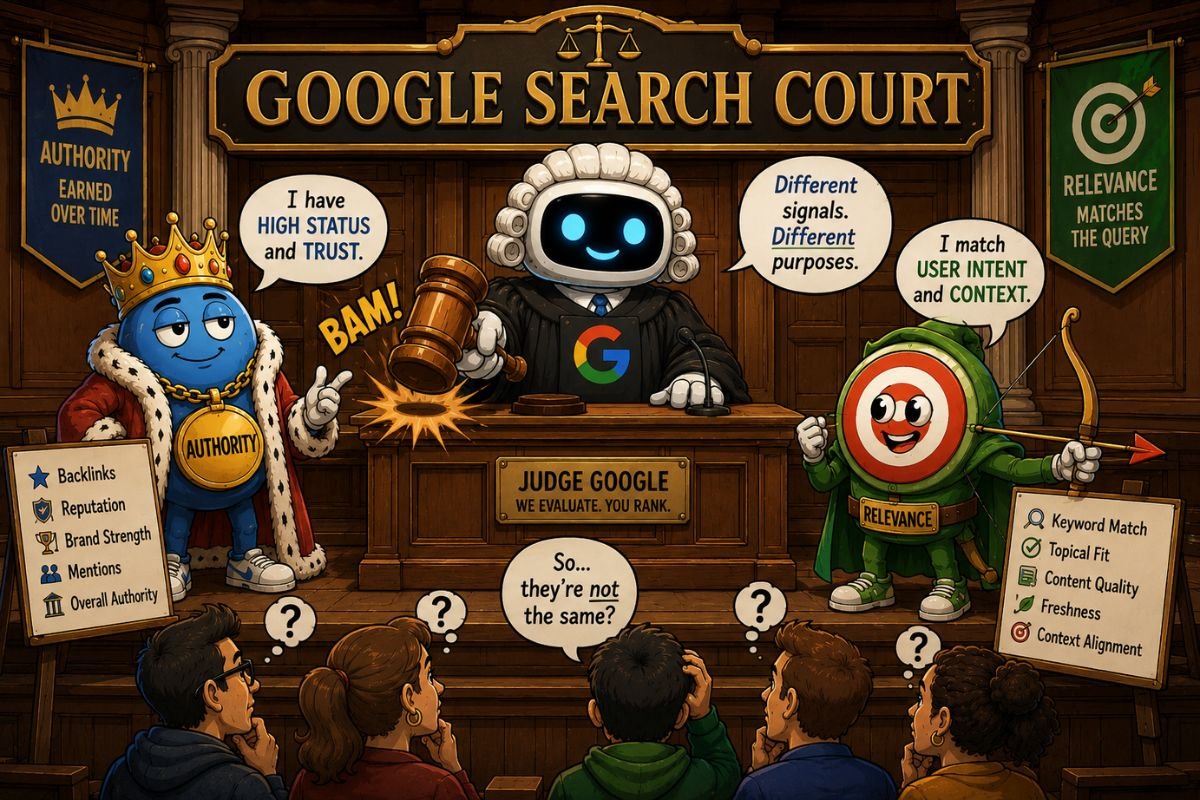

Distinguishing authority from relevance helps search engines produce more accurate and balanced rankings.
Although a webpage may appear highly trustworthy overall, that does not automatically mean it is the best resource for a specific topic, question, or search intent.
Authority and relevance are closely connected concepts, but they solve very different interpretive problems inside modern ranking systems.
Understanding this distinction is important because modern search engines no longer rely on one-dimensional evaluation models.
Instead, they operate through multiple interpretive layers simultaneously.
Authority and Relevance Solve Different Problems
Authority and relevance exist to answer different questions about webpage quality.
Authority primarily helps estimate how trustworthy, reliable, and established a website or page appears within the broader web ecosystem.
Relevance, on the other hand, helps determine how closely the content connects to the subject matter behind the search query itself.
Both are essential.
However, they operate differently.



A highly reputable website does not automatically become highly relevant for every topic it discusses. Likewise, a highly relevant page does not suddenly inherit broad authority simply because it covers a subject accurately.
This distinction explains why search engines cannot rely on one universal quality signal when evaluating webpages, especially when topical authority signals are built through relevance rather than reputation alone.
Why Search Systems Separate Both Concepts
Each concept addresses a separate ranking challenge.
Authority helps search systems estimate broader trust and reliability signals surrounding a domain or page.
Relevance helps determine topical suitability and contextual alignment with the user’s intent.
Because these layers solve different interpretive problems, the same webpage may score strongly in one dimension while remaining relatively weak in another.
A page can therefore appear highly authoritative while lacking strong topical alignment.
The reverse situation is also possible.
This separation is necessary because search quality would deteriorate significantly if one factor completely dominated the evaluation process.
Authority Does Not Automatically Create Relevance
One of the clearest examples of this distinction appears when powerful websites publish content outside their normal topical scope.
Large trusted websites often possess strong authority signals overall because of accumulated trust, historical consistency, broad recognition, and established reputational patterns.
However, individual pages on those websites may still lack topical precision or contextual depth for specific subjects.
In such situations, authority remains present, but weaker relevance signals may still limit how strongly that page is interpreted within a specific topic.
Without separating these two concepts, powerful domains could potentially dominate rankings for almost any subject, regardless of topical suitability.
That would create highly distorted search results where trust alone outweighs contextual accuracy.
Search systems therefore, appear to evaluate topical alignment independently from general authority.
Relevance Operates Through Contextual Interpretation
Relevance itself depends on numerous contextual factors.
Search systems increasingly appear to evaluate topical suitability through broader semantic interpretation rather than through simple keyword matching alone.
This may involve factors such as topic depth, contextual accuracy, subject consistency, semantic relationships, alignment with query intent, and broader topical integration across the page.
Because of this, relevance often functions much more at the page level than at the domain level.
Even highly reputable websites may contain pages with relatively weak topical relevance simply because their coverage is broad and generalized.
Meanwhile, smaller websites focused narrowly on one subject area may produce highly relevant content despite having weaker overall authority signals.
This distinction helps explain why smaller topical resources sometimes outperform larger domains for highly specialized searches, particularly when comparing broad domain metrics with the actual authority carried by individual links.
Separating Both Signals Improves Search Quality
Separating authority from relevance is essential for maintaining balanced search quality.
If search systems relied almost entirely on authority signals, rankings would gradually become dominated by the largest and most powerful websites regardless of topical precision.
That would reduce the usefulness of search results significantly.
Users typically expect webpages that directly address the specific context behind their searches rather than simply pages published by the strongest domains overall.
Distinguishing authority from relevance, therefore allows search systems to provide more contextually precise results.
This is one reason modern ranking systems appear increasingly layered and interpretive rather than purely authority-driven.
Search Systems Evaluate Multiple Layers Simultaneously
Modern search algorithms operate through multiple overlapping interpretive systems at once.
Authority helps estimate overall trustworthiness and reliability.
Relevance helps estimate topical suitability and semantic alignment.
While these signals may overlap in certain situations, they still function relatively independently from one another.
This creates more nuanced ranking environments.
A webpage may therefore appear:
- authoritative and highly topical
- authoritative but only partially relevant
- highly relevant but less authoritative
- weak in both dimensions simultaneously
This multi-layered structure helps explain why search results often appear more context-sensitive than older SEO models suggested.
Why This Distinction Matters
Separating authority from relevance is critical for maintaining the overall quality of search systems.
Authority estimates broader trust and reliability.
Relevance evaluates contextual suitability for the specific query itself.
Both concepts solve different ranking challenges.
Without authority evaluation, search systems would struggle to distinguish trustworthy resources from unreliable ones.
Without relevance evaluation, rankings could become dominated by powerful domains regardless of topical accuracy.
Modern search quality depends heavily on balancing both layers simultaneously.
This is one reason search interpretation became increasingly complex over time.
Search systems no longer appear to evaluate websites through one universal authority model alone.
Instead, they continuously balance trust, topical alignment, contextual meaning, semantic relationships, and user intent together within the same interpretive environment.