Sunday, March 15, 2026
BacklinkSense
  • Anchor Text
    • Anchor Text Context
    • Anchor Text Distribution
    • Anchor Text Strategy
    • Types of Anchor Text
  • Backlink Quality and Analysis
    • Authority and Trust Signals
    • Backlink Analysis Tools
    • Link Context
    • Link Placement
    • Link Quality Signals
    • Link Relevance
  • Link Building Basics
    • How Google Ranks Links
    • Types of Backlinks
    • What Are Backlinks
    • Why Backlinks Matter
  • Link Building Methods
    • Asset-Based Link Building
    • Content-Based Link Building
    • Digital PR and Authority Mentions
    • Passive Link Acquisition
    • Resource and Reference Links
  • Link Building Risks
    • Link Penalties
    • Link Velocity
    • Low-Quality Backlinks
    • Over-Optimized Anchor Text
    • Unnatural Link Patterns
  • Link Outreach
    • Finding Outreach Targets
    • Follow Up in Outreach
    • Outreach Email Strategies
    • Outreach Personalization
    • Relationship Based Outreach
No Result
View All Result
  • Anchor Text
    • Anchor Text Context
    • Anchor Text Distribution
    • Anchor Text Strategy
    • Types of Anchor Text
  • Backlink Quality and Analysis
    • Authority and Trust Signals
    • Backlink Analysis Tools
    • Link Context
    • Link Placement
    • Link Quality Signals
    • Link Relevance
  • Link Building Basics
    • How Google Ranks Links
    • Types of Backlinks
    • What Are Backlinks
    • Why Backlinks Matter
  • Link Building Methods
    • Asset-Based Link Building
    • Content-Based Link Building
    • Digital PR and Authority Mentions
    • Passive Link Acquisition
    • Resource and Reference Links
  • Link Building Risks
    • Link Penalties
    • Link Velocity
    • Low-Quality Backlinks
    • Over-Optimized Anchor Text
    • Unnatural Link Patterns
  • Link Outreach
    • Finding Outreach Targets
    • Follow Up in Outreach
    • Outreach Email Strategies
    • Outreach Personalization
    • Relationship Based Outreach
No Result
View All Result
BacklinkSense
No Result
View All Result
ADVERTISEMENT
Link Velocity and Does It Matter?

What Is Link Velocity and Does It Matter?

Backlink Sense by Backlink Sense
February 9, 2026
in Link Velocity
Reading Time: 5 mins read
0
Share on FacebookShare on Twitter

Page Contents

  • 1 Defining Link Velocity Clearly
  • 2 Natural Growth vs Artificial Spikes
  • 3 Natural Link Growth
  • 4 Related Posts
  • 5 When Link Velocity Matters More
  • 6 When Velocity Is Less Concerning
  • 7 The Role of Consistency
  • 8 Velocity and Risk Interpretation
  • 9 What Link Velocity Does Not Mean
  • 10 A Balanced Perspective

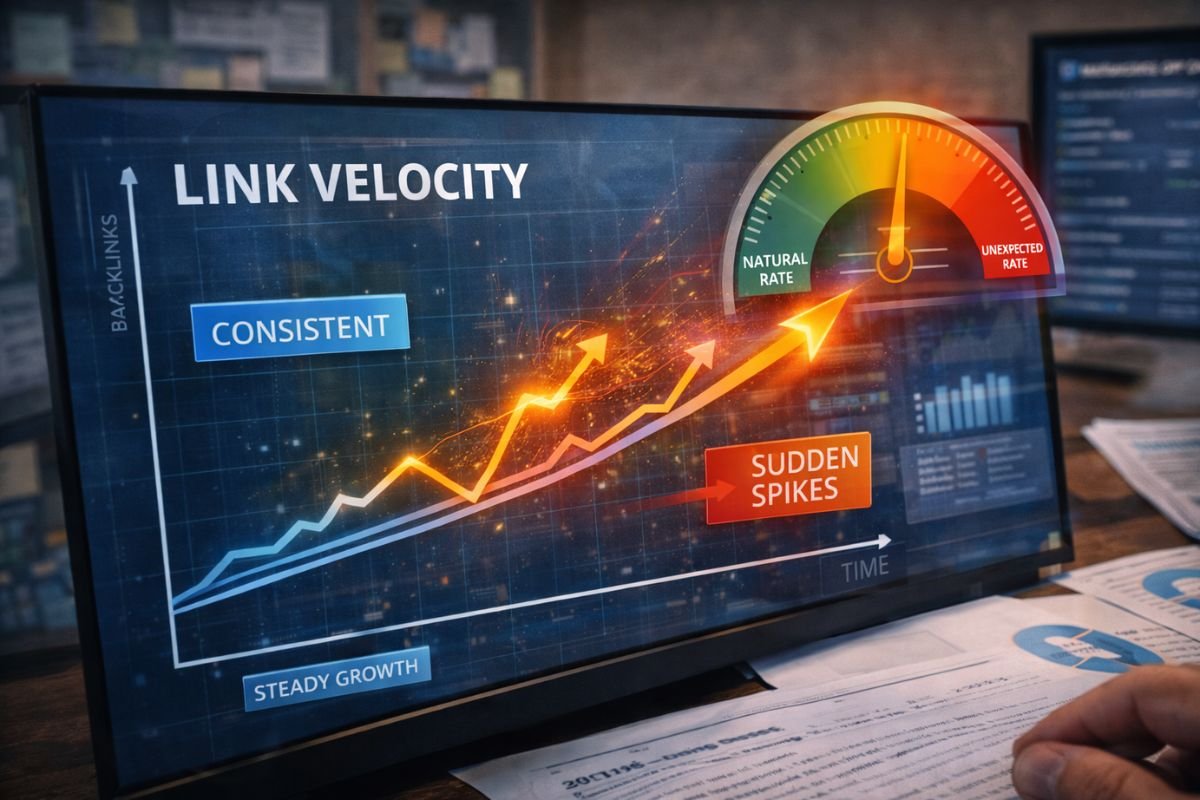
Link velocity is the rate at which a website acquires new backlinks. In other words, it measures the pattern of link acquisition over time. Does it matter? Yes, but only in context.

If a site gains backlinks at a consistent and proportionate rate, that pattern is generally neutral or positive. If growth appears irregular, disproportionate, or disconnected from observable activity, it may raise questions.

Velocity is about patterns, not speed.

Defining Link Velocity Clearly

Link velocity is typically evaluated through:

  • New backlinks acquired weekly or monthly
  • New referring domains gained
  • Shifts in acquisition patterns over time

Velocity does not measure quality. It measures change.

For example, if a site consistently gains five new referring domains each month, its growth appears stable. If it suddenly gains 300 referring domains in a single week, that indicates a spike.

Spikes are not inherently problematic. Interpretation depends on context.

Natural Growth vs Artificial Spikes

The central distinction is whether growth appears natural or artificial.

Natural Link Growth

Natural velocity often aligns with observable activity, such as:

  • Publishing strong content
  • Media coverage
  • Product launches
  • Industry recognition
  • Viral engagement

When link growth corresponds with real-world visibility, higher velocity is expected. Artificial spikes, however, are often disconnected from external signals.

Related Posts

No Content Available

Indicators may include:

  • Large volumes of links from unrelated domains
  • Anchor text concentration during bursts
  • Link surges without brand or media presence
  • Clusters from low quality or networked sites

Search systems evaluate velocity within broader behavioral patterns.

When Link Velocity Matters More

Velocity becomes more relevant when link growth appears detached from real activity.

Examples include:

  • New domains receiving high volume links without public exposure
  • Recurring spikes that suggest coordinated campaigns
  • Anchor repetition concentrated within spike periods

Velocity alone is rarely the issue. Velocity combined with unnatural patterns is.

When Velocity Is Less Concerning

High velocity is not automatically risky.

It may occur due to:

  • Viral content
  • News and media exposure
  • Major brand campaigns

In these cases, velocity reflects audience engagement. Growth corresponds to visibility. Consistency over time carries more weight than temporary spikes.

The Role of Consistency

Steady acquisition of new referring domains may indicate credibility.

Consistent growth suggests:

  • Ongoing visibility
  • Topical relevance
  • Active contribution

Sustainable authority modeling depends more on stable patterns than raw numbers. Consistency does not mean identical numbers each month. Variation is natural. What matters is the absence of unnatural clustering.

Velocity and Risk Interpretation

Velocity becomes a risk signal when:

  • Growth is disproportionate to domain age
  • Patterns suggest coordinated acquisition
  • Links originate from concentrated domain clusters
  • Anchor repetition intensifies during spikes

Search systems evaluate cumulative behavior. One spike rarely creates risk. Repeated unnatural patterns may affect trust interpretation. Velocity is one factor among many, including relevance, authority distribution, and contextual placement.


What Link Velocity Does Not Mean

Link velocity does not automatically improve rankings, and faster growth is not inherently better, since quality determines signal strength. It is not something that should be engineered artificially, as attempts to manipulate growth patterns tend to create detectable anomalies. Organic growth evolves naturally, while artificial growth attempts to simulate it, and search systems distinguish between the two through pattern recognition.

A Balanced Perspective

So what is link velocity, and does it matter? It is the rate at which a site gains links, interpreted within its historical and contextual patterns. Organic velocity, even when high, is rarely problematic if it aligns with real-world activity, whereas artificial acceleration without supporting signals introduces risk. Link velocity is not about speed, but about understanding growth within context.

Tags: Authority modelingBacklink growth patternsLink acquisition analysisSEO risk signals
ShareTweetPin

Related Posts

Over-Optimized Anchor Text

Can Over-Optimization Cause Ranking Drops?

by Backlink Sense
March 3, 2026
0

Yes, over-optimization can cause ranking drops, but typically through algorithmic signal recalibration rather than...

Read moreDetails

Structural Errors in Link Prospecting Logic: A Quiet Risk Analysis

February 28, 2026

Signs Your Anchor Text Profile Looks Manipulative

February 26, 2026

What Is Anchor Text Over-Optimization?

February 26, 2026
  • About Us
  • Terms of Use
  • Use of Cookies
  • Affiliate Disclosure
  • Contact
  • Privacy Policy
2026 BacklinkSense © All rights reserved.

Welcome Back!

Login to your account below

Forgotten Password?

Retrieve your password

Please enter your username or email address to reset your password.

Log In

Accessibility Toolbar

  • Powered with favoriteLove by Codenroll
No Result
View All Result
  • Anchor Text
    • Anchor Text Context
    • Anchor Text Distribution
    • Anchor Text Strategy
    • Types of Anchor Text
  • Backlink Quality and Analysis
    • Authority and Trust Signals
    • Backlink Analysis Tools
    • Link Context
    • Link Placement
    • Link Quality Signals
    • Link Relevance
  • Link Building Basics
    • How Google Ranks Links
    • Types of Backlinks
    • What Are Backlinks
    • Why Backlinks Matter
  • Link Building Methods
    • Asset-Based Link Building
    • Content-Based Link Building
    • Digital PR and Authority Mentions
    • Passive Link Acquisition
    • Resource and Reference Links
  • Link Building Risks
    • Link Penalties
    • Link Velocity
    • Low-Quality Backlinks
    • Over-Optimized Anchor Text
    • Unnatural Link Patterns
  • Link Outreach
    • Finding Outreach Targets
    • Follow Up in Outreach
    • Outreach Email Strategies
    • Outreach Personalization
    • Relationship Based Outreach

2026 BacklinkSense © All rights reserved.

This website uses cookies to improve your experience and analyze site performance. By continuing to browse, you agree to our Privacy and Cookie Policy.