




Page Contents
- 1 Anchor Text Distribution as a Pattern Signal
- 2 Related Posts
- 3 How to Analyze Anchor Text Distribution in a Backlink Profile
- 4 How to Diversify Anchor Text Without Creating Risk
- 5 How to Fix an Unnatural Anchor Text Distribution
- 6 How Much Exact Match Is Too Much?
- 7 What a Natural Anchor Text Distribution Reflects
- 8 When Distribution Becomes a Risk Signal
- 9 Distribution Over Time
- 10 What Not To Do
- 11 Anchor Text Distribution as Context, Not Control
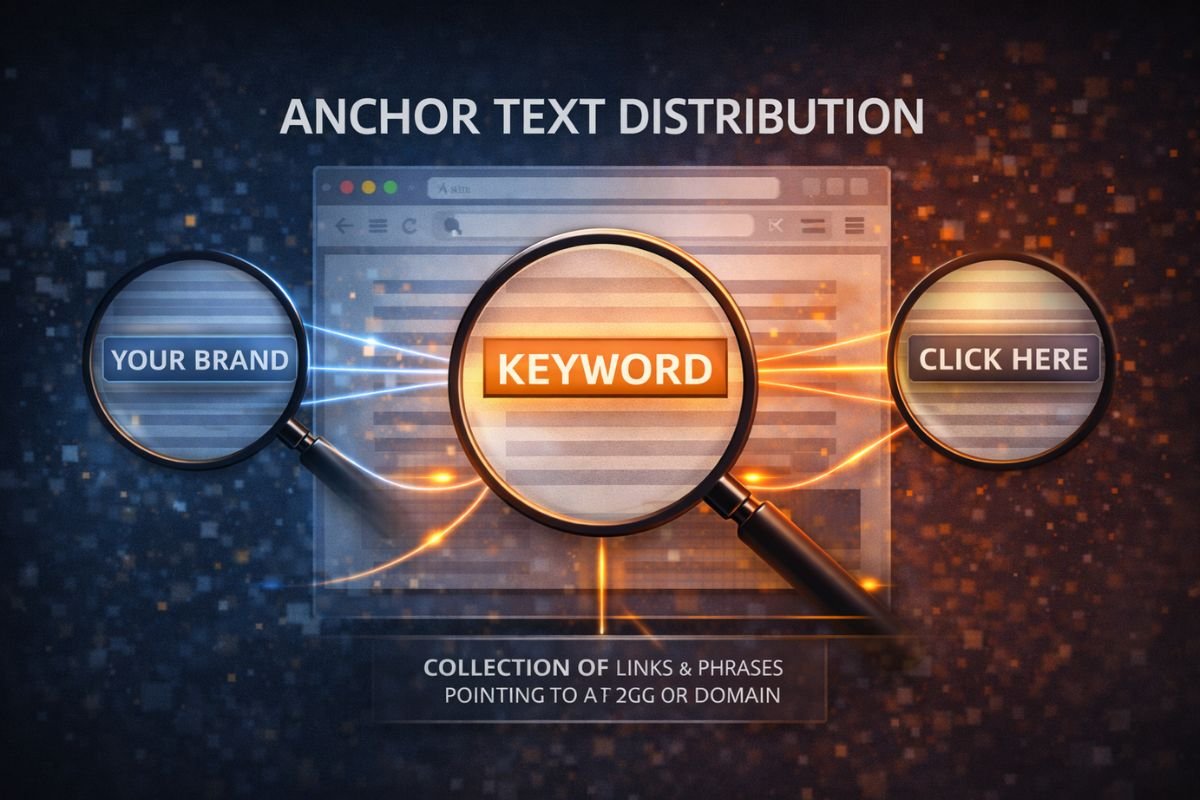
Anchor text distribution is not about a single link. It is about a collection of links. It is not about one anchor phrase. It is about the range of anchor texts pointing to a page or a domain.
In other words, distribution reflects how different types of anchor text accumulate over time. It looks at branded terms, exact matches, generic phrases, and contextual variations as a whole rather than in isolation.
If a link profile shows strong concentration around a single commercial keyword, that concentration becomes the signal. The more varied the phrasing, the branded references, and the contextual expressions, the more natural the pattern tends to appear.
Anchor text distribution matters because it turns raw link data into something interpretable.
Anchor Text Distribution as a Pattern Signal
Distribution functions as a pattern signal rather than a rigid rule.
When analyzing a backlink profile, the focus is not only on counting links but on observing proportions.
This includes:
-
The percentage of branded anchors
-
The percentage of exact match anchors
-
The presence of generic anchors
-
The variation across semantically related phrases
The objective is not perfection. It is proportionality. A natural distribution is rarely uniform. It is rarely symmetrical. It has variation. It has an imbalance. It reflects how different authors reference a page differently.
When anchor text becomes overly concentrated, that variation disappears. Texture is replaced by uniformity.
What a Natural Anchor Text Distribution Reflects
A natural distribution often includes:
-
A significant share of branded anchors
-
Contextual or descriptive phrases
-
Variations around the same topic
-
Some generic anchors
It is rarely balanced in a mathematical sense. A homepage may attract mostly branded anchors. A resource page may attract more descriptive anchors. The distribution reflects how the content is cited.
The key is diversity combined with coherence.
When Distribution Becomes a Risk Signal
Anchor text distribution becomes a risk signal when it reflects coordination rather than independent referencing.
Examples of imbalance may include:
-
High concentration of identical commercial anchors
-
Very limited branded or entity-based anchors
-
Repetition of keyword-heavy anchors across unrelated domains
These signals do not operate independently. They interact with link velocity, source quality, and topical alignment. Anchor text distribution often reveals those underlying patterns more clearly.
Artificially constructed ratios tend to alter interpretation.
Distribution Over Time
Anchor text distribution is dynamic. It evolves. A newly published page may initially attract only a few anchor variations. Over time, as more independent sources reference it, variation typically increases.
Abrupt shifts can also become signals. For example, if a page historically receives branded anchors and then suddenly accumulates large volumes of exact match anchors, the pattern changes.
Temporal consistency plays a role in how the distribution is interpreted.
What Not To Do
A common mistake is focusing on anchor text as if it exists on its own. Exact match anchors are not inherently problematic. What tends to create issues is imbalance, when one type dominates the overall distribution.
Another mistake is assuming there is an ideal percentage. Anchor text distribution does not follow a universal formula. It depends on context, industry, and organic citation behavior.
Trying to engineer an ideal ratio often results in patterns that appear constructed rather than natural.
Anchor Text Distribution as Context, Not Control
Anchor text distribution is not a control mechanism. It is an explanatory lens. It describes how backlink wording accumulates meaning across a profile. Search systems interpret the collective pattern of anchor usage rather than any single instance.
A backlink profile is evaluated as a whole. Anchor text distribution is one structural expression of that whole.