

Sunday, March 15, 2026
BacklinkSense
  • Anchor Text
    • Anchor Text Context
    • Anchor Text Distribution
    • Anchor Text Strategy
    • Types of Anchor Text
  • Backlink Quality and Analysis
    • Authority and Trust Signals
    • Backlink Analysis Tools
    • Link Context
    • Link Placement
    • Link Quality Signals
    • Link Relevance
  • Link Building Basics
    • How Google Ranks Links
    • Types of Backlinks
    • What Are Backlinks
    • Why Backlinks Matter
  • Link Building Methods
    • Asset-Based Link Building
    • Content-Based Link Building
    • Digital PR and Authority Mentions
    • Passive Link Acquisition
    • Resource and Reference Links
  • Link Building Risks
    • Link Penalties
    • Link Velocity
    • Low-Quality Backlinks
    • Over-Optimized Anchor Text
    • Unnatural Link Patterns
  • Link Outreach
    • Finding Outreach Targets
    • Follow Up in Outreach
    • Outreach Email Strategies
    • Outreach Personalization
    • Relationship Based Outreach
No Result
View All Result
  • Anchor Text
    • Anchor Text Context
    • Anchor Text Distribution
    • Anchor Text Strategy
    • Types of Anchor Text
  • Backlink Quality and Analysis
    • Authority and Trust Signals
    • Backlink Analysis Tools
    • Link Context
    • Link Placement
    • Link Quality Signals
    • Link Relevance
  • Link Building Basics
    • How Google Ranks Links
    • Types of Backlinks
    • What Are Backlinks
    • Why Backlinks Matter
  • Link Building Methods
    • Asset-Based Link Building
    • Content-Based Link Building
    • Digital PR and Authority Mentions
    • Passive Link Acquisition
    • Resource and Reference Links
  • Link Building Risks
    • Link Penalties
    • Link Velocity
    • Low-Quality Backlinks
    • Over-Optimized Anchor Text
    • Unnatural Link Patterns
  • Link Outreach
    • Finding Outreach Targets
    • Follow Up in Outreach
    • Outreach Email Strategies
    • Outreach Personalization
    • Relationship Based Outreach
No Result
View All Result
BacklinkSense
No Result
View All Result
ADVERTISEMENT
What Is a Natural Backlink Profile?

What Is a Natural Backlink Profile?

Backlink Sense by Backlink Sense
February 9, 2026
in Unnatural Link Patterns
Reading Time: 4 mins read
0
Share on FacebookShare on Twitter

Page Contents

  • 1 Distribution Over Appearance
  • 2 Anchor Text Distribution
  • 3 Source Diversity
  • 4 Topical Coherence
  • 5 Related Posts
  • 6 Are Paid Backlinks Worth the Risk?
  • 7 How Does Google Evaluate Backlink Patterns?
  • 8 Growth Over Time
  • 9 Placement Variety
  • 10 What a Natural Backlink Profile Is Not
  • 11 Pattern Integrity as the Core Signal
  • 12 A Clear Framework

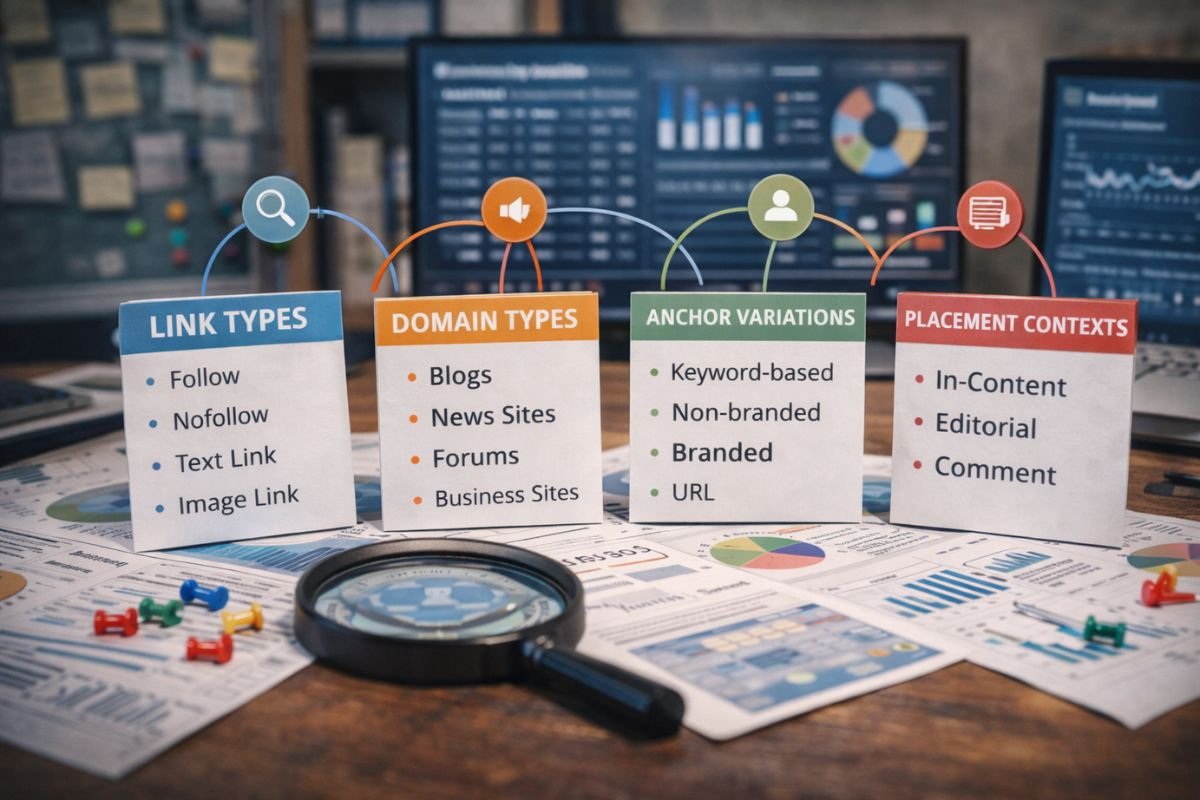
A natural backlink profile is characterized by a set of backlinks that have developed organically and independently over time. It is not defined by one type of backlink, one acquisition channel, or one anchor text format. Instead, it reflects distribution across link types, domain types, anchor variations, and placement contexts. Natural does not mean random. It means distributed.

Distribution Over Appearance

When defining a natural backlink profile, the focus should not be on how individual links look, but on how they function collectively. Search systems evaluate diversity of anchor text, variety of referring domains, acquisition rhythm, topical alignment, and contextual appearance. What matters is how these elements interact across the profile as a whole.

It is not about avoiding optimization. It is about avoiding concentration.

Anchor Text Distribution

One of the clearest indicators of a natural backlink profile is anchor text distribution.

A natural profile often includes:

  • Branded anchors
  • Partial match anchors
  • Generic anchors such as “read more”
  • Naked URLs
  • Occasional exact match anchors

When the majority of backlinks rely on a single keyword phrase, the pattern becomes concentrated. Concentration is one of the most recognizable signals of coordinated acquisition.

Source Diversity

A natural backlink profile includes links from different types of domains. These may come from industry blogs, news publications, niche directories, educational platforms, community forums, or business listings. The point is not the category itself but the distribution across categories.

If nearly all backlinks originate from a single acquisition method, such as only guest posts or only directories, the profile becomes structurally uniform. Diversity reduces predictability and supports organic modeling.

Topical Coherence

Diversity alone does not define naturalness. Random links do not create balance.

A natural backlink profile maintains topical coherence. If a site operates in digital marketing, most references should originate from marketing, business, or technology-related environments. Too much randomness dilutes clarity. Too much uniformity suggests coordination.


Related Posts

Are Paid Backlinks Worth the Risk

Are Paid Backlinks Worth the Risk?

February 9, 2026
How Does Google Evaluate Backlink Patterns?

How Does Google Evaluate Backlink Patterns?

February 9, 2026

Natural profiles maintain diversity within relevance.

Growth Over Time

Time-based distribution is another defining characteristic.

A natural backlink profile may show:

  • Gradual growth
  • Occasional acceleration due to visibility events
  • Slower periods
  • Stable long-term trends

Sudden large-scale acquisition without visible context may raise questions. However, growth itself is not the issue. What matters is whether the pattern aligns with observable activity. consistency over time carries more weight than speed.

Placement Variety

A natural backlink profile also reflects variation in placement. Links may appear within editorial paragraphs, resource pages, citations, community discussions, collaborative content, or other contextual environments.

When placement becomes repetitive, such as identical sidebar blocks or recurring site-wide footer inserts  distribution becomes uniform. Uniformity is uncommon in organic environments. Variation in placement supports natural interpretation.

What a Natural Backlink Profile Is Not

It is not defined by a perfect ratio. There is no universal percentage for branded anchors. There is no fixed threshold for referring domains. There is no required growth curve.

Attempts to artificially engineer “natural” patterns often produce new detectable patterns. A natural backlink profile is shaped by visibility, ongoing content contribution, and independent referencing across environments.

Pattern Integrity as the Core Signal

The defining characteristic is pattern integrity.

  • No single anchor type dominates.
  • No single source type dominates.
  • Links originate from multiple environments.
  • Growth aligns with content visibility.
  • Topical alignment remains consistent.

Search systems interpret these patterns collectively. When distribution reflects independence, interpretation leans toward organic growth. When patterns show repetition and concentration, interpretation leans toward risk.

A Clear Framework

So what is a natural backlink profile? It is defined by distributed anchors, varied sources, topical alignment, contextual growth, and placement diversity. Natural does not mean accidental; it means balanced over time.

Tags: Backlink growthbacklink profileLink diversitySEO risk signals
ShareTweetPin

Related Posts

Anchor Text Strategy

How Much Branded Anchor Text Is Natural?

by Backlink Sense
March 13, 2026
0

Branded anchor text is the anchor text used in a link that contains the...

Read moreDetails

What Is Branded Anchor Text?

March 9, 2026

Can Over-Optimization Cause Ranking Drops?

March 3, 2026

How Much Exact Match Is Too Much?

March 3, 2026
  • About Us
  • Terms of Use
  • Use of Cookies
  • Affiliate Disclosure
  • Contact
  • Privacy Policy
2026 BacklinkSense © All rights reserved.

Welcome Back!

Login to your account below

Forgotten Password?

Retrieve your password

Please enter your username or email address to reset your password.

Log In

Accessibility Toolbar

  • Powered with favoriteLove by Codenroll
No Result
View All Result
  • Anchor Text
    • Anchor Text Context
    • Anchor Text Distribution
    • Anchor Text Strategy
    • Types of Anchor Text
  • Backlink Quality and Analysis
    • Authority and Trust Signals
    • Backlink Analysis Tools
    • Link Context
    • Link Placement
    • Link Quality Signals
    • Link Relevance
  • Link Building Basics
    • How Google Ranks Links
    • Types of Backlinks
    • What Are Backlinks
    • Why Backlinks Matter
  • Link Building Methods
    • Asset-Based Link Building
    • Content-Based Link Building
    • Digital PR and Authority Mentions
    • Passive Link Acquisition
    • Resource and Reference Links
  • Link Building Risks
    • Link Penalties
    • Link Velocity
    • Low-Quality Backlinks
    • Over-Optimized Anchor Text
    • Unnatural Link Patterns
  • Link Outreach
    • Finding Outreach Targets
    • Follow Up in Outreach
    • Outreach Email Strategies
    • Outreach Personalization
    • Relationship Based Outreach

2026 BacklinkSense © All rights reserved.

This website uses cookies to improve your experience and analyze site performance. By continuing to browse, you agree to our Privacy and Cookie Policy.