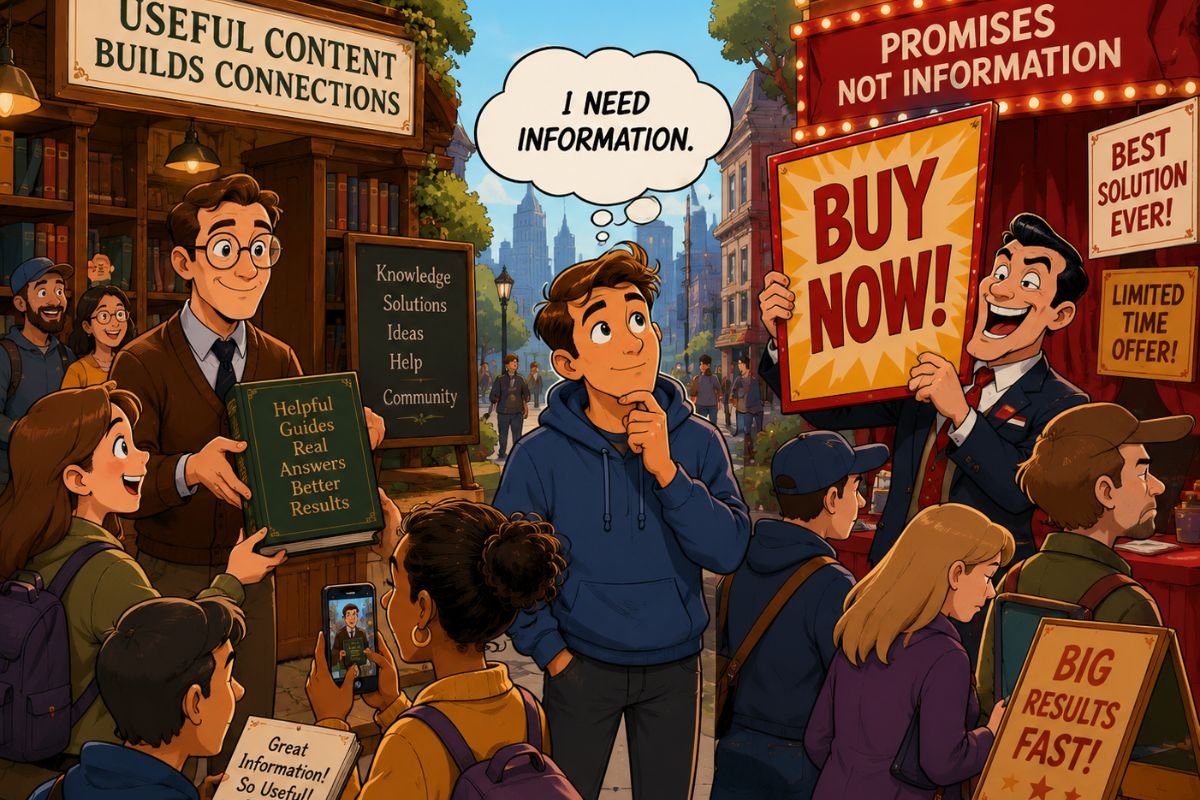

Useful content gives other websites a reason to reference it.
Imagine someone writing an article about choosing the right running shoes. A page explaining how different types of cushioning affect comfort gives that writer information they can use and point readers toward. A page whose main purpose is selling one particular shoe gives them fewer reasons to do so.
That does not make promotional content bad. It simply performs a different job.
This difference helps explain why useful content often has more opportunities to attract backlinks: it can become part of someone else’s explanation.
What Makes Content Worth Linking To?
Writers often add links because another page helps them explain something, support a statement, or give readers somewhere useful to continue.
That resource might provide original research, a clear explanation, a useful tool, a practical tutorial, a statistic, or an example that would be difficult to reproduce within the article itself.
This gives the page reference value: another writer has a genuine reason to point readers toward it.
That is one of the basic ways content can earn backlinks. The page is not simply asking for attention. It contains something another publisher can actually use.
Why Does Promotional Content Have Fewer Opportunities?
Promotional content usually has a different objective.
A product page may help someone understand or buy a product. A sales page can explain a service clearly. A company announcement can communicate important news.
Those pages can still receive backlinks, especially when a product, company, or announcement is itself relevant to what another publisher is discussing.
The difference becomes clearer when the two purposes are placed side by side.
| Useful content | Promotional content | |
|---|---|---|
| What is it mainly trying to do? | Help, explain, demonstrate, or provide information | Promote a product, service, company, or offer |
| What can another writer use it for? | Evidence, explanations, data, instructions, tools, or further reading | Information about the promoted offering |
| Why might someone link to it? | It adds something useful to their own content | The product, company, or offer is directly relevant |
| Can it attract backlinks? | Yes | Yes |
| How many situations could create a reason to reference it? | Potentially many, depending on what the page provides | Often fewer because its purpose is narrower |
Useful resources can also remain referenceable for a long time when the information, research, or tool continues to solve the same problem. Promotional content tied to a particular campaign or announcement may have a narrower window of relevance, which helps explain why some articles attract links more naturally than others.
What Can Another Writer Actually Reference?
This is the more useful question to ask when creating content for backlinks.
Simply publishing an “informative article” is not enough. If the page repeats information already available in hundreds of similar articles, another publisher may have little reason to choose it as a reference.
Instead, ask what the page gives someone that is genuinely worth pointing readers toward.
It could be original data, a particularly clear explanation, first-hand research, a useful comparison, a free tool, or a diagram that makes a difficult idea easier to understand.
Promotional pages have their own purpose, and there is nothing inherently wrong with that purpose. But when the objective is earning references from other websites, the content needs to provide a reason for the reference itself.
That idea sits at the heart of content-based link building: the content gives another publisher something worth linking to.
Meta Description: Useful content attracts backlinks by giving publishers explanations, evidence, tools, or resources worth referencing instead of simply promoting an offer.