
Sunday, March 15, 2026
BacklinkSense
  • Anchor Text
    • Anchor Text Context
    • Anchor Text Distribution
    • Anchor Text Strategy
    • Types of Anchor Text
  • Backlink Quality and Analysis
    • Authority and Trust Signals
    • Backlink Analysis Tools
    • Link Context
    • Link Placement
    • Link Quality Signals
    • Link Relevance
  • Link Building Basics
    • How Google Ranks Links
    • Types of Backlinks
    • What Are Backlinks
    • Why Backlinks Matter
  • Link Building Methods
    • Asset-Based Link Building
    • Content-Based Link Building
    • Digital PR and Authority Mentions
    • Passive Link Acquisition
    • Resource and Reference Links
  • Link Building Risks
    • Link Penalties
    • Link Velocity
    • Low-Quality Backlinks
    • Over-Optimized Anchor Text
    • Unnatural Link Patterns
  • Link Outreach
    • Finding Outreach Targets
    • Follow Up in Outreach
    • Outreach Email Strategies
    • Outreach Personalization
    • Relationship Based Outreach
No Result
View All Result
  • Anchor Text
    • Anchor Text Context
    • Anchor Text Distribution
    • Anchor Text Strategy
    • Types of Anchor Text
  • Backlink Quality and Analysis
    • Authority and Trust Signals
    • Backlink Analysis Tools
    • Link Context
    • Link Placement
    • Link Quality Signals
    • Link Relevance
  • Link Building Basics
    • How Google Ranks Links
    • Types of Backlinks
    • What Are Backlinks
    • Why Backlinks Matter
  • Link Building Methods
    • Asset-Based Link Building
    • Content-Based Link Building
    • Digital PR and Authority Mentions
    • Passive Link Acquisition
    • Resource and Reference Links
  • Link Building Risks
    • Link Penalties
    • Link Velocity
    • Low-Quality Backlinks
    • Over-Optimized Anchor Text
    • Unnatural Link Patterns
  • Link Outreach
    • Finding Outreach Targets
    • Follow Up in Outreach
    • Outreach Email Strategies
    • Outreach Personalization
    • Relationship Based Outreach
No Result
View All Result
BacklinkSense
No Result
View All Result
ADVERTISEMENT

How to Analyze Competitor Backlinks for Outreach Prospects: A Technical Workflow

Backlink Sense by Backlink Sense
February 28, 2026
in Finding Outreach Targets
Reading Time: 5 mins read
0
Share on FacebookShare on Twitter

Page Contents

  • 1 Link Intersection Analysis
  • 2 Related Posts
  • 3 Common Link Prospecting Mistakes to Avoid: Execution-Level Errors
  • 4 Prospect Scoring Framework for Link Building Campaigns: A Computation Model
  • 5 How to Qualify Outreach Prospects – Relevance vs Authority
  • 6 How to Find Guest Post Opportunities in Any Niche: A Tactical Discovery Guide
  • 7 Filtering by Link Type
  • 8 Determining Editorial Versus Paid Placements
  • 9 Finding Repeat Linking Domains
  • 10 Extracting Content Themes From Linking Pages
  • 11 Operational Flow
  • 12 Closing Perspective

Competitor backlink analysis for outreach is fundamentally an extraction and filtering process. The objective is to identify repeatable prospect environments within competitor link graphs, then classify and filter them based on placement type and contextual consistency.

This is technical discovery. It is extraction and classification, not interpretive theory.

Link Intersection Analysis

The first operational step is link intersection analysis. It is the fastest way to surface shared acquisition environments.

To conduct link intersection analysis:

  • Choose several competitors with similar topical scope

  • Export referring domains or linking pages from each

  • Identify domains that link to at least two competitors

Shared domains typically represent one of three environments:

  • Accessible editorial ecosystems

  • Industry resource hubs

    Related Posts

    Common Link Prospecting Mistakes to Avoid: Execution-Level Errors

    February 28, 2026

    Prospect Scoring Framework for Link Building Campaigns: A Computation Model

    February 28, 2026

    How to Qualify Outreach Prospects – Relevance vs Authority

    February 28, 2026

    How to Find Guest Post Opportunities in Any Niche: A Tactical Discovery Guide

    February 28, 2026
  • Paid or semi-commercial environments with repeated placements
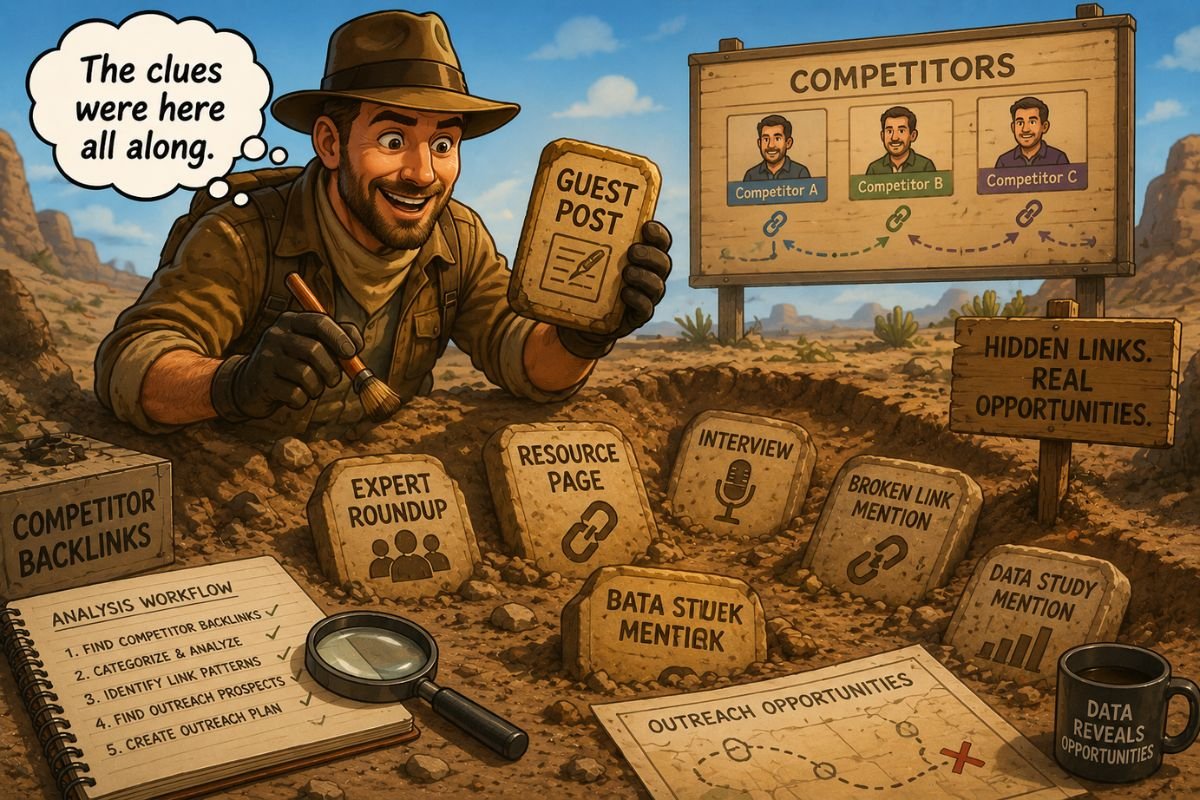
Commonality acts as the filter. The more frequently a domain appears across competitors, the more likely it represents a structural acquisition environment rather than an isolated event.

When performing intersection analysis:

  • Prioritize contextual links over homepage or sidebar links

  • Filter out directories and automated aggregators

  • Separate single overlaps from multi-competitor overlaps

The output should not be a raw export. It should be a prioritized list of structurally repeated environments.

Filtering by Link Type

After identifying shared domains, classification becomes necessary.

Not all backlinks provide equal discovery value.

Backlinks can be categorized as:

  • In-content editorial links

  • Author bio links

  • Resource page links

  • Directory links

  • Sponsored or labeled placements

This classification isolates outreach-relevant environments and removes structural noise.

For prospecting purposes, contextual in-content links typically carry more discovery value because they reflect integration into actual content rather than static listing.

Filtering by type prevents dilution of the dataset.

Determining Editorial Versus Paid Placements

Competitor backlink sets usually contain a mixture of organic editorial placements and sponsored environments. Distinguishing between them is essential for clean prospect extraction.

Indicators of paid or semi-commercial networks include:

  • Disclosure labels such as “Sponsored” or “Partner Content”

  • Repetitive outbound links to unrelated industries

  • Uniform formatting across multiple posts

  • Identical author accounts publishing across domains

Editorial environments, by contrast, tend to:

  • Integrate links naturally within content

  • Reference linked sites contextually

  • Appear inside thematically aligned articles

  • Maintain selective outbound linking patterns

Paid networks often repeat structural templates across domains. Editorial ecosystems repeat story structure, not linking behavior.

For prospect extraction, environments with consistent editorial structure tend to offer more stable discovery value.

Finding Repeat Linking Domains

Repeat linking domains are strong structural signals.

When a domain links multiple times to the same competitor across different pages, it often indicates an ongoing relationship or thematic alignment.

To extract repeat linking domains:

  • Sort backlink exports by referring domain

  • Calculate frequency of linking pages per domain

  • Highlight domains with multiple contextual placements

Repeated domains often indicate:

  • Contributor access

  • Industry collaborations

  • Ongoing thematic coverage

A single placement may be coincidental. Repeated placements suggest integration.

For outreach discovery, repeated domains often provide stronger signals than isolated high-authority links.

Extracting Content Themes From Linking Pages

Domain-level analysis is incomplete without content-level classification.

Open a sample of contextual linking pages and categorize article formats. Identify repeated themes such as:

  • Industry comparison content

  • Tool aggregation articles

  • Expert commentary

  • Case studies

  • Research-driven content

If competitors repeatedly appear within specific formats, those formats become discovery pathways.

For example, consistent presence inside comparison or aggregation content indicates a repeatable placement pattern.

Extracting themes shifts the focus from domain authority to contextual positioning. This reduces dependency on domain metrics and increases structural alignment.

Operational Flow

A structured workflow for competitor backlink prospecting should follow this sequence:

  • Perform link intersection analysis across competitors

  • Filter overlapping domains by link type

  • Separate editorial from paid environments

  • Identify repeat linking domains

  • Extract recurring content themes

The result should not be a list of copied backlinks. It should be a structured dataset organized around:

  • Recurring domains

  • Contextual placement categories

  • Repeated content formats

At this stage, the dataset becomes a discovery engine rather than a static export.

Closing Perspective

Competitor backlink analysis for outreach is a process of intersection filtering, classification, and repetition detection.

Its value lies in identifying acquisition patterns, not replicating placements.

When executed correctly, competitor link analysis becomes a systematic discovery workflow rather than a reactive copying exercise.


Tags: Competitor AnalysisEditorial linksLink IntersectionProspect Discovery
ShareTweetPin

Related Posts

Finding Outreach Targets

Structural Errors in Link Prospecting Logic: A Quiet Risk Analysis

by Backlink Sense
February 28, 2026
0

Structural errors in link prospecting logic rarely look dramatic. They rarely look like mistakes...

Read moreDetails

Best Tools for Finding Outreach Targets: Context Before Choice

February 28, 2026
Editorial vs Guest Post Backlinks

Editorial vs Guest Post Backlinks: What’s the Difference?

February 17, 2026
What Makes a Backlink of High Quality?

What Makes a Backlink of High Quality?

February 9, 2026

Leave a Reply Cancel reply

Your email address will not be published. Required fields are marked *

  • About Us
  • Terms of Use
  • Use of Cookies
  • Affiliate Disclosure
  • Contact
  • Privacy Policy
2026 BacklinkSense © All rights reserved.

Welcome Back!

Login to your account below

Forgotten Password?

Retrieve your password

Please enter your username or email address to reset your password.

Log In

Accessibility Toolbar

  • Powered with favoriteLove by Codenroll
No Result
View All Result
  • Anchor Text
    • Anchor Text Context
    • Anchor Text Distribution
    • Anchor Text Strategy
    • Types of Anchor Text
  • Backlink Quality and Analysis
    • Authority and Trust Signals
    • Backlink Analysis Tools
    • Link Context
    • Link Placement
    • Link Quality Signals
    • Link Relevance
  • Link Building Basics
    • How Google Ranks Links
    • Types of Backlinks
    • What Are Backlinks
    • Why Backlinks Matter
  • Link Building Methods
    • Asset-Based Link Building
    • Content-Based Link Building
    • Digital PR and Authority Mentions
    • Passive Link Acquisition
    • Resource and Reference Links
  • Link Building Risks
    • Link Penalties
    • Link Velocity
    • Low-Quality Backlinks
    • Over-Optimized Anchor Text
    • Unnatural Link Patterns
  • Link Outreach
    • Finding Outreach Targets
    • Follow Up in Outreach
    • Outreach Email Strategies
    • Outreach Personalization
    • Relationship Based Outreach

2026 BacklinkSense © All rights reserved.

This website uses cookies to improve your experience and analyze site performance. By continuing to browse, you agree to our Privacy and Cookie Policy.