

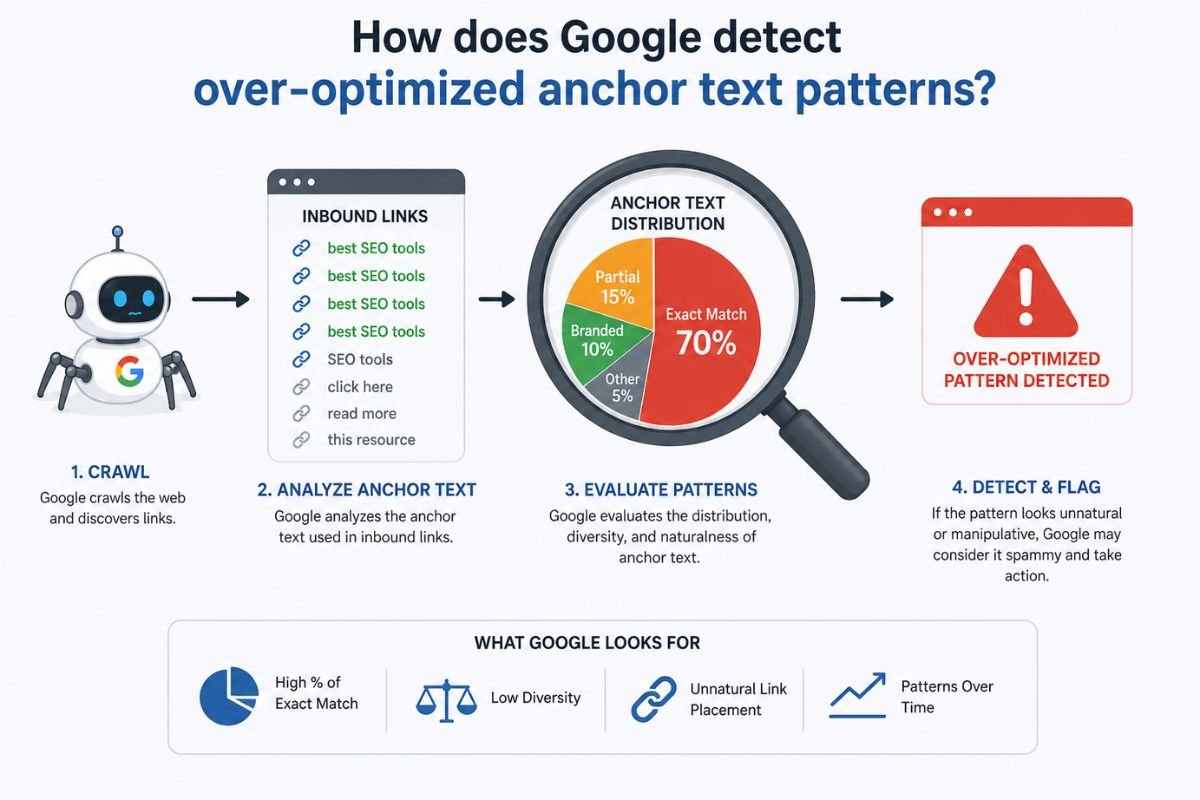

Google doesn’t detect over-optimized anchor text based on a single keyword-rich link. It detects it through patterns. Over-optimized anchor text becomes visible when the overall distribution is disproportionately structured.
What constitutes over-optimized anchor text?
Over-optimized anchor text is usually characterized by an unusually high concentration of keyword-rich anchors.
This typically includes:
- Repeated use of the exact phrase
- Limited variation in anchor wording
- Minimal use of branded or neutral anchors
Over-optimization is not defined by the presence of keyword-rich anchors. It is defined by their proportion within the overall profile.
A site may include some exact match anchors without issue. The difference emerges when most anchors repeat the same commercial phrase.
How is over-optimized anchor text detected?
Detection is ratio-based, not instance-based. A few keyword-rich anchors are not enough to trigger concern. The evaluation revolves around proportion and pattern.
Questions that shape interpretation include:
How frequently is a phrase repeated relative to other anchor types?
Is there natural variation across domains?
Do different sites use different phrasing to reference the same topic?
Over-optimization becomes visible when linguistic diversity compresses into a narrow set of highly commercial phrases.
If multiple independent sites use identical anchor wording for competitive keywords, that uniformity may imply coordination rather than editorial choice. Natural linking behavior tends to vary. Different authors describe the same subject differently. When phrasing becomes uniform across unrelated domains, randomness decreases, and the pattern becomes detectable.


Contextual Inconsistency
Google evaluates not only the anchor itself, but also:
- The topical relevance of the linking site
- The semantic relationship between the anchor and sentence
- The placement of the link within the content
Anchor text does not operate alone. It contributes to pattern formation within its context.
Velocity and Sudden Pattern Shifts
Detection does not occur in isolation from time.
If a site historically accumulates varied or branded anchors and then suddenly receives a wave of identical keyword-rich anchors, that shift forms a pattern. Over-optimized profiles often emerge from sudden concentration rather than gradual evolution.
When Is It Actually Risky?
Over-optimization becomes riskier when multiple signals align:
- High concentration of exact match anchors
- Limited variation in referring domains
- Repetition within commercial contexts
- Minimal branded or neutral anchors
- Anchor concentration combined with other link quality weaknesses
There is no fixed percentage that defines over-optimization. Interpretation is context-dependent and influenced by industry norms, competition level, link history, and page type.
Over-optimization exists on a continuum rather than as a binary state.
Why It Is Not Binary
There is no rule such as “X% exact match equals penalty.” Anchor text is part of a broader evaluation framework.
One site may have a relatively high keyword ratio without issue. Another may show similar ratios but carry higher volatility due to additional risk factors. Over-optimization becomes problematic when it signals coordinated intent.
The Underlying Principle
When asking how Google detects over-optimized anchor text patterns, the answer is not a formula. It is anomaly detection.
Natural link profiles exhibit variation, irregularity, and linguistic diversity. Over-optimized profiles exhibit repetition, similarity, and structural uniformity. Detection is not about catching tactics. It is about identifying patterns that deviate from organic linking behavior.
The risk rarely lies in a single anchor. It emerges from the structure formed when many anchors follow the same artificial logic.