Wednesday, October 14, 2026
BacklinkSense
  • Anchor Text
    • Anchor Text Context
    • Anchor Text Distribution
    • Anchor Text Strategy
    • Types of Anchor Text
  • Backlink Quality and Analysis
    • Authority and Trust Signals
    • Backlink Analysis Tools
    • Link Context
    • Link Placement
    • Link Quality Signals
    • Link Relevance
  • Link Building Basics
    • How Google Ranks Links
    • Types of Backlinks
    • What Are Backlinks
    • Why Backlinks Matter
  • Link Building Methods
    • Asset-Based Link Building
    • Content-Based Link Building
    • Digital PR and Authority Mentions
    • Passive Link Acquisition
    • Resource and Reference Links
  • Link Building Risks
    • Link Penalties
    • Link Velocity
    • Low-Quality Backlinks
    • Over-Optimized Anchor Text
    • Unnatural Link Patterns
  • Link Outreach
    • Finding Outreach Targets
    • Follow Up in Outreach
    • Outreach Email Strategies
No Result
View All Result
  • Anchor Text
    • Anchor Text Context
    • Anchor Text Distribution
    • Anchor Text Strategy
    • Types of Anchor Text
  • Backlink Quality and Analysis
    • Authority and Trust Signals
    • Backlink Analysis Tools
    • Link Context
    • Link Placement
    • Link Quality Signals
    • Link Relevance
  • Link Building Basics
    • How Google Ranks Links
    • Types of Backlinks
    • What Are Backlinks
    • Why Backlinks Matter
  • Link Building Methods
    • Asset-Based Link Building
    • Content-Based Link Building
    • Digital PR and Authority Mentions
    • Passive Link Acquisition
    • Resource and Reference Links
  • Link Building Risks
    • Link Penalties
    • Link Velocity
    • Low-Quality Backlinks
    • Over-Optimized Anchor Text
    • Unnatural Link Patterns
  • Link Outreach
    • Finding Outreach Targets
    • Follow Up in Outreach
    • Outreach Email Strategies
No Result
View All Result
BacklinkSense
No Result
View All Result

Home - Backlink Quality and Analysis - Link Quality Signals - High Quality vs Low Quality Backlinks

High Quality vs Low Quality Backlinks

Backlink Sense by Backlink Sense
May 20, 2026
in Link Quality Signals
Reading Time: 4 mins read
Share On FacebookShare On Reddit

Page Contents

  • 1. What Does the Difference Look Like in a Real Paragraph?
  • 2. Is Relevance Enough to Make a Backlink High Quality?
  • 3. Does a Link Inside an Article Automatically Count as High Quality?
  • 4. What If a Backlink Is Somewhere Between High and Low Quality?

Two backlinks can lead to exactly the same page and still be very different.

One might appear in an article because the writer is discussing the same subject and the linked page gives readers useful additional information. Another might be squeezed into an unrelated paragraph where there is no obvious reason for the link to exist.

Both are backlinks. So what makes one look like a high-quality backlink and the other a low-quality one?

There is no single characteristic that answers that question. Instead, the difference becomes clearer when you look at where the backlink came from, what is being discussed around it, why the link appears, and where it leads.

High-Quality Backlink Low-Quality Backlink
Why is the link there? There is a clear reason for the page to reference the destination The reason for the link may be difficult to understand
Does it fit the discussion? The link relates naturally to what the reader is already learning about The link may interrupt the discussion or introduce an unrelated subject
What is around the link? The surrounding content helps explain why the destination is useful The surrounding content provides little connection to the destination
Does the destination make sense? The linked page continues, supports, or expands on something relevant The destination may have little to do with what is being discussed
Easy way to think about it The link belongs there The link feels placed there

What Does the Difference Look Like in a Real Paragraph?

Take an article about analyzing backlinks. It reaches a section explaining how to judge whether individual links are useful and includes this reference:

More detailed approaches to backlink analysis can help you examine individual links more closely.

The backlink makes sense because the reader is already learning about backlink analysis. The destination continues that subject.

Now change the situation. A page about web design trends is discussing typography, page layouts, and visual design when a sentence suddenly introduces a backlink analysis guide.

The link may still work perfectly. It may even sit inside the main content. But a reader could reasonably wonder why that particular destination appeared in a discussion about visual design.

This is one of the simplest ways to begin comparing backlink quality: does the link belong in the conversation taking place around it?

Is Relevance Enough to Make a Backlink High Quality?

Not by itself.

A backlink can point between two pages covering related subjects and still raise other questions. For example, a page may discuss the right subject but exist mainly to publish or sell links rather than to provide useful information. In that situation, topical relevance alone does not tell you that the backlink is high quality.

This is why high-quality backlinks cannot be identified from topical relevance alone.

The source of the link, the page containing it, the reason it exists, and the way it fits into the content can all add useful information when you examine the backlink.

Does a Link Inside an Article Automatically Count as High Quality?

No. This is an easy assumption to make because a link inside a paragraph can look natural at first glance.

But placement and purpose are different things.

A backlink can be inserted directly into an article and still have very little connection to the sentence around it. It can also use wording designed mainly to target a search term rather than to help the reader understand where the link leads.

Google’s spam policies make this distinction especially important. They focus on links created primarily to manipulate rankings and include examples involving paid links, automated link creation, low-quality directories, and widely distributed links in footers or templates.

A sponsored link is not automatically a low-quality link simply because it is sponsored. Google allows advertising and sponsorship links when they are properly qualified, such as with rel="sponsored" or rel="nofollow". These attributes help describe the relationship behind the link rather than serving as a quality label.

So simply finding a backlink inside an article does not tell you whether it is high quality.

What If a Backlink Is Somewhere Between High and Low Quality?

This is where the comparison becomes more realistic.

Not every backlink fits neatly into one side of the table. A link might come from a relevant page but appear in a weak paragraph. Another might be surrounded by useful context but come from a page created largely to place links.

That does not mean you need to invent a precise quality score for every backlink. It means the labels high quality and low quality are easier to use after you have examined the actual link rather than judging it from one characteristic.

This is also why high-quality backlink identification involves looking at several parts of the backlink together rather than searching for one feature that settles the question.

Tags: backlink analysisBacklink evaluationBacklink QualitySEO Concepts
ShareShareShareShareSend

Related Posts

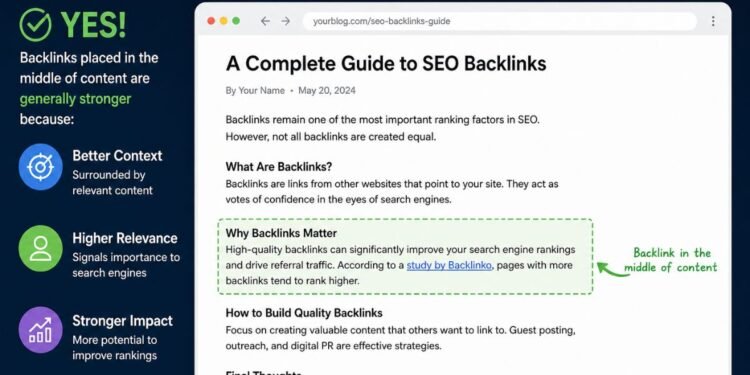
SEO article highlighting Backlinks in the Middle of content and showing how contextual placement connects a backlink with the surrounding topic.
Link Placement

Are Backlinks in the Middle of Content Stronger?

by Backlink Sense
March 8, 2026
Illustration showing link equity losing strength as it flows from trusted website authority through a weak connection toward a target URL.
Authority and Trust Signals

Can Trusted Websites Still Pass Weak Signals?

by Backlink Sense
June 2, 2026
Link Placement

Where Should Backlinks Be Placed in the Content?

by Backlink Sense
May 20, 2026
Authority, relevance, trust, and contextual placement illustrate the key signals that make a backlink powerful.
How Google Ranks Links

What Signals Make a Backlink Powerful?

by Backlink Sense
February 17, 2026
Illustration comparing topical relevance vs domain authority in an SEO showdown, with both ranking factors facing off in a boxing arena.
Link Relevance

Topical Relevance vs Domain Authority

by Backlink Sense
March 26, 2026
Load More
  • About Us
  • Terms of Use
  • Use of Cookies
  • Affiliate Disclosure
  • Contact
  • Privacy Policy
2026 BacklinkSense © All rights reserved.

Welcome Back!

Login to your account below

Forgotten Password?

Retrieve your password

Please enter your username or email address to reset your password.

Log In

Accessibility Toolbar

  • Powered with favoriteLove by Codenroll
No Result
View All Result
  • Anchor Text
    • Anchor Text Context
    • Anchor Text Distribution
    • Anchor Text Strategy
    • Types of Anchor Text
  • Backlink Quality and Analysis
    • Authority and Trust Signals
    • Backlink Analysis Tools
    • Link Context
    • Link Placement
    • Link Quality Signals
    • Link Relevance
  • Link Building Basics
    • How Google Ranks Links
    • Types of Backlinks
    • What Are Backlinks
    • Why Backlinks Matter
  • Link Building Methods
    • Asset-Based Link Building
    • Content-Based Link Building
    • Digital PR and Authority Mentions
    • Passive Link Acquisition
    • Resource and Reference Links
  • Link Building Risks
    • Link Penalties
    • Link Velocity
    • Low-Quality Backlinks
    • Over-Optimized Anchor Text
    • Unnatural Link Patterns
  • Link Outreach
    • Finding Outreach Targets
    • Follow Up in Outreach
    • Outreach Email Strategies

2026 BacklinkSense © All rights reserved.

This website uses cookies to improve your experience and analyze site performance. By continuing to browse, you agree to our Privacy and Cookie Policy.