
Page Contents
- 1 The Technical Meaning of a Dofollow Backlink
- 2 What Signal Does a Dofollow Backlink Pass?
- 3 Related Posts
- 4 What Is a Sponsored or UGC Link?
- 5 What Is a Nofollow Backlink?
- 6 Editorial vs Guest Post Backlinks: What’s the Difference?
- 7 What Are the Different Types of Backlinks in SEO?
- 8 What a Dofollow Backlink Is Not
- 9 Dofollow vs. Restricted Attributes
- 10 Why the Term Became Common
- 11 Structural Perspective
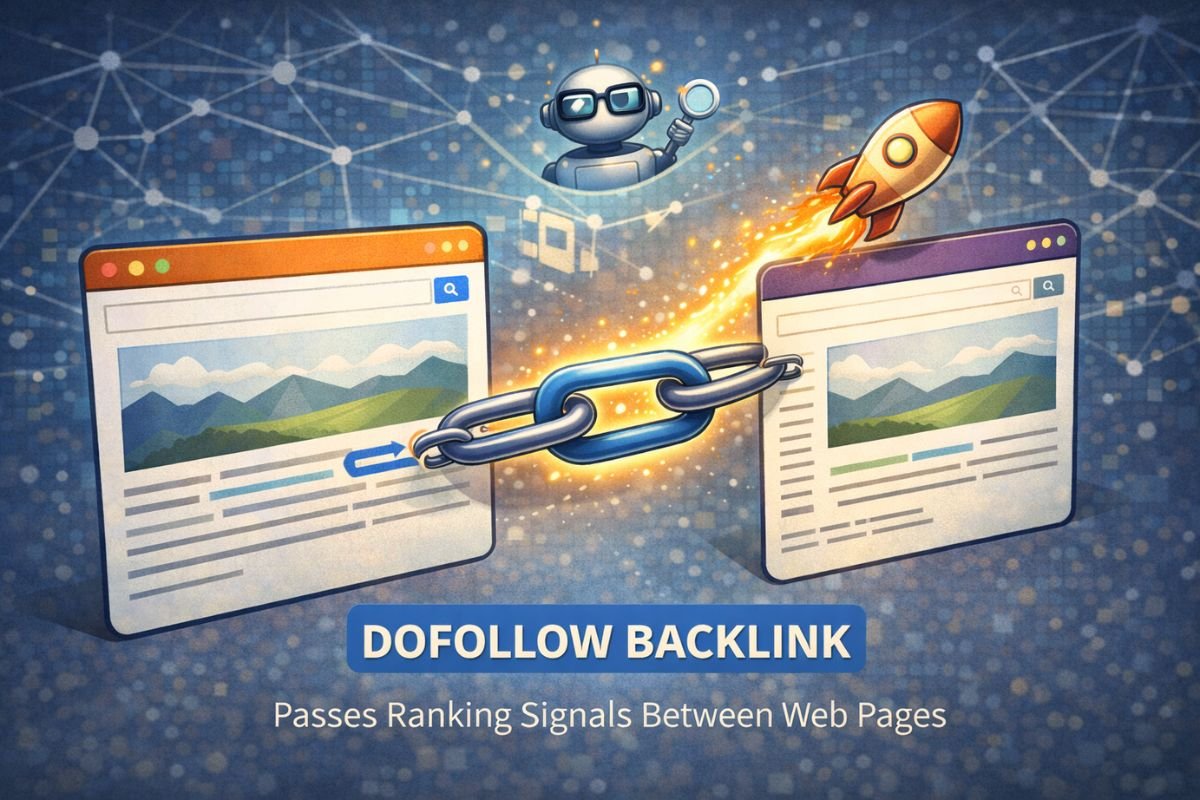
Dofollow backlinks are hyperlinks that allow search engines to pass ranking signals between two different web pages. This term is not used to define a source or overall link quality. It defines the attribute state of the link.
Standard hyperlinks are dofollow by default unless they contain specific attributes that define otherwise.
The Technical Meaning of a Dofollow Backlink
The term “dofollow” is not an official HTML term. There is no dofollow attribute in HTML.
A dofollow backlink is simply a link that does not contain restrictive attributes such as “rel=’nofollow’”, “rel=’sponsored’”, or “rel=’ugc’”.
If we take a standard HTML link like this:
<a href=”https://example.com”>Example</a>
The link above is dofollow by default. This means that a search engine can crawl the link and include it in its ranking evaluation system.
A dofollow backlink allows signal transfer. That signal may contribute to authority or relevance within a broader ranking system.
You May Also Like:
What Signal Does a Dofollow Backlink Pass?
A dofollow backlink passes ranking signals, often referred to as “link equity.”




If a page links to another page using a standard hyperlink, the second page may be serving as one or more of the following:
- A reference
- A citation
- A contextual association
The strength of this signal depends on multiple factors beyond the attribute itself.
Dofollow simply means the signal is eligible for evaluation.
What a Dofollow Backlink Is Not
A dofollow backlink is not:
- A specific backlink type such as editorial, guest post, or directory
- A guarantee of improved rankings
- A measure of quality
- A comparison metric against other backlink sources
It is purely an attribute state.
A backlink can be dofollow and low quality.
A backlink can be dofollow and highly authoritative.
This attribute does not define a value. It defines permission.
Dofollow vs. Restricted Attributes
The nofollow, sponsored, and ugc attributes were introduced to provide context for how links should be interpreted.
When present, they signal that the link may be treated differently within ranking systems.
A dofollow backlink does not contain these restrictions.
However, modern search engines apply nuanced evaluations even to dofollow links. The attribute itself simply allows signal flow.
Why the Term Became Common
The term dofollow backlink became common only after the introduction of the nofollow attribute.
Nofollow changed link behavior. As a result, “dofollow” emerged informally to describe links without that restriction.
Since most links on the web are dofollow by default, the term does not describe a new backlink type. It exists to distinguish links that are unrestricted.
Structural Perspective
When asking what a dofollow backlink is, the answer is straightforward: it is a standard link that allows search engines to evaluate ranking signals.
It is purely an attribute state.
Understanding this distinction prevents confusion between link origin and link treatment. The source of a backlink explains how it was created. The attribute explains how it is processed.
These are separate layers.