
Sunday, March 15, 2026
BacklinkSense
  • Anchor Text
    • Anchor Text Context
    • Anchor Text Distribution
    • Anchor Text Strategy
    • Types of Anchor Text
  • Backlink Quality and Analysis
    • Authority and Trust Signals
    • Backlink Analysis Tools
    • Link Context
    • Link Placement
    • Link Quality Signals
    • Link Relevance
  • Link Building Basics
    • How Google Ranks Links
    • Types of Backlinks
    • What Are Backlinks
    • Why Backlinks Matter
  • Link Building Methods
    • Asset-Based Link Building
    • Content-Based Link Building
    • Digital PR and Authority Mentions
    • Passive Link Acquisition
    • Resource and Reference Links
  • Link Building Risks
    • Link Penalties
    • Link Velocity
    • Low-Quality Backlinks
    • Over-Optimized Anchor Text
    • Unnatural Link Patterns
  • Link Outreach
    • Finding Outreach Targets
    • Follow Up in Outreach
    • Outreach Email Strategies
    • Outreach Personalization
    • Relationship Based Outreach
No Result
View All Result
  • Anchor Text
    • Anchor Text Context
    • Anchor Text Distribution
    • Anchor Text Strategy
    • Types of Anchor Text
  • Backlink Quality and Analysis
    • Authority and Trust Signals
    • Backlink Analysis Tools
    • Link Context
    • Link Placement
    • Link Quality Signals
    • Link Relevance
  • Link Building Basics
    • How Google Ranks Links
    • Types of Backlinks
    • What Are Backlinks
    • Why Backlinks Matter
  • Link Building Methods
    • Asset-Based Link Building
    • Content-Based Link Building
    • Digital PR and Authority Mentions
    • Passive Link Acquisition
    • Resource and Reference Links
  • Link Building Risks
    • Link Penalties
    • Link Velocity
    • Low-Quality Backlinks
    • Over-Optimized Anchor Text
    • Unnatural Link Patterns
  • Link Outreach
    • Finding Outreach Targets
    • Follow Up in Outreach
    • Outreach Email Strategies
    • Outreach Personalization
    • Relationship Based Outreach
No Result
View All Result
BacklinkSense
No Result
View All Result
ADVERTISEMENT
What Is Link Equity and How Is It Distributed?

What Is Link Equity and How Is It Distributed?

Backlink Sense by Backlink Sense
February 9, 2026
in Authority and Trust Signals
Reading Time: 5 mins read
0
Share on FacebookShare on Twitter

Page Contents

  • 1 Understanding Link Equity as Flow
  • 2 External vs Internal Distribution
  • 3 Related Posts
  • 4 Do High Authority Backlinks Always Improve Rankings?
  • 5 How Many Backlinks Do You Actually Need to Rank?
  • 6 How Backlinks Build Topical Authority
  • 7 A Simple Structural Example
  • 8 Factors That Influence Distribution
  • 9 What Link Equity Is Not
  • 10 Equity Concentration vs Equity Diffusion
  • 11 A Balanced View

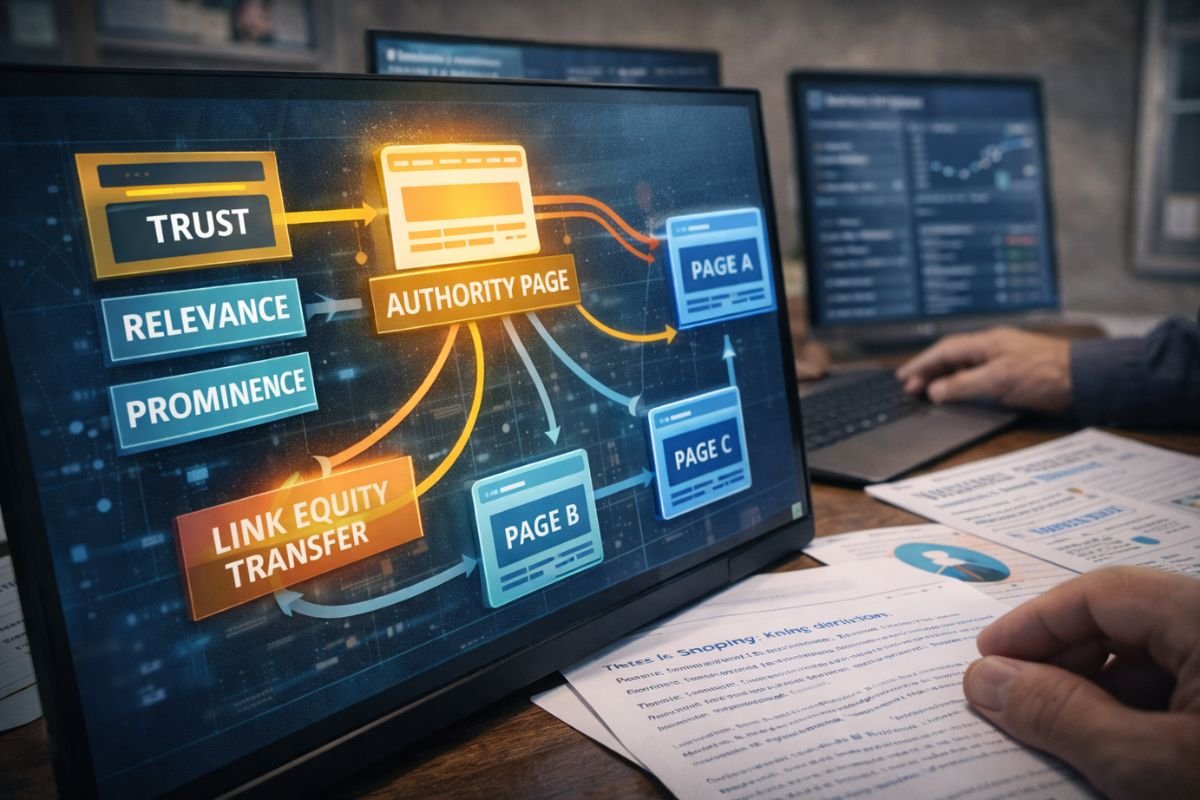
Link equity is defined as the value or authority one page sends to another through hyperlinks. It is also known as link value. It represents how one page transfers trust, relevance, and prominence signals to another. It is not quantified as a number but operates as a relationship-based mechanism affected by structure, context, and link patterns. Its distribution depends on how web pages connect across the web and how they connect within a single domain.

In simple terms, link equity is transferred through links. The structure of those links determines how it flows and how it is distributed.

Understanding Link Equity as Flow

It helps to think of link equity as flow. When page A links to page B, it sends part of its authority signals. If page A is considered authoritative and contextually strong, it transfers some of that strength to page B.

When page B receives these signals, it gains authority in relative terms.

However, page B does not receive 100% of page A’s authority. If page A links to multiple pages, it divides its attention among them. The more outgoing links it has, the less concentrated the transfer becomes for each destination.

Link equity accumulates, distributes, and reinforces itself depending on how it is structured.

External vs Internal Distribution

Link equity distribution operates across domains and within domains.

External Distribution

When credible external pages link to your page, they pass external link equity. When many respected domains point to a single page, equity builds around that page. It may then function as a hub within its topic cluster.

Pages that accumulate high-quality external links often act as entry points into a domain’s broader authority system.


Related Posts

Do High Authority Backlinks Always Improve Rankings?

March 7, 2026
How Many Backlinks Do You Actually Need to Rank?

How Many Backlinks Do You Actually Need to Rank?

February 9, 2026
How Backlinks Build Topical Authority

How Backlinks Build Topical Authority

February 9, 2026

Internal Distribution

Internal linking transfers link equity between pages on your own site.

For example:

If Page A has many strong external backlinks and links internally to Page B and Page C, then part of its acquired equity flows to those pages.

If Page B links to Page D, and Page C links to Page E, the flow continues. Internal linking architecture determines how equity reaches important pages within the domain.

A Simple Structural Example

Consider a site structured as follows:

  • Homepage
  • Links to Category Page
  • Links to Article 1
  • Links to Article 2

If the homepage has many high-quality external links, equity may flow through the structure in a sequence such as: Homepage → Category Page → Article 1 → Article 2.

If, however, the Category Page links to many unrelated pages without hierarchy, distribution becomes diluted. If the structure is organized around a clear topical cluster, equity becomes more concentrated within that cluster.

The principle is structural: the stronger the source, the fewer the strategic links, and the clearer the hierarchy, the more focused the distribution. Equity distribution is ultimately a function of pathways.

Factors That Influence Distribution

Several elements shape how link equity flows.

Link Placement

Placement affects interpretation. A link integrated within meaningful content tends to carry clearer relational signals than one placed in peripheral sections.

Outbound Link Volume

If a page links to a limited number of relevant pages, distribution remains more concentrated. If it links to many unrelated pages, the distribution becomes broader and less focused.

Dilution occurs when outbound volume increases without structure.

Topical Alignment

Equity transfer becomes more meaningful when linking pages share topical alignment. Transfers between related themes reinforce authority more effectively than transfers between unrelated topics. Search systems evaluate alignment alongside structural linking.

Link Network Structure

A structured internal linking system facilitates efficient distribution. Weak or fragmented internal structures create uneven flow, leaving deeper pages under-supported. Pages buried within poorly connected structures may receive insufficient equity.

What Link Equity Is Not

Link equity does not exist as a visible score within search systems. Tools may estimate domain strength, but these are approximations.

It is not static; it changes as new links are created, old ones disappear, and internal structures evolve. It does not transfer as a fixed percentage but instead functions through relational modeling.

Most importantly, link equity does not replace content quality. A page may receive equity, but without substantive content, distribution alone will not create strong performance.

Equity Concentration vs Equity Diffusion

Two structural patterns clarify distribution dynamics.

Equity Concentration

When multiple authoritative pages point to a single page, equity becomes concentrated. This strengthens prominence for a specific topic.

Equity Diffusion

When a page distributes links across many unrelated destinations, equity diffuses. Distribution without structure may reduce clarity rather than enhance it.

Strategic internal linking helps concentrate equity where it matters most.

A Balanced View

Link equity is distributed through structure, placement, and relevance, with external links introducing equity into a domain and internal links determining how that equity flows. The mechanism is relational rather than numerical.

Tags: Authority modelingLink equitySite architecture
ShareTweetPin

Related Posts

Finding Outreach Targets

The Strategic Framework Behind Finding Outreach Targets

by Backlink Sense
February 23, 2026
0

Finding outreach targets isn't about collecting websites. It is about crafting a sequence of...

Read moreDetails
How Does Page Authority Affect Link Strength?

How Does Page Authority Affect Link Strength?

February 17, 2026
Do All Links Pass the Same Value?

Do All Links Pass the Same Value?

February 17, 2026
How Does Google Evaluate Backlinks Algorithmically?

How Does Google Evaluate Backlinks Algorithmically?

February 17, 2026
  • About Us
  • Terms of Use
  • Use of Cookies
  • Affiliate Disclosure
  • Contact
  • Privacy Policy
2026 BacklinkSense © All rights reserved.

Welcome Back!

Login to your account below

Forgotten Password?

Retrieve your password

Please enter your username or email address to reset your password.

Log In

Accessibility Toolbar

  • Powered with favoriteLove by Codenroll
No Result
View All Result
  • Anchor Text
    • Anchor Text Context
    • Anchor Text Distribution
    • Anchor Text Strategy
    • Types of Anchor Text
  • Backlink Quality and Analysis
    • Authority and Trust Signals
    • Backlink Analysis Tools
    • Link Context
    • Link Placement
    • Link Quality Signals
    • Link Relevance
  • Link Building Basics
    • How Google Ranks Links
    • Types of Backlinks
    • What Are Backlinks
    • Why Backlinks Matter
  • Link Building Methods
    • Asset-Based Link Building
    • Content-Based Link Building
    • Digital PR and Authority Mentions
    • Passive Link Acquisition
    • Resource and Reference Links
  • Link Building Risks
    • Link Penalties
    • Link Velocity
    • Low-Quality Backlinks
    • Over-Optimized Anchor Text
    • Unnatural Link Patterns
  • Link Outreach
    • Finding Outreach Targets
    • Follow Up in Outreach
    • Outreach Email Strategies
    • Outreach Personalization
    • Relationship Based Outreach

2026 BacklinkSense © All rights reserved.

This website uses cookies to improve your experience and analyze site performance. By continuing to browse, you agree to our Privacy and Cookie Policy.