


Page Contents
- 1 What Is a Topical Cluster?
- 2 How Backlinks Reinforce Context – How Backlinks Build Topical Authority
- 3 External Signals and Internal Structure
- 4 Relevance Over General Authority
- 5 Pattern Reinforcement Across Pages
- 6 Related Posts
- 7 Do High Authority Backlinks Always Improve Rankings?
- 8 How Many Backlinks Do You Actually Need to Rank?
- 9 What Is Link Equity and How Is It Distributed?
- 10 Contextual Anchors and Semantic Signals
- 11 Depth as a Strategic Layer
- 12 Avoiding Fragmented Authority
- 13 A Strategic Perspective
Topical authority is the level at which a website is recognized as a reliable and knowledgeable source within a specific subject area. It is established through systematic, in-depth coverage of related themes rather than isolated articles. Authority in this context extends beyond trust. It reflects demonstrated expertise within a defined topic cluster. Topical authority begins with structure, and backlinks enhance that structure when they are contextually aligned to it.
What Is a Topical Cluster?
Topical authority is built through comprehensive coverage. A topical cluster typically includes a cornerstone page that addresses a broad subject in depth, supporting pages that explore related subtopics, and internal links that connect those pages into a coherent hierarchy.
For example, a digital marketing cluster might include a comprehensive guide on technical SEO, alongside supporting pages on crawl optimization, internal linking, and site architecture, all connected through structured internal links. When coverage is organized in this way, the result is not a collection of articles but a thematic ecosystem. Search systems evaluate how thoroughly and coherently a site covers a subject, and that level of coverage contributes directly to perceived authority.
How Backlinks Reinforce Context – How Backlinks Build Topical Authority
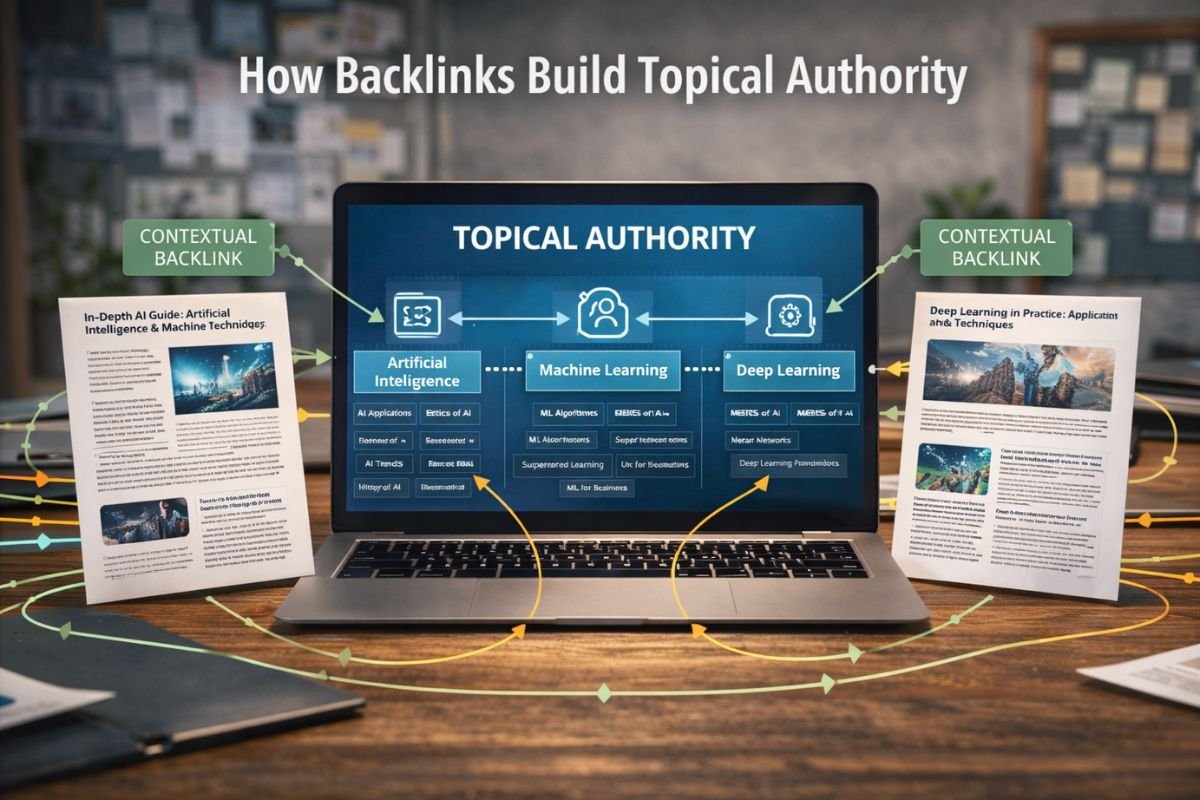
Backlinks contribute to topical authority when they align contextually with the cluster. If different external sites reference multiple pages within the same subject framework, recognition expands beyond a single article.
A cluster may include a foundational guide on anchor text strategy, a related piece on link velocity, and another article addressing contextual backlinks. When external references point to different components of that cluster, and those references converge around related themes, they collectively strengthen topical identity. Backlinks in this sense provide external verification that the subject area is recognized, not just published.
External Signals and Internal Structure
Topical authority is shaped by both internal architecture and external validation. Internal linking defines hierarchy and clarifies relationships between core and supporting content. Backlinks highlight important elements within that hierarchy.
If authoritative domains link to a cornerstone piece on link equity, internal links can distribute that authority across related articles within the same cluster. External signals amplify key nodes in the structure, while internal links control how authority flows across the subject framework. The interaction between these two systems determines how concentrated and cohesive authority becomes.
Relevance Over General Authority
A website may possess high overall authority yet lack topical authority within a specific subject. A large news domain, for example, might have strong domain-level recognition but limited depth in a niche area. In contrast, a specialized site with consistent, interconnected coverage may hold stronger topical authority within its focus area.
Backlinks from thematically aligned environments contribute more effectively to topical authority than links from unrelated niches, which is precisely why understanding how backlinks build topical authority requires examining alignment across the entire ecosystem. Search systems assess the relationship between the linking domain, the linking page, the linked page, and the broader site cluster as a unified structure. When these elements operate within the same semantic framework, authority strengthens; when alignment weakens, the overall impact diminishes accordingly.
Pattern Reinforcement Across Pages
Topical authority increases when backlinks are distributed across multiple pages within a structured hierarchy rather than concentrated on a single URL. If only one article receives external validation, authority remains isolated. When foundational guides, supporting subtopics, and related frameworks all receive references, the entire subject area gains structural credibility. Distributed external validation reinforces the integrity of the cluster.


Contextual Anchors and Semantic Signals
Backlinks support topical authority not only through domain credibility but also through semantic reinforcement. When anchor text and surrounding content consistently reflect related terminology, the semantic field surrounding the cluster becomes clearer.
For example, references that include variations such as “SEO link analysis,” “backlink evaluation framework,” and “link authority modeling” help clarify the thematic ecosystem. Variation strengthens topic modeling without relying on repetitive phrasing. Topical authority is reinforced through contextual signals rather than mechanical repetition.
Depth as a Strategic Layer
Topical authority requires intentional depth. It involves addressing foundational concepts, explaining mechanisms, analyzing patterns, and connecting related themes into a structured whole. Backlinks reinforce that depth when external sources recognize the site’s coverage as valuable.
However, without substantive content, backlinks have limited structural impact. Without backlinks, even well-built clusters lack external validation. The two elements operate together. Structure establishes identity. Backlinks confirm it.
Avoiding Fragmented Authority
Fragmentation weakens topical authority. When content is scattered across unrelated subjects without clear organization, backlinks may reinforce disconnected themes rather than a cohesive framework. When clusters are clearly defined and structurally organized, backlinks reinforce clarity instead of dispersion. Search systems tend to reward coherence over diffusion.
A Strategic Perspective
Topical authority is recognition earned within a defined subject cluster through structured and comprehensive coverage. How Backlinks Build Topical Authority becomes clear when backlinks align contextually with that structure, reference multiple interconnected pages, and strengthen semantic coherence across the topic.
Authority does not emerge from isolated articles or scattered mentions. It develops from structured coverage supported by aligned external validation. Backlinks function most effectively when they reinforce a clearly defined topical framework rather than operate independently of it.