



Page Contents
- 1 What Is an Editorial Backlink?
- 2 Related Posts
- 3 What Is a Sponsored or UGC Link?
- 4 What Is a Nofollow Backlink?
- 5 What Is a Dofollow Backlink?
- 6 What Are the Different Types of Backlinks in SEO?
- 7 What Is a Guest Post Backlink?
- 8 The Core Structural Difference
- 9 Intent Behind Placement
- 10 Control and Context
- 11 Why the Distinction Matters
- 12 A Structural Perspective
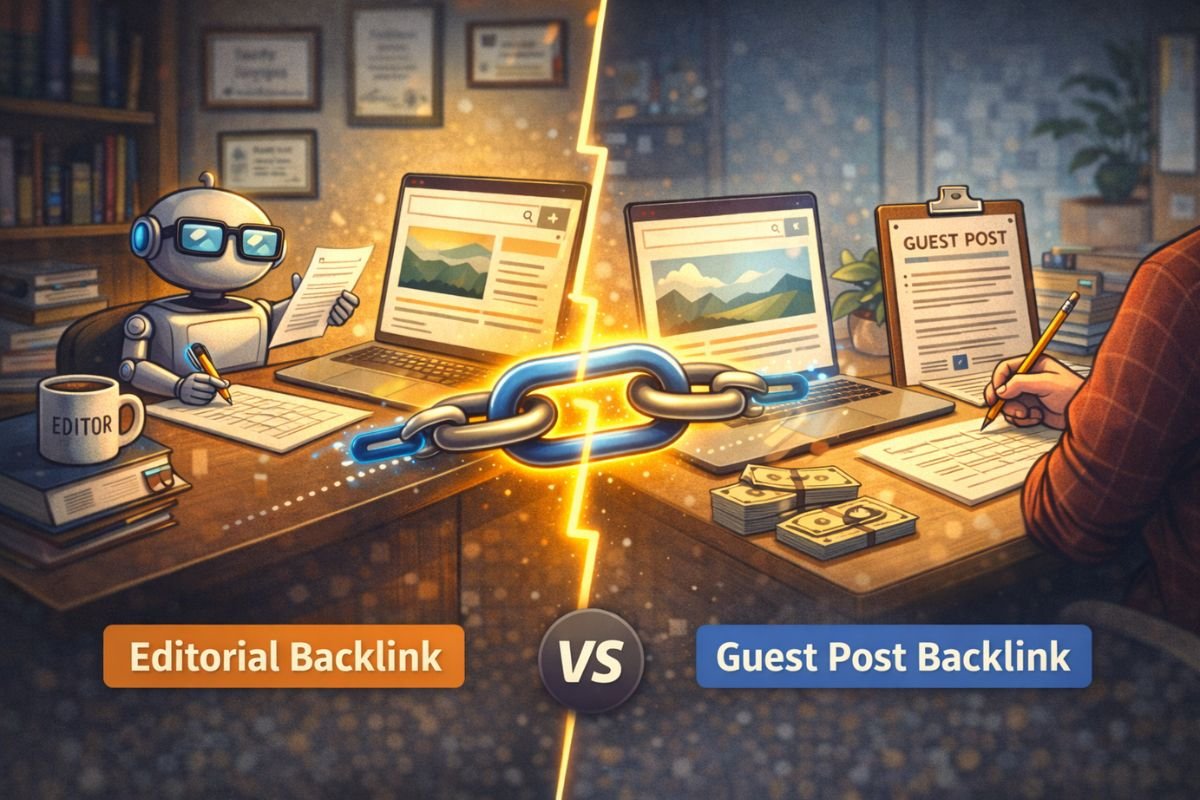
Editorial and guest post backlinks differ in origin and initiative. The distinction is not technical. It is procedural. The difference lies in who initiates the placement of the link and who controls the context in which it appears.
Both links may look identical in code. Both may appear inside the body of an article. Yet structurally, they emerge from different decision paths.
What Is an Editorial Backlink?
An editorial backlink is placed independently by a publisher or author within their own content. The linked site does not request the placement, negotiate the anchor, or control the surrounding context.
The decision to include the link is made by the publisher.
This includes:
-
Whether the link is included
-
Where it appears
-
What anchor text is used
-
How it is framed within the paragraph
The inclusion is typically motivated by clarity, citation, or explanation. The publisher determines that referencing the linked resource strengthens the argument, supports a claim, or improves the reader’s understanding.




The defining characteristic is independence.
The linked site does not shape the placement. The link is integrated because the publisher judged it to be useful within their editorial logic.
That independence is structural, not emotional. It describes who made the decision.
What Is a Guest Post Backlink?
A guest post backlink appears within content written and submitted by a contributor. The contributor initiates the article. The contributor includes the link. The publisher may approve or reject it, but the link originates from the contributor’s side.
The core distinction is initiative.
In a guest post scenario:
-
The contributor creates the content
-
The contributor proposes or embeds the link
-
The publisher reviews and approves publication
The link exists within a collaborative framework rather than an independent one.
This does not automatically imply manipulation. It simply means the linking process involved participation from the linked party.
The structural difference is not about placement inside content. Both editorial and guest links can appear contextually embedded in paragraphs. The difference lies in authorship and control.
The Core Structural Difference
In editorial backlinks, the publisher independently references another source. In guest post backlinks, the contributor includes a reference within the content they authored.
This distinction is procedural.
It does not depend on:
-
Whether the link is dofollow or nofollow
-
Whether the link appears in the body or bio
-
Whether a specific HTML attribute is present
Those are technical attributes. The classification is source-based.
Understanding that separation prevents confusion between link characteristics and link origins.
Intent Behind Placement
Intent often differs, though not absolutely.
Editorial backlinks are generally interpretive in nature. The link exists to enhance explanation, provide attribution, or clarify a point. The inclusion supports the editorial narrative.
Guest post backlinks operate within a visibility framework. The contributor participates in content creation on another site, and the link becomes part of that participation.
This does not mean one is inherently superior. It means the motivation structures differ.
Editorial links emerge from recognition.
Guest post links emerge from collaboration.
The distinction is subtle but meaningful when analyzing link profiles.
Control and Context
Control is central to the difference.
With editorial backlinks, the linked site has minimal control over wording, anchor phrasing, or placement. The publisher frames the reference according to their own logic.
With guest post backlinks, the contributor shapes the initial wording and placement of the link within the submitted article. The publisher retains final approval, but the contributor has influence over structure.
Control affects how independence is perceived within link patterns.
A backlink profile dominated by independently placed editorial references signals a different acquisition structure than one dominated by contributor-initiated placements.
Again, this is descriptive, not evaluative.
Why the Distinction Matters
The distinction between editorial and guest post backlinks helps clarify how a link profile was built.
A profile composed largely of editorial backlinks reflects external recognition.
A profile composed largely of guest post backlinks reflects a proactive placement strategy.
Neither classification automatically determines quality.
However, when analyzing backlink patterns, understanding the origin clarifies how the links entered the profile.
It becomes easier to evaluate distribution, independence, and initiative when the categories are properly separated.
Without that distinction, discussions about “natural” or “proactive” acquisition become vague.
A Structural Perspective
When asking, “Editorial vs guest post backlinks: what’s the difference?” the answer is rooted in process.
Editorial backlinks are publisher-initiated references placed independently within content.
Guest post backlinks are contributor-initiated placements embedded within collaboratively published content.
Both can exist within contextual paragraphs. Both can appear structurally similar. The difference is embedded in the decision-making chain that led to their placement.
The recognition of this structural distinction allows backlink analysis to remain analytical rather than emotional.
It shifts the discussion from assumptions about quality to clarity about origin.
And clarity about origin is what allows link profiles to be understood structurally rather than superficially.