



Page Contents
- 1 What Anchor Text Distribution Actually Represents
- 2 Identifying the Main Anchor Types in a Profile
- 3 Related Posts
- 4 How to Diversify Anchor Text Without Creating Risk
- 5 How to Fix an Unnatural Anchor Text Distribution
- 6 How Much Exact Match Is Too Much?
- 7 What is anchor text distribution, and why is it significant?
- 8 Reading the Distribution Pattern
- 9 Understanding the Signs of Imbalance
- 10 How Repeated Phrases Create Detectable Patterns
- 11 Understanding the Broader Pattern
- 12 Anchor Distribution as a Structural Signal
Anchor text distribution refers to the range of anchor phrases used in the backlinks pointing to a particular page or domain. When analyzing anchor text distribution, what you are examining is how different types of anchor text are represented across the entire backlink profile and the pattern they form together.
Instead of focusing on how many times a single phrase appears, the focus is on how the language used in anchor text is distributed across the profile.
What Anchor Text Distribution Actually Represents
Anchor text distribution represents a pattern of language.
When backlinks point to a site, the anchor text used in those links acts as a reference to that site. When there are hundreds or thousands of such links, the language used in those anchors collectively represents how the site is described across the web.
Some links may use the brand name. Others may describe the topic of the page. Some may use generic phrases such as “click here.”
Together, these references form the linguistic profile of how the site is mentioned across the internet.
Identifying the Main Anchor Types in a Profile
When examining the anchor text in backlinks pointing to a site, it is rare to see only one anchor type. Most profiles contain several categories of anchors.
Common anchor types include:
- Brand references that use the website or company name
- Descriptive anchors that reference the topic of the destination page
- Generic phrases such as “this site” or “read more”
- Naked URLs where the address itself appears as the anchor
Each of these categories produces a different type of signal. Some anchors identify the source being referenced, while others describe the subject of the destination page.
When analyzing a backlink profile, the first step is identifying how these anchor categories appear within the distribution.
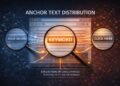
Reading the Distribution Pattern
Once anchor categories are visible within the profile, the next step is to examine how they are distributed.
Some profiles show a broad spread of anchor types. In other cases, certain phrases may appear more frequently than others.
Patterns begin to emerge when anchor phrases repeat across multiple domains. A phrase describing the topic of a page might appear in links from several websites. In other cases, brand mentions may appear across many articles.
At this stage, the analyst begins to see how references to the site are forming.
Instead of focusing on individual links, the analysis shifts toward the overall pattern created by the anchor language.
Within that pattern, the structure of the backlink profile becomes visible.
Understanding the Signs of Imbalance
An imbalance in anchor distribution can also become visible during analysis.
Natural link environments typically contain variation in wording. Different authors refer to the same resource in slightly different ways.
Some references may describe the topic of the content. Others may reference the brand or organization behind the site.
When this range of variation begins to narrow, the anchor profile may start to concentrate around a limited number of phrases.
This does not automatically indicate a problem, but it changes the structure of the distribution.
A narrow distribution means that many links use similar language patterns.
Understanding this requires examining the diversity of anchor phrasing across the link environment.
How Repeated Phrases Create Detectable Patterns
Backlink profiles often contain repetition of certain anchor phrases.
This repetition becomes more noticeable when the same words appear across many different domains.
Search engines observe how patterns of language repeat across the web. When multiple sources reference the same page using identical phrasing, that pattern becomes visible within the anchor distribution.
In some cases, this repetition may occur naturally if many sources refer to the same topic in similar ways.
In other situations, it may reflect a standardized form of link language.
Either way, the repetition becomes part of the structural pattern visible within the profile.
Understanding the Broader Pattern
Anchor distribution becomes easier to interpret when the analysis focuses on the broader pattern rather than individual statistics.
The analyst begins asking broader questions:
- How varied is the language used in the links?
- Do different domains use different wording when referencing the page?
- Are there multiple ways in which the page is described?
These questions help determine whether the anchor language is widely distributed or concentrated around a small number of phrases.
When the language varies across many sources, it suggests independent references. When the wording is highly uniform, the profile may appear more standardized.
The shape of the distribution can therefore reveal how the site is being referenced across the web.
Anchor Distribution as a Structural Signal
Anchor distribution is more than a list of phrases. It is a structural signal within a backlink profile.
By examining anchor categories, variations in language, and repeated phrases, it becomes possible to observe the structure of the referencing pattern.
The analysis is not focused on individual links. It focuses on how anchor text behaves collectively.
Understanding this structure reveals how the web is referring to a particular page or site.