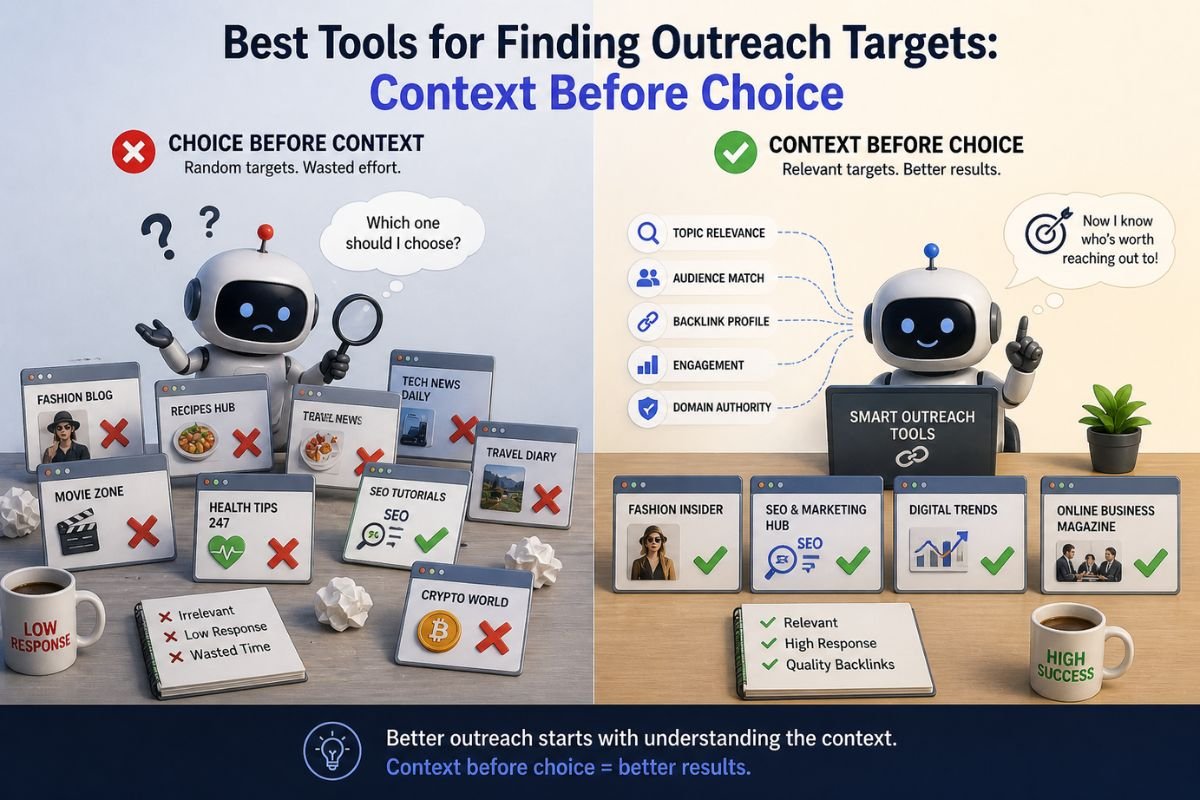

The best tools for finding outreach targets have less to do with features and more to do with context. The choice of tool is conditional. It can vary depending on scale, team composition, competitive environment, and even manual effort thresholds.
There is no tool type that is universally superior. The choice is contextual, not categorical. This is not a comparison of tools. It is a comparison of contexts in which a tool becomes beneficial and contexts in which it becomes a distortion.
Manual Search vs. Database Environments
At a fundamental level, most outreach target discovery strategies fall into two environments.
Manual search is based on open discovery. Targets are identified through contextual interpretation and pattern recognition.
Database environments, on the other hand, rely on pre-indexed collections of sites. Speed and structured filtering are prioritized.
It is not difficult to understand the tradeoff.
Manual search favors contextual accuracy. Databases favor speed and coverage.
Manual search tends to create differentiated pools. Databases tend to create common pools.
This is not about which is better in absolute terms. It is about which aligns with your objective.
If your objective is differentiation, manual search may be more appropriate.


If your objective is volume, databases may be more appropriate.
Neither approach is inherently superior. They operate under different assumptions.
Solo Operator vs. Team Dynamics
Another factor influencing tool choice is who is using it.
A solo SEO has limited resources. Efficiency matters. Time is constrained, and extended manual discovery may not be practical.
A team environment introduces coordination challenges. Without structured systems, prospecting can become inconsistent across members.
A solo environment may benefit from flexibility and lighter structure.
A team environment often requires more formal systems to avoid drift.
The question is not how sophisticated a tool is, but whether it fits operationally.
Speed vs. Precision
Speed and precision rarely coexist at maximum levels.
High-speed prospecting tools reduce friction in discovery, producing large prospect sets. They often shift validation friction downstream.
Precision-focused tools reduce downstream noise but slow initial acquisition, producing fewer prospects with cleaner structural alignment.
The key question becomes: where should friction exist in the process?
Is it preferable to slow initial discovery for structural clarity, or to accelerate discovery and absorb complexity later?
If rapid scaling is required, speed may dominate.
If structural correctness is critical, precision may dominate.
Tools should be evaluated based on where they place friction, not how advanced they appear.
Cost vs. Control
Tool selection presents a tradeoff between cost and control.
A subscription system may be financially efficient but introduce dependency. If access changes or datasets shift, the system becomes constrained.
A manual system provides control and customization but requires significant time investment.
Cost is not purely monetary. It includes:
-
Time investment
-
Learning curve
-
Process rigidity
-
Dependency exposure
A low subscription price may carry high strategic cost if it locks discovery into a narrow paradigm.
Control often becomes more valuable in long-term systems than short-term convenience.
When You Do Not Need a Tool at All
Not every stage requires additional tooling.
Early-stage sites in narrow niches may gain more from ecosystem mapping than database expansion.
In specialized verticals with limited prospect pools, structured manual exploration may be more efficient than automated aggregation.
Tools become necessary when scale or competitive density demands broader surface coverage.
Using a tool is not a prerequisite for legitimacy.
The absence of a tool can be intentional design.
Comparative Logic Rather Than Feature Comparison
The phrase “best tools for finding outreach targets” implies feature comparison. The comparison should instead be strategic.
Ask:
Do I need speed or differentiation?
Am I optimizing for scale or coherence?
Is my process individual or collaborative?
Do I prefer control over convenience?
These answers categorize tool types naturally.
Feature lists do not. Context does.
Under the Lens of Finding Outreach Targets
Within the broader process of finding outreach targets, tools are not decision-makers. They are enablers.
They identify candidates. They do not qualify them.
They facilitate discovery. They do not validate strategic fit.
If tools begin influencing strategic direction, the order has reversed.
Strategy should dictate tooling.
A pragmatic strategist evaluates tools based on whether they enhance or distort process architecture. A tool may accelerate outreach while simultaneously compressing a phase that requires interpretive judgment.
Closing Perspective
The best tools for finding outreach targets are situational decisions, not universal answers.
Manual vs. database
Individual vs. team
Speed vs. precision
Cost vs. control
The answer depends on stage and objective.
It may be no tool at all.
It may be a structured toolset.
It may be a combination.
The correct choice is the one that reinforces your model rather than reshaping it unintentionally.