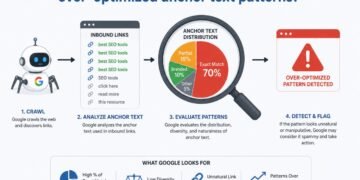



An anchor text profile looks manipulative when the overall pattern of anchor text usage seems unnatural.
This isn’t about the presence of one keyword-rich link. It’s about patterns that reduce linguistic diversity. You’re not trying to identify an algorithm. You’re looking at structural signals that don’t fit the norm.
Excessive Exact Match Concentration
One of the most obvious signs your anchor text profile looks manipulative is an excessive concentration of exact match anchors for one or two commercial phrases, which can be explored further.
When the majority of your backlinks contain the exact same wording of a keyword, your profile starts to look suspicious.
Natural linking does not usually happen this way. Different people use different wording to describe the same thing.
When repetition becomes the norm, the profile becomes unnatural.
Low Linguistic Diversity
A healthy anchor profile will contain a mix of:
- Brand name usage
- Partial phrase usage
- Generic usage
- Descriptive usage
When most of your anchor text looks similar in sentence structure or phrasing, your profile begins to lose linguistic diversity, especially when anchors are detached from their context. A manipulative profile often contains uniformity in language and tone. Language does not normally remain uniform across a wide range of independent domains. When diversity disappears, coordination becomes more visible.
Commercial Bias Across Domains
Another sign your anchor text profile looks manipulative is a high concentration of commercial anchors across multiple domains.
A healthy profile will normally contain a strong presence of brand-based anchors.

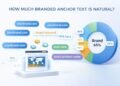

If most domains use promotional or keyword-focused anchors rather than brand references, the pattern may suggest incentive-driven placement.
Overemphasis on transactional language often stands out more than the raw percentage itself.
Identical Anchor Usage From Similar Environments
Patterns become more suspicious when identical anchors appear across structurally similar websites.
If referring domains share similar layouts, publication styles, or outbound linking behavior, and all use the same anchor text, the pattern gains weight.
It’s not necessarily the individual links. It’s the repetition of the pattern across environments.
Anchor Distribution Without Evolution
Organic anchor distributions show evolution over time.
Early references may rely heavily on brand names. As awareness grows, descriptive anchors may appear. Language shifts gradually.
When anchor distribution remains static or repeatedly centers around the same phrasing, rigidity becomes noticeable.
Organic distributions evolve. Engineered ones tend to remain fixed.
Disconnection Between Anchor Text and Context
A clear mismatch between anchor text and surrounding content is another signal.
If the anchor does not integrate naturally into the paragraph, it may appear inserted rather than referenced.
When the surrounding content does not logically support the anchor, the intent becomes more visible.
No advanced knowledge of algorithmic behavior is required to notice this. It is often evident at the surface level.
Anchors should integrate into sentences, not be attached to them.
Sudden Anchor Shifts
A rapid increase in a specific anchor phrase within a short period may create imbalance.
Even if the overall percentage appears moderate, concentrated timing can alter the visual shape of the profile. Organic patterns are uneven but rarely synchronized around one dominant term.
When synchronization becomes noticeable, so does intent.
What You Are Actually Evaluating
When you analyze signs of manipulation, you are evaluating coherence and randomness.
An organic profile resembles a distributed language system. There is variation, inconsistency, and natural unpredictability.
A manipulative profile often shows:
- Repetition
- Compression
- Predictability
- Structural similarity
The distinction lies in statistical shape.
You’re not measuring against a fixed rule. You’re assessing whether the profile resembles natural citation behavior or a pattern of anchor text over-optimization.
A Balanced Perspective
Not every imbalance indicates danger. Some industries naturally include higher levels of keyword-based anchors.
The goal is not perfection. It is plausible.
If your anchor profile resembles a controlled environment rather than organic growth, imbalance is already visible.
Manipulation can be recognizable before it becomes enforceable.
Recognizing those signals early allows adjustment before patterns converge into structural risk.
Anchor text should reflect how people naturally refer to a subject.
When it begins to reflect strategic construction rather than natural reference, imbalance becomes evident.